Why Choose Sodium-Ion Batteries in 2026?

For off-grid energy storage, residential energy storage, communication energy storage, and industrial and commercial energy storage, users need a green, safe, sustainable, and low-cost rechargeable battery, but existing rechargeable batteries cannot meet the demands, while only Sodium Ion Battery meets this demand.
Starting in 2026, from the perspective of the development of China’s mainstream sodium-ion battery industry, NFPP sodium-ion batteries (NFPP Sodium Ion Battery) have become the mainstream sodium-ion battery technology, because of their advantages such as long cycle life, low material cost, and ability to pass the nail penetration test, and are widely used in energy storage scenarios.
The core materials of NFPP sodium-ion battery are: positive electrode materials (sodium iron phosphate and sodium iron sulfate), negative electrode materials (hard carbon), and electrolyte (sodium hexafluorophosphate).
- Sodium-ion Polyanion Battery (NFPP Sodium Ion Battery)
NFPP sodium-ion batteries will be widely used in off-grid energy storage, communication base station energy storage, residential energy storage, and industrial and commercial energy storage in the future. Their main advantages are as follows:
- Advantage 1: NFPP sodium-ion batteries can be used at both low and high temperatures. High-temperature resistance technology: significantly improves cycle life at 60℃, solving the problem of energy decay in high-temperature scenarios; Low-temperature charging technology: supports charging and discharging at extreme low temperatures of -40℃, with a capacity retention rate as high as 90%, suitable for energy storage projects in cold regions.
- Advantage 2: NFPP sodium-ion batteries have high rate capability. NFPP sodium-ion batteries support 1-2C charging and 4C discharging, suitable for applications such as data centers and energy storage;
- Advantage 3: NFPP sodium-ion batteries are safer. They are resistant to overcharging (no fire, no explosion) and over-discharging (can be discharged to 0V); the temperature rise during the needle penetration test is low, and the maximum needle penetration temperature of sodium batteries is 70℃ when the pressure relief valve is not open. Stable NFPP material structure, Mass-produced needle-punched smokeless cells have passed rigorous safety testing, no risk of fire or explosion
Safety Comparison Between LFP and NFPP SIB
| Safety Items | LFP | NFPP SIB |
| Initiation temperature of Thermal runaway | 160℃-200℃ | Over 500℃ |
| Risk of thermal runaway | It is prone to generating oxygen and releasing heat under extreme conditions, posing a risk of fire and explosion. | positive electrode releases low oxygen, and the stable hard carbon negative electrode completely blocks heat diffusion. |
| Charging safety in low-temperature | It is prone to lithium plating when charged below 0°C. Dendrite accumulation can lead to short circuits, and low-temperature charging poses significant safety risks. | Charging at -20℃ remains safe; dendrite growth will not cause the diaphragm to puncture and thus lead to a short circuit. |
| Structural safety | LFP batteries must use copper foil as the negative electrode. Over-discharge can easily cause the copper foil to dissolve, leading to the risk of internal short circuits. | Aluminum foil can be used as the negative electrode current collector. Aluminum and sodium do not form an alloy, so even in the event of over-discharge, there will be no corrosion or dissolution of the current collector. |
- Advantage 4: Polyanion sodium-ion batteries have a longer cycle life. They offer better cycle life and capacity efficiency (low capacity decay rate even at 45°C high-temperature cycling); there is almost no temperature rise during charging and low temperature rise during discharging, making them easier to manage in large modules.
III. Sodium-ion batteries in 2026: Layered oxide sodium-ion battery (LTO SIB) and NFPP Sodium-ion battery( NFPP SIB)
- Layered oxide sodium-ion batteries have an energy density of 130Wh/kg-140Wh/kg and are mainly used in new energy vehicles, two-wheeled electric vehicles, three-wheeled electric vehicles, and four-wheeled electric vehicles. Key factors include energy density and discharge rate performance.
- NFPP sodium ion batteries have a cycle life of 15,000 cycles and are mainly used in energy storage scenarios such as home energy storage, communication base station energy storage, industrial and commercial energy storage, and large-scale centralized energy storage power stations. Key factors include long lifespan, high safety, and low degradation.
Technology Comparison Between LTO SIB and NFPP SIB
| Items | LTO SIB | NFPP SIB |
| Material | nickel-iron-manganese copper-iron-manganese oxide | sodium iron phosphate sodium iron sulfate. |
| Energy density(wh/kg) | 130~140 | 90~110 |
| Voltage(V) | 1.5V-4.0V | 1.5~3.6 |
| Cycles | 3000 | 10000 |
| Dropout Voltage | 200 millivolt | 100 millivolt |
| Heating | High | Low |
| Safety | Not 100% pass nail testing | 100% pass nail testing |
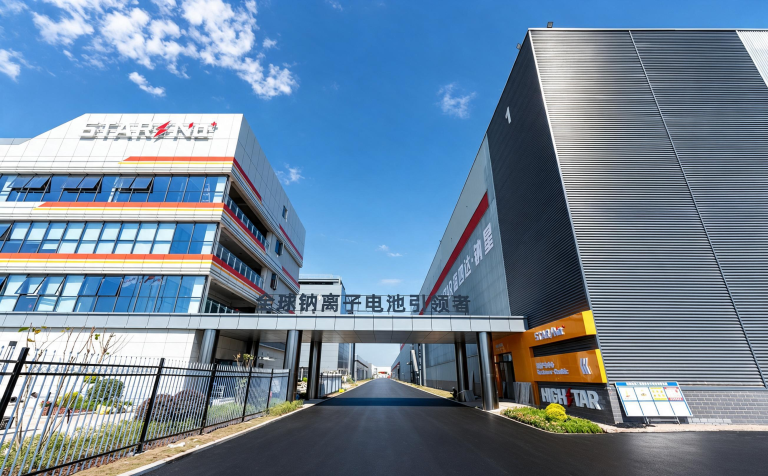
According to data from SPIR (Start-up Research Institute), Highstar Sodium ranked second globally in sodium-ion battery shipments in 2026, with total global sodium battery shipments reaching approximately 800 MWh. Its 12 GWh sodiumery production capacity, making it the first GW-level mass production line in China, focusing on NFPP Sodium-ion Battery technology and primarily covering the energy storage field.
Top 5 Prismatic Sodium Ion Cell manufacturer in China (2026)
| Manufacturer | Core Chemistry | Capacity | Cell Size( Thickness* Length* Height) | Application |
| CATL | Layered Oxide | 240AH | 71mm *173mm *203mm | EV, Energy Storage |
| BYD | NFPP | 189AH | 961mm*122mm*27mm | Energy Storage |
| HiNa | Layered Oxide | 240AH | 73mm *174mm *207mm | EV, Energy Storage |
| Highstar | NFPP | 160AH | 71mm *173mm *208mm | Energy Storage |
| Veken | NFPP | 170AH | 72mm *173mm *208mm | Energy Storage |
Highstar Sodium Battery Company clearly shifted its sodium battery technology route for energy storage from layered oxide to NFPP since Year 2026, focusing on long cycle life, high safety, and wide temperature range performance to precisely match energy storage needs.
In the ” Year 2026 China Sodium-ion Battery Industry Annual Competitive Brand” list jointly released by EV Tank and other institutions, Highstar Sodium Battery Company ranked second globally. In Year 2026, it received the “Leading Brand in Sodium Battery Cell Technology” award and maintained its position as the world’s number one supplier in the NFPP sodium battery segment.