160Ah NFPP Sodium-Ion Battery: Why Its Low-Temperature Cycle Life Beats LFP
160Ah NFPP Sodium-Ion Battery for Cold-Climate Energy Storage: Performance at a Glance
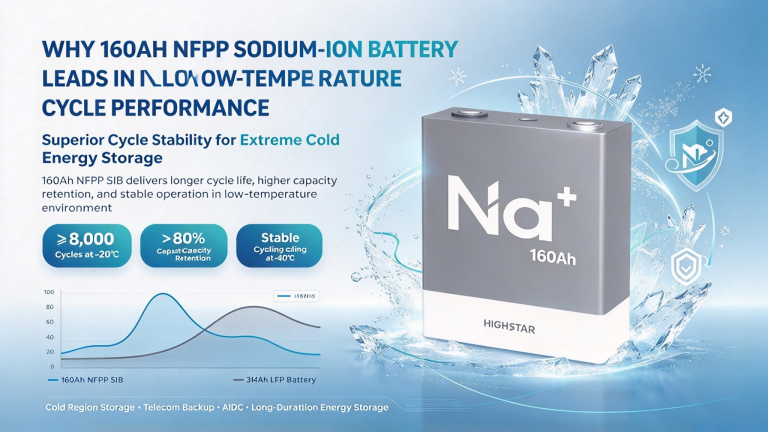
The 160Ah NFPP sodium-ion battery provided by Highstar Sodium Battery Company is a dedicated poly-anionic battery cell for energy storage. At -20°C, with a 1C rate, its effective cycle life is ≥8,000 cycles, and the capacity retention rate still exceeds 80%. Even in the extreme -40°C environment, it can still complete more than 3,000 charge and discharge cycles stably.
Key takeaways: 160Ah NFPP sodium-ion battery low-temperature cycle life
- At -20°C / 1C: effective cycle life ≥8,000 cycles, capacity retention rate above 80%
- At -40°C extreme cold: more than 3,000 stable charge-discharge cycles
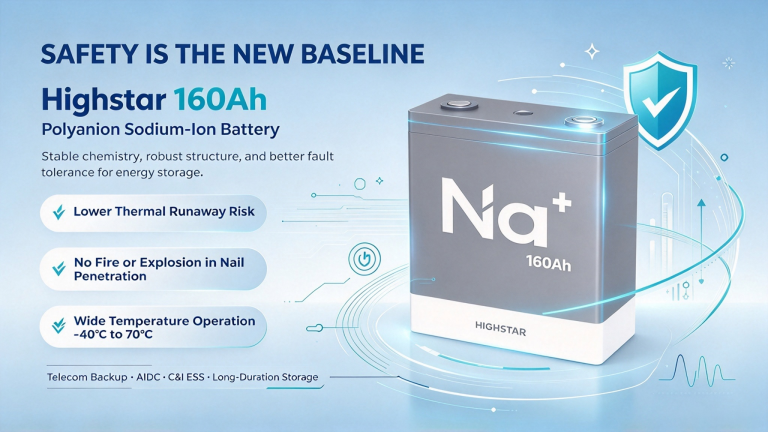
- At 0 ~ -10°C: 8,000–12,000 cycles, with cycle life decreasing by only 15%–25% versus room temperature
- No complex preheating system required; effective full-life cycle count is two to three times that of comparable LFP batteries, supporting over 15 years of stable operation
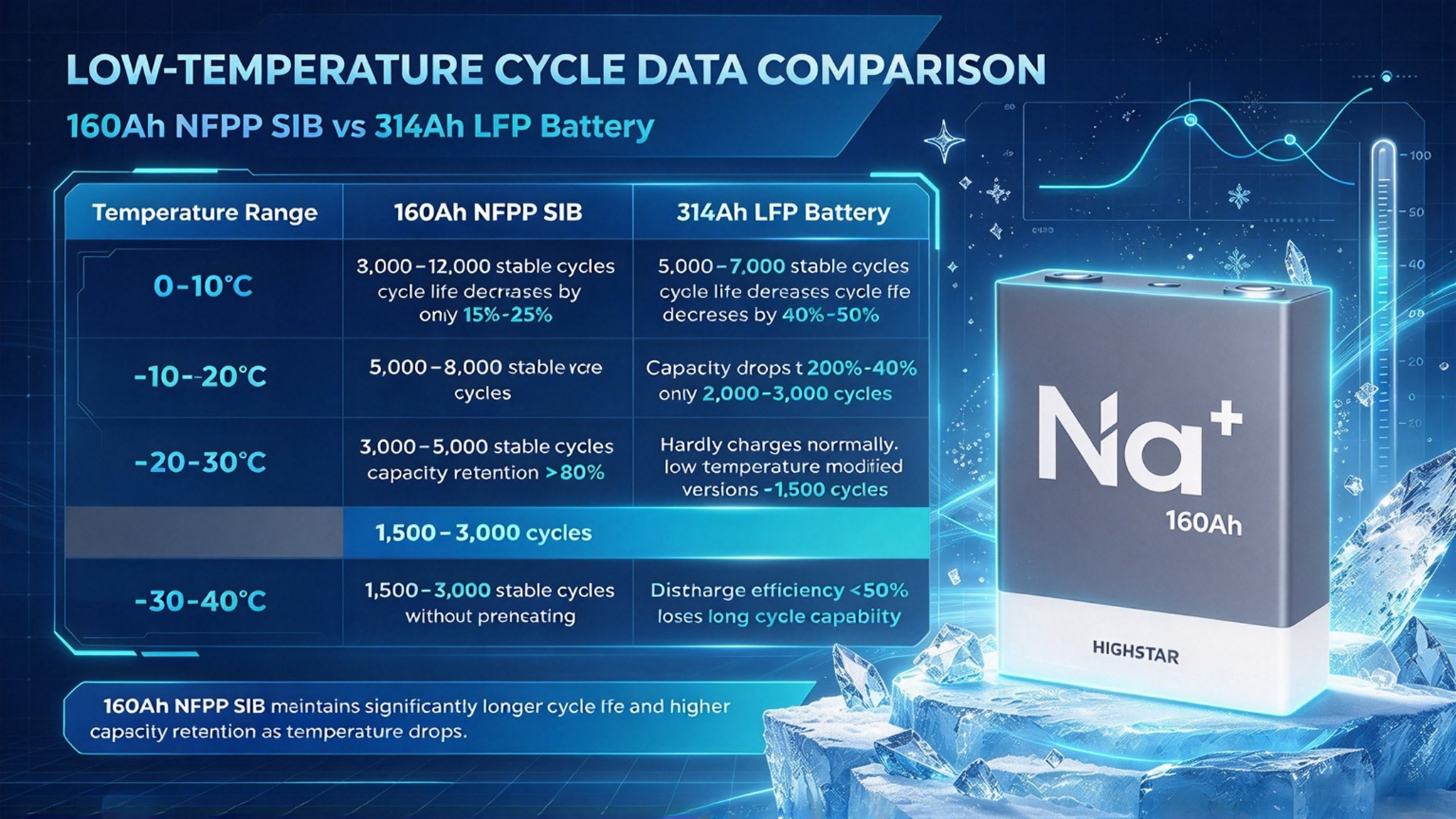
160Ah NFPP Sodium-Ion Battery vs 314Ah LFP Battery: Measured Low-Temperature Cycle Data
160Ah NFPP sodium-ion batteries vastly outperform 314Ah lithium iron phosphate (LFP) batteries in terms of low-temperature cycle life. In deep low-temperature environments of -20°C and below, they demonstrate significantly lower capacity fade and superior long-term cycling stability compared to LFP systems under the same conditions — making them a more suitable long-life energy storage solution for extreme cold scenarios.
Comparison table: low-temperature cycle life, NFPP sodium-ion vs LFP
| Temperature | 160Ah NFPP Sodium-Ion Battery (SIB) | 314Ah LFP Battery |
|---|---|---|
| 0 ~ -10°C | Cycle life decreases by only 15%–25% compared to room-temperature performance, enabling a stable 8,000–12,000 charge-discharge cycles. | Cycle life decreases by 40%–50% compared to room temperature, with an actual effective cycle count of only 5,000–7,000. |
| -10 ~ -20°C | Cycle life decreases by 30%–40% compared to room temperature, yet it can stably complete 5,000–8,000 charge-discharge cycles. | The capacity of standard models drops to just 20%–40%, and significant degradation occurs after only 2,000–3,000 long-term cycles. |
| -20 ~ -30°C | It can still achieve 3,000 to 5,000 stable cycles, with a capacity retention rate exceeding 80%. | It can barely charge normally, and even specialized low-temperature modified versions fall short of 1,500 cycles in long-term use. |
| -30 ~ -40°C | It can achieve 1,500 to 3,000 stable cycles without preheating. | It exhibits a discharge efficiency of less than 50% and essentially loses the ability to sustain long-term cycling. |
Core Mechanisms Behind the Low-Temperature Cycle Life Difference
NFPP Sodium-Ion Batteries — NASICON Framework and Safer Sodium Chemistry
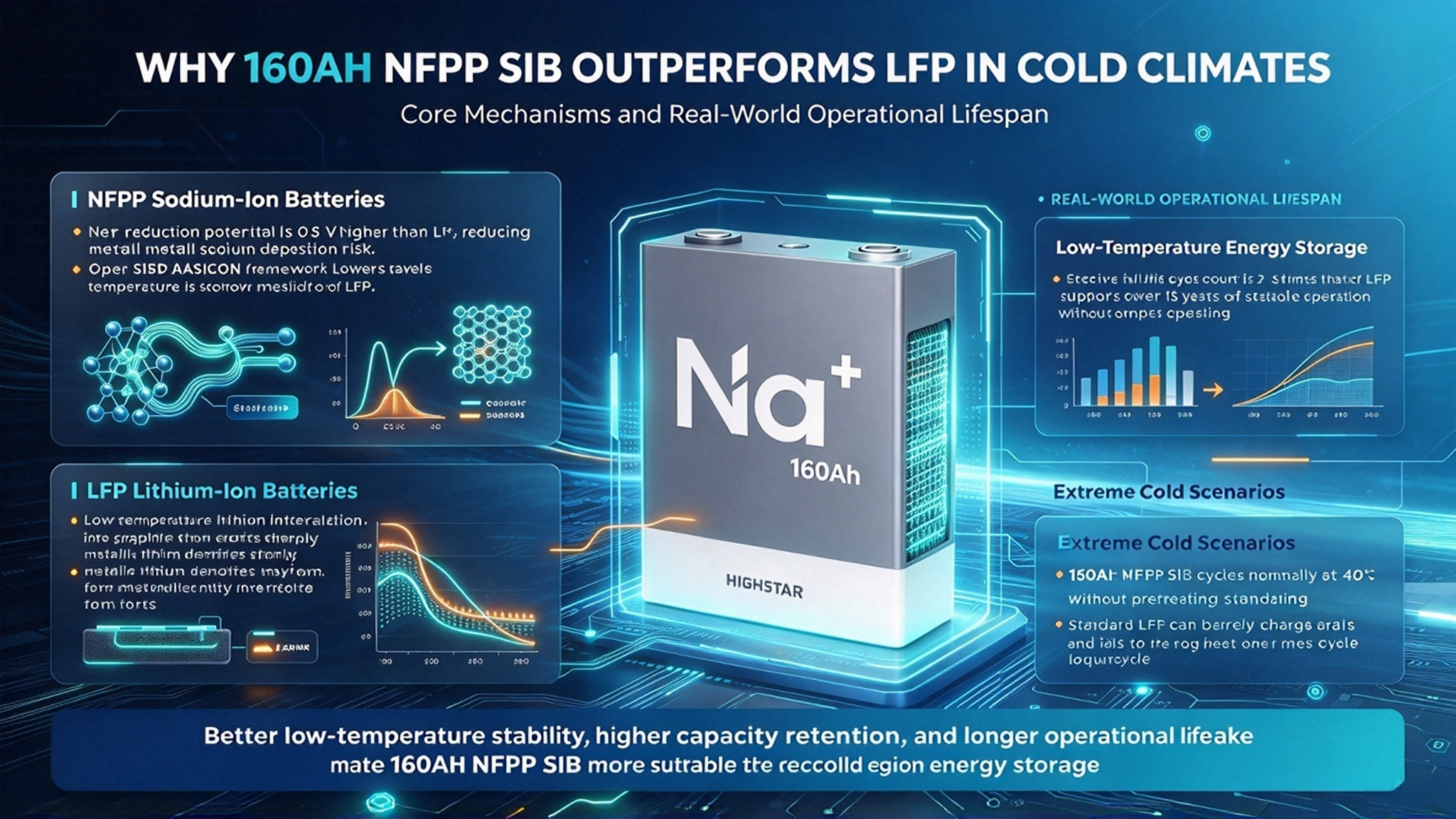
The reduction potential of sodium ions is 0.3 V higher than that of lithium, virtually eliminating the risk of catastrophic crystallization damage caused by metallic sodium deposition at low temperatures. The open, three-dimensional NASICON framework minimizes resistance to sodium-ion migration; furthermore, the rate of interfacial side reactions at low temperatures is merely one-third that of lithium iron phosphate (LFP) batteries — fundamentally preventing the precipitous drop in cycle life often seen in other chemistries.
LFP Lithium-Ion Batteries — Lithium Plating, Dendrites and SEI Damage
At low temperatures, the rate of lithium intercalation into graphite plummets, making the formation of metallic lithium dendrites highly likely; these dendrites not only cause permanent capacity loss but can also puncture the separator, creating safety hazards. Simultaneously, electrolyte viscosity rises exponentially, causing internal resistance to spike. Repeated damage to and reconstruction of the Solid Electrolyte Interphase (SEI) layer during prolonged low-temperature cycling leads to rapid loss of active material, effectively halving the cycle life.
Real-World Service Life: NFPP Sodium-Ion vs LFP in Cold-Climate Operation
Low-Temperature Energy Storage Scenarios
160Ah NFPP sodium-ion batteries do not require complex preheating systems; their effective full-life cycle count is two to three times that of comparable lithium iron phosphate (LFP) batteries, easily supporting over 15 years of stable operation. In contrast, even when equipped with sophisticated liquid-cooling and preheating systems, LFP batteries struggle to exceed 6,000 effective cycles under prolonged winter low-temperature conditions, often suffering a significant drop in capacity after just 5 to 8 years of use.
Extreme Cold Scenarios (-40°C)
In environments as cold as -40°C without preheating, 160Ah NFPP sodium-ion batteries can still initiate cycles normally. Standard LFP batteries, however, are essentially unable to charge and can only operate marginally with brief preheating; their long-term cycle life falls far short of operational requirements.
FAQ — 160Ah NFPP Sodium-Ion Battery Low-Temperature Cycle Life
Q1. How many cycles does the 160Ah NFPP sodium-ion battery last at -20°C? At -20°C with a 1C rate, the effective cycle life is ≥8,000 cycles, and the capacity retention rate still exceeds 80%. In the -20 ~ -30°C range it can still achieve 3,000 to 5,000 stable cycles with capacity retention above 80%.
Q2. Can the 160Ah NFPP sodium-ion battery cycle at -40°C without preheating? Yes. In the extreme -40°C environment it can complete more than 3,000 charge and discharge cycles stably, and it achieves 1,500 to 3,000 stable cycles without preheating in the -30 ~ -40°C range.
Q3. Why does the 314Ah LFP battery degrade faster in cold weather? At low temperatures the rate of lithium intercalation into graphite plummets, making metallic lithium dendrites highly likely; electrolyte viscosity rises exponentially and internal resistance spikes; and repeated damage to and reconstruction of the SEI layer causes rapid loss of active material, effectively halving the cycle life.
Q4. Is an NFPP sodium-ion battery safer than LFP when charged at low temperature? The reduction potential of sodium ions is 0.3 V higher than that of lithium, virtually eliminating the risk of catastrophic crystallization damage caused by metallic sodium deposition at low temperatures. In LFP cells, lithium dendrites can puncture the separator, creating safety hazards.
Q5. How much longer does an NFPP sodium-ion battery last than LFP in real energy storage projects? The effective full-life cycle count is two to three times that of comparable LFP batteries, easily supporting over 15 years of stable operation without complex preheating systems. LFP batteries, even with liquid-cooling and preheating, struggle to exceed 6,000 effective cycles in prolonged winter conditions and often drop significantly in capacity after 5 to 8 years.
Q6. Does a 160Ah NFPP sodium-ion battery need a preheating system for winter operation? No complex preheating systems are required. Its open three-dimensional NASICON framework minimizes resistance to sodium-ion migration, and the rate of interfacial side reactions at low temperatures is merely one-third that of LFP batteries.
Conclusion — The Long-Life Choice for Extreme Cold Energy Storage
For projects operating at -20°C and below, the 160Ah NFPP sodium-ion battery from Highstar Sodium Battery Company combines ≥8,000 effective cycles at -20°C/1C, >80% capacity retention, and stable cycling beyond -40°C without preheating — a low-temperature cycle-life profile that 314Ah LFP systems cannot match under the same conditions.