Why Sodium-Ion Batteries Are the Safest: A 160Ah Polyanion Analysis (2026)
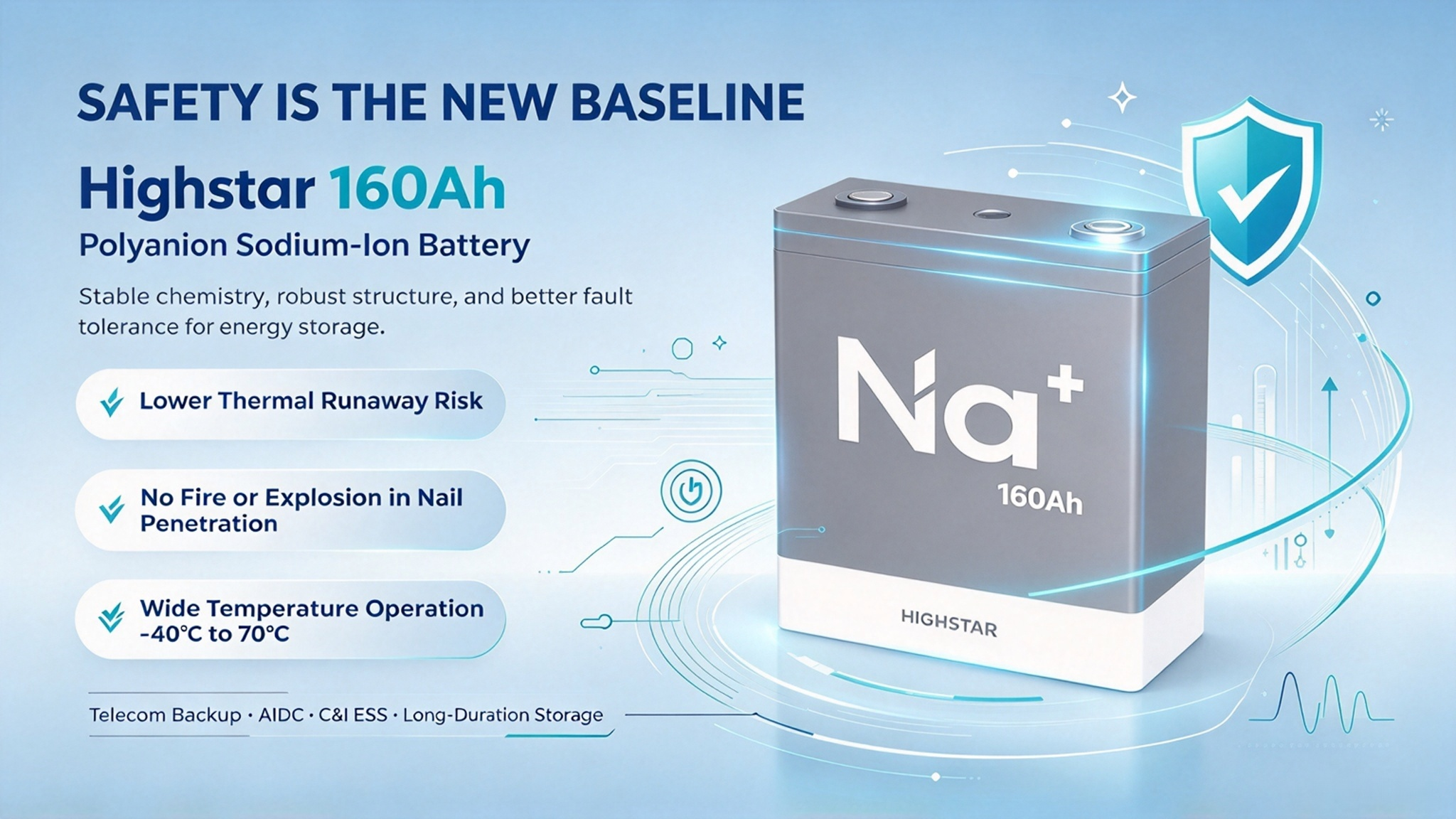
The safety of the 160Ah polyanion sodium-ion battery far exceeds that of traditional lithium-ion cells. The advantage is not marketing: it comes from lower chemical reactivity, a near-zero-strain material system, and structural choices that suppress thermal runaway long before it can start.
Key figures at a glance
| Metric | Value (160Ah polyanion SIB) |
| Thermal-runaway onset | >220°C |
| Runaway temperature vs. LFP | ~80°C lower |
| Cell surface after nail penetration | 30–60°C |
| Protection hardware saved per MWh | >15% |
| Daily inspection frequency reduction | 60% |
| Operating temperature range | -40°C to 70°C |
1. The three pillars of inherent safety
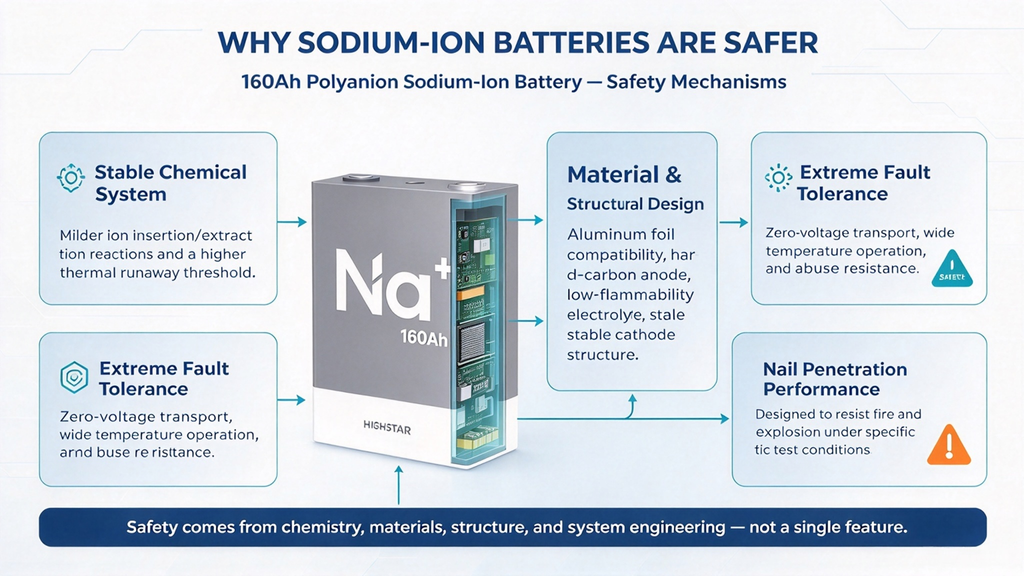
Safety is not added by the BMS alone. In the 160Ah polyanion sodium-ion cell it is built into the chemistry, the materials, and the cell structure — which is why risks of thermal runaway, fire, or explosion are so much lower under abuse.
An inherently stable chemical system
- Lower reactivity. The electrochemical reactions during sodium-ion insertion and extraction are milder than in lithium-ion cells, so equivalent external stimuli are far less likely to trigger violent, exothermic reactions.
- Higher thermal-runaway threshold. The onset temperature for thermal runaway can exceed 220°C — well above conventional lithium-ion cells — giving a much wider safety margin.
- Less heat on short circuit. The cell has a naturally higher internal resistance, so the total heat released during a short circuit is significantly lower than in lithium-ion cells. Heat cannot accumulate fast enough to reach ignition.
Safety built into materials and structure
- No current-collector corrosion risk. Both cathode and anode use low-cost aluminum foil. There is no copper foil (required on lithium anodes), which removes the internal-short-circuit risk tied to copper corrosion.
- No dendrite puncture risk. The hard-carbon anode has a stable layered structure. Even if trace sodium metal plates out, it forms a flat layer rather than the needle-like dendrites seen in lithium cells — separators stay intact, and catastrophic shorts are avoided.
- Less flammable electrolyte. A PC-based electrolyte produces a much smaller share of flammable gases (such as CO and H2) during combustion, sharply cutting fire and explosion probability.
- Stable cathode structure. Mainstream cathodes — layered oxides and Prussian blue analogues — do not violently decompose at high temperature and do not rapidly release oxygen that would feed a fire.
Fault tolerance under extreme conditions
- Supports zero-voltage transport. The cell can be deep-discharged to 0V without damage. This gives exceptional fault tolerance in storage, transport, and accident scenarios, and removes the fire risks associated with shipping lithium-ion batteries.
- Wide-temperature stability. It holds stable performance across -40°C to 70°C without complex low-temperature heaters or high-temperature cooling, reducing the safety risks of thermal-management failure.
- Proven in abuse tests. It withstands extreme stress — including 10x standard nail penetration and 4.5x standard over-voltage overcharging — without open flame, explosion, or swelling.
2. The nail-penetration test — and the 2026 milestone
The puncture test is widely regarded as the most rigorous “life-or-death” test in battery safety, and it is the industry’s ultimate benchmark for thermal runaway. A high-temperature-resistant steel needle, 3–8 mm in diameter, pierces a fully charged cell vertically at 0.1–1 mm/s — instantly creating a large-area internal short and a millisecond-scale temperature spike. It directly simulates the worst real faults: metal foreign objects piercing a cell during an accident, or metal debris inside a cell piercing the separator.
National standards call a cell qualified only if there is no fire or explosion within one hour of puncture. This is effectively a “must-pass” gate for almost all conventional lithium-ion cells — and even ordinary LFP cells need complex system protection to barely clear it. The 160Ah polyanion sodium-ion cell passes by fundamentally holding the thermal-runaway line under the most extreme test in the industry.
2026 MILESTONE
In 2026, the 160Ah polyanion sodium-ion battery made by Highstar Sodium Battery Company Limited was the first ampere-hour-scale cell to achieve complete no-smoke, no-fire results in the nail-penetration test. It also passed the 300°C high-temperature chamber test, and withstood nail penetration, electric-drill penetration, and battery sawing without fire or explosion at any point. The result passed the special on-site assessment organized by the Ministry of Industry and Information Technology — removing the core safety barrier to large-scale deployment in energy storage and new-energy vehicles.
“Even after collision, being knocked over, or being pierced by metal debris, the cell holds the line: no fire, no explosion — and enough time to escape.”
3. What passing nail penetration means for energy storage
The nail-penetration result does more than check a box. It redefines the safety baseline for energy storage — changing how systems are designed, how much protection hardware they need, and where they can be sited.
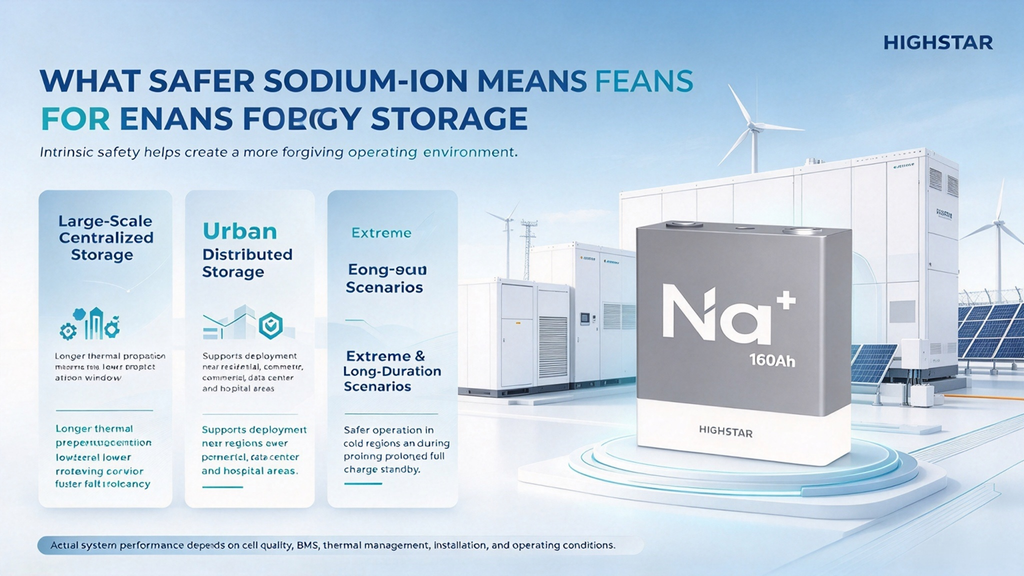
Large-scale centralized storage — systematic risk collapses
- A far longer thermal-propagation window. The cell’s thermal-runaway temperature sits roughly 80°C below LFP’s. After nail penetration its surface stays at 30–60°C and propagation is extremely slow — giving fire-suppression systems a response window several times longer than lithium systems, and stopping single-cell shorts from cascading into a full-cluster or full-container fire.
- Lower system protection cost. Instead of perfluorohexanone suppression, dense liquid-cooling pipework, and ultra-precise BMS runaway early-warning, the sodium system evens out container temperature with simple phase-change cooling plates — cutting protection hardware by over 15% per MWh.
- Maximum fault tolerance for million-cell clusters. In GWh-scale long-duration stations, puncture or metallic contamination no longer triggers chain-reaction runaway — eliminating the catastrophic loss of an entire station from a single failed cell.
Urban distributed storage — the siting barrier comes down
- Siting in core areas. Because it does not catch fire when nailed, storage cabinets can go directly into residential complexes, commercial districts, data centers, and hospitals — without the strict setback distances that constrain lithium systems.
- Far less O&M pressure. No 24-hour infrared patrols and no monthly cell-temperature monitoring. Daily inspection frequency can drop by 60%, cutting the long-term labor cost of distributed storage.
- Lower fire-compliance cost. The system meets urban fire-safety acceptance without specialized, costly protection infrastructure — removing a long-standing bottleneck for distributed storage approvals.
Unique fit for extreme and long-duration duty
- Safe in extreme cold and high altitude. In wind-and-solar storage at -40°C, it avoids the lithium problems of low-temperature lithium plating and runaway-after-puncture — the intrinsic no-fire-on-nail character removes the cold-weather safety risk.
- Natural fit for long-duration storage. In duty cycles beyond four hours, cells sit fully charged for long periods. The no-fire-on-puncture characteristic removes the internal-short-circuit fire risk of a permanent full-charge state.
Cell / system comparison at a glance
| Metric | Lithium-ion / LFP | 160Ah polyanion SIB |
| Thermal-runaway onset | Lower baseline | >220°C |
| Runaway vs. LFP | Baseline | ~80°C lower |
| Surface after nail penetration | Rapid, hot propagation | 30–60°C |
| Protection hardware per MWh | Perfluorohexanone + liquid cooling | Over 15% lower |
| Daily inspection frequency | 24h IR + monthly cell checks | 60% fewer |
| Operating range | Typ. -20 to 60°C | -40 to 70°C |
4. Frequently asked questions
Can a 160Ah polyanion sodium-ion cell really pass nail penetration?
Yes. In 2026 the 160Ah polyanion cell from Highstar Sodium Battery was the first ampere-hour-scale sodium-ion cell to show no smoke and no fire during nail penetration. It also passed the 300°C high-temperature chamber, electric-drill penetration, and battery-sawing abuse tests, and cleared the MIIT on-site special assessment.
What temperature does thermal runaway start at?
The onset temperature for thermal runaway can exceed 220°C. After nail penetration the cell surface stays between 30°C and 60°C, and its runaway temperature is roughly 80°C lower than LFP — meaning heat spreads far more slowly.
Is sodium-ion actually safer than lithium-ion for storage?
For abuse scenarios, yes. Lower chemical reactivity, higher internal resistance (less short-circuit heat), aluminum current collectors on both sides, flat sodium plating instead of needle dendrites, and a PC-based electrolyte all work together. It passes puncture, overcharge, and over-discharge tests without fire or explosion.
Does this cut the cost of a storage system?
It can. Intrinsic safety lets operators replace heavy protection hardware with simple phase-change cooling plates, cutting protection investment by over 15% per MWh, and reducing daily inspection frequency by 60% over the system life.