50Ah Prismatic Sodium-Ion Cell (NaCP50160118-50H3): 6C High-Rate NFPP Cell for UPS, Forklifts and Cold-Climate Storage
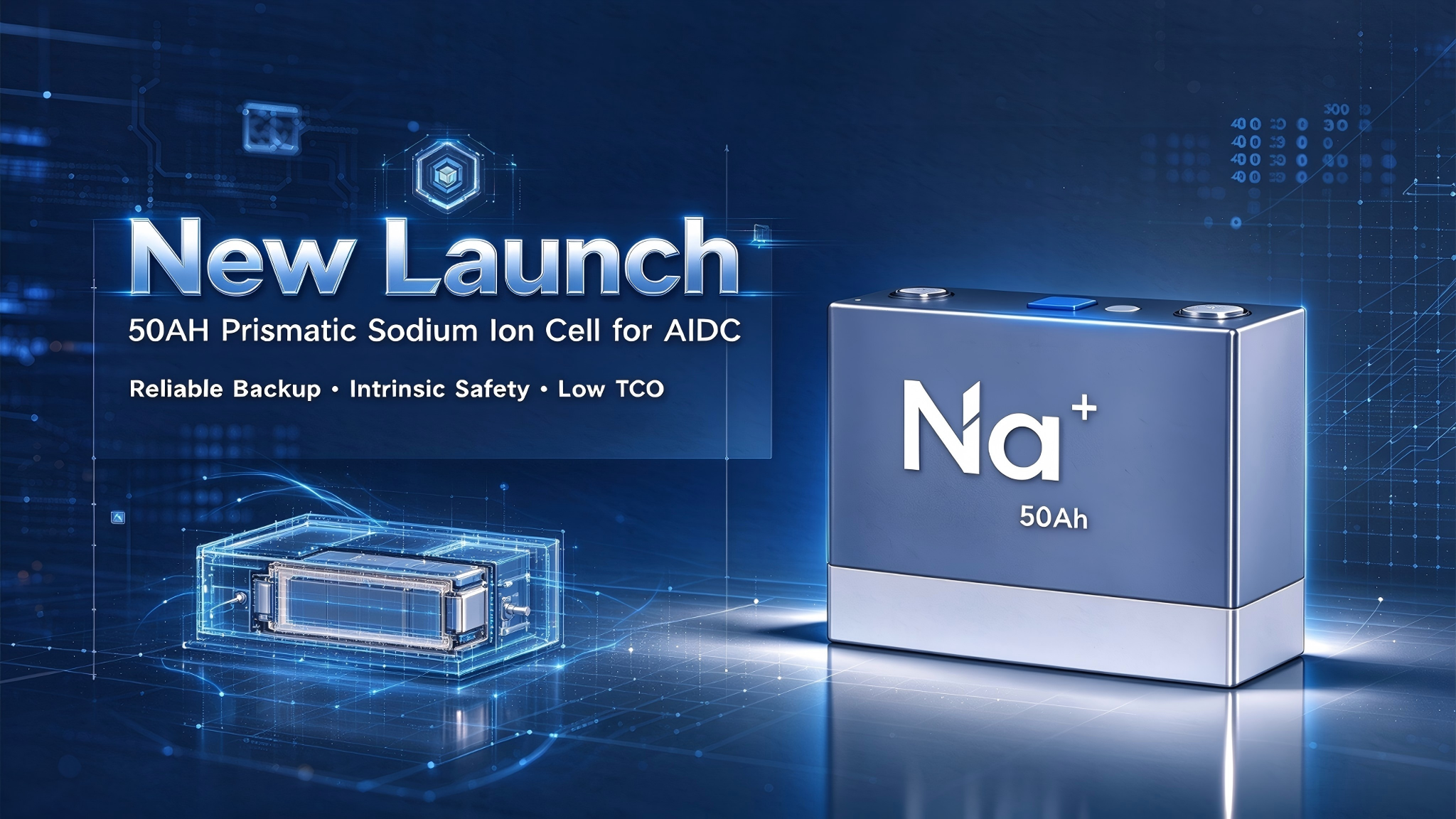
The NaCP50160118-50H3 is a 50Ah prismatic sodium-ion cell built on the NFPP (polyanionic) chemistry route. It delivers 6C continuous discharge, operates from -40 °C to 80 °C, and retains above 85% of rated capacity at -40 °C. Its 50 × 160 × 118 mm case matches an established prismatic format, so existing lithium iron phosphate (LFP) pack lines can adopt it without major retooling.**
That combination — high rate, extreme temperature tolerance, and familiar mechanical packaging — targets applications where LFP cells need expensive thermal management to survive: UPS and HVDC backup, data center battery rooms, electric forklifts and transport robots, telecom shelters, and cold climate residential storage.
As a high-rate sodium ion cell, the NaCP50160118-50H3 is positioned for duty profiles that punish conventional energy-storage grades: millisecond load transfer, sub-zero cold starts, and high-frequency shallow cycling. The sections below cover its specification, its honest trade-off against LFP, and how to design it into a pack.
What “NaCP50160118-50H3” Means: Decoding the Model Number
The NaCP50160118-50H3 is a 50Ah sodium ion prismatic cell. Its model number carries the full physical specification:
| Segment | Meaning |
|---|---|
| Na | Sodium-ion chemistry |
| CP | Cylindrical-to-Prismatic — prismatic aluminum-case format |
| 50160118 | Case dimensions: 50 mm thick × 160 mm wide × 118 mm high |
| 50H3 | Rated capacity 50 Ah, H3 performance series |
Cell volume is therefore 944 cm³ (0.944 L), and nominal stored energy is 143 Wh per cell (50 Ah × 2.86 V).
Design note: because the case geometry is fixed and shared with comparable prismatic LFP formats, mechanical integration, busbar spacing and module tooling carry over directly. Electrical integration does not — the 2.86 V nominal voltage differs from LFP’s 3.2 V, so BMS voltage windows, series counts and PCS/charger settings must be re-parameterized. Treat this cell as mechanically drop-in, electrically re-engineered.
Full Technical Specifications
| Parameter | NaCP50160118-50H3 |
|---|---|
| Chemistry | NFPP sodium-ion (polyanionic cathode system) |
| Format | Prismatic, aluminum case |
| Rated capacity | 50 Ah |
| Nominal voltage | 2.86 V |
| Nominal energy | 143 Wh |
| Dimensions (T × W × H) | 50 × 160 × 118 mm |
| Cell volume | 944 cm³ |
| Gravimetric energy density | 110 Wh/kg (manufacturer specification — see note below) |
| Continuous discharge rate | 6C |
| Maximum discharge rate | 12C |
| Cycle life (1C) | ≥ 6,000 cycles |
| Operating temperature | -40 °C to 80 °C |
| Capacity retention at -40 °C | > 85% |
| Capacity retention at -20 °C | ≥ 90% |
| Thermal runaway onset | ~600 °C (manufacturer test data) |
| Certifications / test reports | UN 38.3, UL 9540A, IEC 62619 |
Note on energy density. The 110 Wh/kg figure is stated in the source specification sheet. Combined with the 944 cm³ case and 143 Wh energy, it implies a cell mass of 1.30 kg and a bulk density of 1.38 g/cm³, which is low for a prismatic cell of this class. Please confirm the measured cell mass before this number is published — the verification note supplied with this article shows the full arithmetic.
Six Advantages That Matter in Service
1. Wide-Temperature Operation Without Complex Thermal Management
The cell charges and discharges across -40 °C to 80 °C (-40 C to 80 C). At -40 °C it retains above 85% of rated discharge capacity; at -20 °C, ≥ 90%.
A 120-degree operating span makes this a genuine wide temperature battery option rather than a nominally cold-tolerant one. The distinction matters because the useful figure is not the low-temperature limit alone but whether the cell can also charge at that limit — LFP cannot below 0 °C.
For LFP systems this is the expensive part of the bill of materials. Below 0 °C, LFP cells cannot be safely charged without pre-heating, because low-temperature charging drives lithium plating on the graphite anode — plated lithium can pierce the separator and create an internal short. Cold-climate LFP installations therefore carry heater pads, temperature sensors, insulation and the energy to run them.
A sodium-ion cell that charges and discharges at -40 °C removes that subsystem. For telecom shelters, outdoor cabinets and high-altitude sites, the saving is not only capital cost but also the failure modes and maintenance visits that heating systems introduce.
2. High-Rate Discharge: 6C Continuous, 12C Maximum
At 6C discharge continuous, a single cell delivers 300 A (0.86 kW); at the 12C maximum, 600 A (1.72 kW).
This is the specification that separates the cell from typical LFP energy-storage grades, which commonly run 0.5C–1C continuous with 2C–4C peaks. High-rate capability matters where load steps are sudden rather than gradual:
- UPS / HVDC backup — grid loss or rectifier fault demands full load transfer in milliseconds
- Data center battery rooms — rack-level load steps as servers spin up
- Electric forklifts and transport robots — lift motors draw heavy inrush current
- Frequency regulation — continuous short-duration charge/discharge cycling
High-rate variants are specified at over 100,000 pulse cycles, which suits the shallow, frequent cycling profile of frequency-regulation and UPS duty rather than deep daily cycling.
3. Long Cycle Life at 1C
Rated cycle life is ≥ 6,000 cycles at 1C. For context, a cell cycled once daily reaches 6,000 cycles in roughly 16 years; the upper end of the published range (10,000 cycles) corresponds to about 27 years at the same duty.
The comparison point is not only cycle count but the rate at which those cycles are achieved. Many LFP cycle-life claims are quoted at 0.5C; a 6,000-cycle figure at 1C is a harder test. Ask any supplier quoting cycle life which C-rate and which depth of discharge the number was measured at — the same cell can be quoted at very different cycle counts depending on those two conditions.
4. High Thermal Stability
The polyanionic (NFPP) cathode system is intrinsically more thermally stable than layered-oxide lithium cathodes. Manufacturer test data puts thermal runaway onset at approximately 600 °C, against roughly 500 °C for the compared LFP cell.
Sodium-ion chemistry also does not suffer the lithium-plating failure mode that makes low-temperature LFP charging hazardous, and the prismatic aluminum case provides rigid containment. This is why a prismatic sodium ion cell of this class is specified for indoor and occupied-building installations where a lithium cell would trigger additional fire-protection requirements.
The cell has passed nail-penetration testing without fire or explosion. In practice this translates to a wider safety margin for installations in occupied buildings, basement plant rooms and sites where fire-service access is limited — and to a stronger position when submitting designs to AHJs and insurers.
A note on safety claims. Sodium-ion cells are materially safer than lithium-ion in thermal-abuse testing, but no electrochemical cell is incapable of failure under sufficient abuse. This article states test results rather than asserting zero risk, which is both more defensible commercially and more credible to technical buyers.
5. Established Prismatic Format, Reusable Pack Lines
The 50 × 160 × 118 mm prismatic format is compatible with existing prismatic-cell pack processes. Manufacturers moving from LFP to sodium-ion production can reuse module assembly lines, busbar welding, case tooling and test fixtures without large-scale line transformation.
For pack integrators this shortens the path from cell qualification to volume production, and it means the cell fits a broad set of established sodium-ion application architectures: low-speed vehicles, passenger vehicles, industrial and commercial energy storage, and data center backup power.
6. Certification Coverage for Export
The cell holds UN38.3, UL 9540A and IEC 62619 test documentation.
| Document | What it actually is | Why buyers ask for it |
|---|---|---|
| UN 38.3 | Transport safety test summary | Required for air and sea freight of cells and batteries |
| UL 9540A | Test method for thermal runaway propagation in storage systems — produces a test report, not a product certification | Used by AHJs to judge compliance with NFPA 855 and the International Fire Code |
| IEC 62619 | Industrial secondary-cell safety standard; its published scope covers lithium cells, so sodium-ion products are assessed against the same methodology | Commonly requested in tender documents for industrial storage |
Important for 2026 shipping documentation. The IMDG Code 42-24 amendment, mandatory from 1 January 2026, introduced dedicated UN numbers for sodium-ion batteries: UN 3551 for sodium-ion batteries with organic electrolyte, and UN 3552 for batteries packed with or contained in equipment. Sea-freight declarations for this cell should reference the correct UN entry rather than the lithium UN 3480/3481 numbers. Confirm with your forwarder which entry your route and packing configuration require.
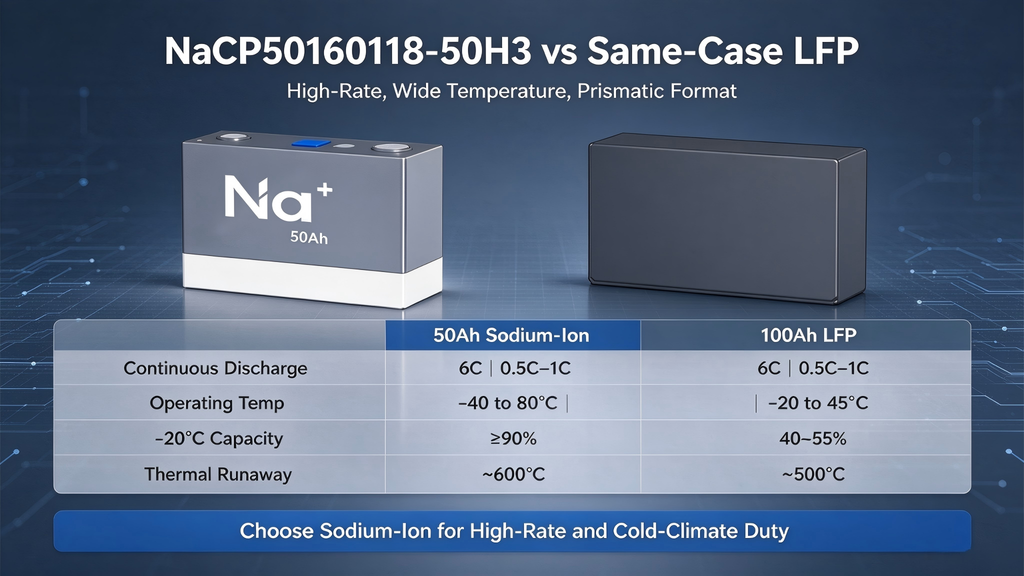
NaCP50160118-50H3 vs. Same-Case 100Ah LFP Cell
Both cells occupy the identical 50160118 case, so this is a like-for-like comparison at fixed volume.
| Item | 50160118-50Ah Sodium-Ion | 50160118-100Ah LFP |
|---|---|---|
| Rated capacity | 50 Ah | 100 Ah |
| Nominal voltage | 2.86 V | 3.2 V |
| Energy per cell | 143 Wh | 320 Wh |
| Volumetric energy density | ~151 Wh/L | ~339 Wh/L |
| Gravimetric energy density | 110 Wh/kg | 160 Wh/kg |
| Maximum discharge rate | 12C | 4C |
| Continuous discharge rate | 6C | typically 0.5C–1C |
| Capacity retention at -20 °C | ≥ 90% | ~40–55% (conventional grades) |
| Capacity retention at -40 °C | > 85% | limited; heating usually required |
| Operating temperature range | -40 °C to 80 °C | -20 °C to 45 °C (charge typically 0 °C to 45 °C) |
| Cycle life | 6,000–10,000 | 3,000–6,000 |
| Thermal runaway onset | ~600 °C | ~500 °C |
| Low-temperature charging | permitted | requires pre-heat below 0 °C |
How to Read This Comparison Honestly
The LFP cell stores 2.24× more energy in the same volume. That is not a marginal gap — it means roughly 2.24 sodium-ion cells are needed for every LFP cell to reach equal stored energy. In space-constrained or weight-constrained designs, LFP remains the better choice, and a specification that ignores this will not survive engineering review.
The sodium-ion cell wins on four axes that LFP cannot easily match: rate capability (12C vs 4C), cold performance (≥90% at -20 °C vs roughly 40–55%), temperature span (-40 to 80 °C vs -20 to 45 °C), and cycle life at high rate.
The practical conclusion is that these are different tools. Choose sodium-ion where the duty profile is high-rate, cold, or thermally constrained. Choose LFP where volumetric energy density dominates. Presenting the trade-off openly is what earns credibility with technical buyers — and it positions the cell accurately for the applications it genuinely serves best.
Application Scenarios
UPS and HVDC Backup Power
Millisecond-level response and 6C continuous discharge suit the instantaneous full-load transfer that UPS duty demands. The -40 °C to 80 °C operating window matters in battery rooms without precise climate control and in outdoor telecom shelters, where ambient temperature swings far beyond the LFP charge window.
Data Center Energy Storage
High pulse-cycle capability (100,000+ on high-rate variants) matches the shallow, frequent cycling of bridge power and rack-level load smoothing. Thermal stability is a material advantage in dense installations where fire suppression access is limited.
Electric Forklifts and Transport Robots
Lift motors draw heavy inrush current. A 6C continuous / 12C peak cell handles these transients without the voltage sag that limits lower-rate chemistries, and cold-store warehouse operation at -20 °C to -30 °C is within rated range — a condition where LFP capacity and charge acceptance both collapse.
Telecom and Communication Energy Storage
Remote sites carry high maintenance cost per visit. Removing the heater subsystem required by LFP eliminates both a component cost and a recurring failure mode.
Home Energy Storage
Suitable where the installation site is unheated — garages, outdoor cabinets, cold climate regions. Note that residential systems require the correct series configuration for the inverter’s DC voltage window; confirm compatibility against your inverter’s specification before design-in.
Low-Speed and Passenger Vehicles
The format and rate capability suit low-speed vehicles directly. Passenger-vehicle use requires automotive-grade qualification (vibration, mechanical shock, ingress protection) beyond the cell-level certification listed here.
Design-In Guidance for Pack Engineers
Series and parallel configuration. With 2.86 V nominal per cell, an 18-series stack yields 51.48 V nominal — the standard 51.2 V class used in low-voltage residential and light commercial storage. A 16-series stack yields 45.76 V. Confirm your BMS and inverter voltage windows before fixing series count.
Voltage window re-parameterization. Do not reuse LFP charge/discharge voltage limits. The 2.86 V nominal and the cell’s specific charge and cut-off voltages require their own BMS profile. Using LFP thresholds will either under-charge the pack or stress the cells.
Busbar and termination sizing. At 6C continuous (300 A per cell), busbar cross-section, weld quality and terminal temperature rise must be designed for the current, not for the energy. This is the most common integration error when a pack line migrates from 1C LFP duty to high-rate sodium-ion duty.
Thermal design. The wide operating window removes the need for heating in most climates, but high-rate discharge generates heat. Verify temperature rise at your actual duty cycle and provide ventilation or conduction paths as needed.
Mixed-chemistry caution. Never series-connect sodium-ion and LFP cells in one string. Different nominal voltages, charge profiles and ageing curves make balanced operation impossible.
Frequently Asked Questions
What is the difference between NFPP and layered-oxide sodium-ion chemistry?
NFPP denotes a polyanionic cathode system (sodium iron phosphate family). Polyanionic cathodes have strong covalent P–O bonding that resists oxygen release at high temperature, which is why thermal runaway onset is higher than in layered-oxide chemistries. The trade-off is lower energy density compared with layered-oxide sodium-ion variants.
Can this cell replace an LFP cell in an existing pack?
Mechanically, yes — the case dimensions match. Electrically, no. The nominal voltage is 2.86 V rather than 3.2 V, so series counts, BMS voltage windows, charger profiles and PCS settings all require re-engineering. Budget for a control-system update, not a cell swap.
Is 6C continuous discharge achievable across the full temperature range?
Rated performance figures are specified at standard test conditions. High-rate capability at temperature extremes is lower than at 25 °C. Request the discharge curve at your specific temperature and rate combination before committing to a design.
Does the cell require pre-heating for low-temperature charging?
No. Unlike LFP, which must not be charged below 0 °C without pre-heating due to lithium plating risk, this sodium-ion cell charges across its rated range. Removing the heater subsystem is one of the main system-level cost savings.
What cycle life should I design around?
Use 6,000 cycles at 1C as the rated figure. The published range extends to 10,000 cycles depending on variant and duty profile. Cycle life is highly sensitive to depth of discharge, C-rate and temperature, so confirm which conditions your supplier’s number was measured at.
Which UN number applies for shipping?
Under the IMDG Code 42-24 amendment (mandatory 1 January 2026), sodium-ion batteries with organic electrolyte are classified under UN 3551, or UN 3552 when packed with or contained in equipment. UN 38.3 test documentation supports the transport declaration but is not itself the classification. Confirm the correct entry with your freight forwarder for your route and packing method.
Is UL 9540A a product certification?
No. UL 9540A is a test method for assessing thermal runaway propagation in energy storage systems; it produces a test report. UL 9540 (without the “A”) is the system-level product certification, and it requires a UL 1973 listed battery. Buyers and AHJs use the 9540A report as evidence when evaluating compliance with NFPA 855 or the International Fire Code.
Summary
The NaCP50160118-50H3 occupies a specific position: a high-rate, wide-temperature sodium ion battery cell in a prismatic format that existing LFP pack lines can adopt mechanically. It does not out-perform LFP on energy density, and it should not be specified where volumetric energy is the dominant constraint.
Where it does win — UPS and data center backup, forklift and robot traction, telecom shelters, cold climate storage — it wins on the specifications that determine whether a system needs a heater subsystem, whether it can meet a millisecond load step, and how many cycles it survives at rate. Those are the parameters that drive total installed cost and lifetime availability, and they are where this cell earns its place in a design.
**For technical datasheets, discharge curves at specified temperatures and rates, certification documentation, and pack-level design support, contact the Highstar Sodium Battery engineering team.