Sodium-Ion Energy Storage in 2027: One NFPP Platform, from 15Ah Cell to a 2.3 MWh System
For years, “sodium-ion or lithium” was framed as a head-to-head contest. It is the wrong question. Sodium-ion does not win on volume-matched energy density, and it does not need to. It wins where cold, fire-code review, cycle count and duty profile decide the bill of materials — and in 2026 those are exactly the battlegrounds across telecom backup, residential solar, commercial and industrial (C&I) storage, grid-scale container plants and motive applications.
This is the umbrella guide to the complete Highstar Sodium product range. Everything below runs on the same in-house NFPP (sodium iron phosphate) chemistry and the same multi-layer BMS architecture — which is precisely why mixed-age expansion and scenario-tailored form factors work. Each tier links to its live product page; every number here is drawn from those pages, and where a figure is a manufacturer test result rather than a third-party report, we say so.
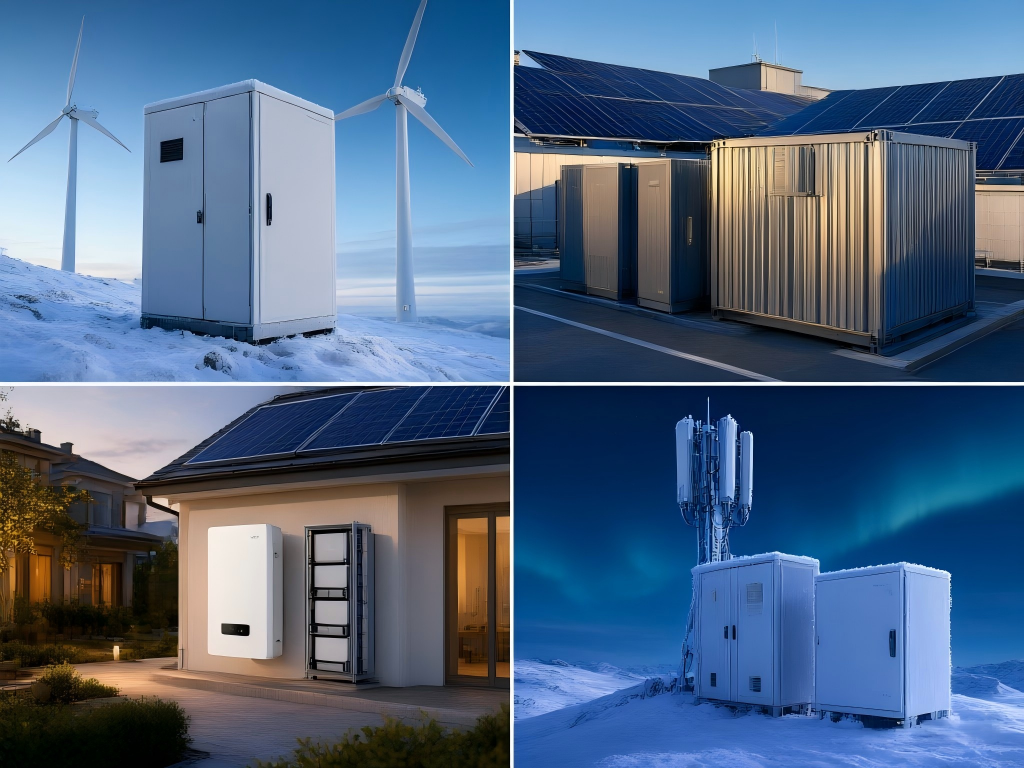
Why 2027 Is the Turning Point
The revenue model moved. China’s updated medium- and long-term electricity-market rules (effective 1 March 2026) removed administratively fixed time-of-use tariffs; more than ten provinces have followed. Static “charge in the valley, discharge at the peak” arbitrage is no longer a safe business plan. What earns money now is fast, repeated response into spot prices and VPP dispatch — which rewards response rate and cycle life, the two things an NFPP platform is built around.
Distributed generation moved to the frontier. Rural wind programs put turbines in cold, remote, unmanned sites, and rooftop solar into coastal and high-altitude homes. The failure mode there is not energy density — it is batteries losing usable capacity at -20 C, refusing to charge below 0 C, and triggering fire-code disputes in dense neighborhoods.
Sodium-ion crossed from pilot to procurement. Its share of new installed storage is still small (industry trackers put sodium under 1% of 2026 additions so far), but the first grid-scale sodium systems have run for over a year, and Highstar ships NFPP cells and finished packs in three application bands — cylindrical, prismatic and integrated cabinets/containers — under a portfolio backed by the first TÜV SÜD sodium-ion certificate. Small share, real deliveries: that is what a commercial inflection looks like before the curve bends.
What NFPP Sodium-Ion Does Better — and What It Does Not
Being precise beats being bullish. Against Highstar’s own cell data and published industry ranges (the company FAQ quotes sodium-ion at 90-110 Wh/kg versus 150-180 Wh/kg for LFP):
- A wider operating window. NFPP cells and most packs are specified for -40 C to 80 C. In winter, LFP’s usable capacity drops and — because charging a graphite anode below roughly 0 C plates metallic lithium — LFP packs forbid sub-zero charging outright. The heating that fixes LFP consumes the very energy you stored.
- Higher thermal-stability headroom. The company’s own comparison puts NFPP thermal-runaway onset above 500 C versus 160-200 C for LFP, and production NFPP cells pass nail-penetration testing without fire or explosion. Read that as lower risk under abuse, not zero risk: any supplier promising “no risk” is promising physics they cannot deliver.
- Cycle life that changes the math. The 160Ah prismatic cell is rated to 15,000+ cycles, and the integrated cabinet and modular systems are specified at >=10,000 cycles at 25 C, 0.5P, 70% end-of-life — the basis for 10-year warranties and 20-year-plus design lives. In a market that now pays for daily dispatch rather than two swings a day, cycles-per-dollar is the metric.
- High rate as a product, not an option. The 15Ah NFPP cylindrical cell is built for high-rate duty — automotive start-stop, AGVs, rack UPS/BBU — where a large-format energy cell cannot.
- Where LFP still wins, said plainly. On a like-for-like footprint, LFP stores roughly twice the energy in the same volume and about 60-80% more per kilogram. If your site is temperate, space-constrained and gently cycled, LFP is the cheaper-per-kWh answer. Sodium-ion is a targeted answer to a specific set of hard problems, not a blanket replacement.
The Full Range, Tier by Tier
Cells and building blocks
- 160Ah NFPP prismatic cell (NaCP71173208-160E3) — the energy platform: 2.86 V nominal, ~458 Wh per cell, the cell inside the 48 V packs, the cabinets and the container. Roadmap 180Ah and 400Ah prismatic cells were shown at Battery Show Europe 2026.
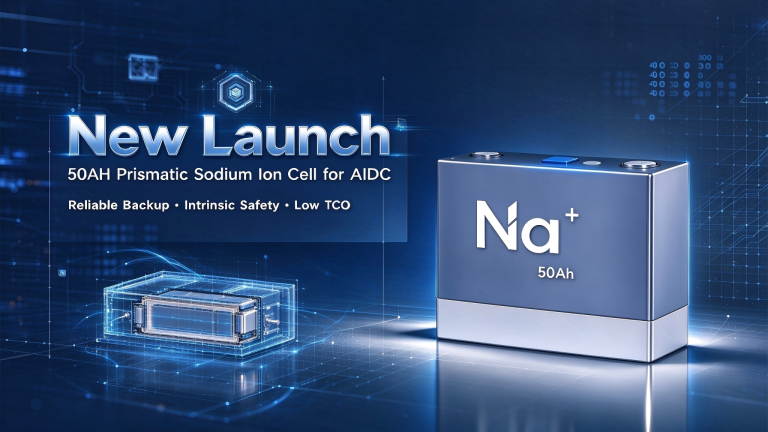
- 15Ah NFPP cylindrical cell — the power platform: high-rate, high-safety, for start-stop, 12 V/24 V lead-acid replacement, AGV and data-center BBU.
- Liquid- and air-cooled modules (NA-MESS 1P48S / 1P52S) — building blocks for C&I rack and cabinet systems.
Low-voltage motive and lead-acid replacement (NA-LESS)
- 12 V 160Ah (NA-LESS-12160) and Super Pack (NA-LESS-12160S) — Bluetooth OTA management, fast charge, -40 C to 80 C, 20+ year design life; replaces 12 V lead-acid banks.
- 24 V 160Ah (NA-LESS-24160) — rapid charge and remote management for 24 V motive and telecom duty.
Residential and light-commercial energy storage (NA-RESS)
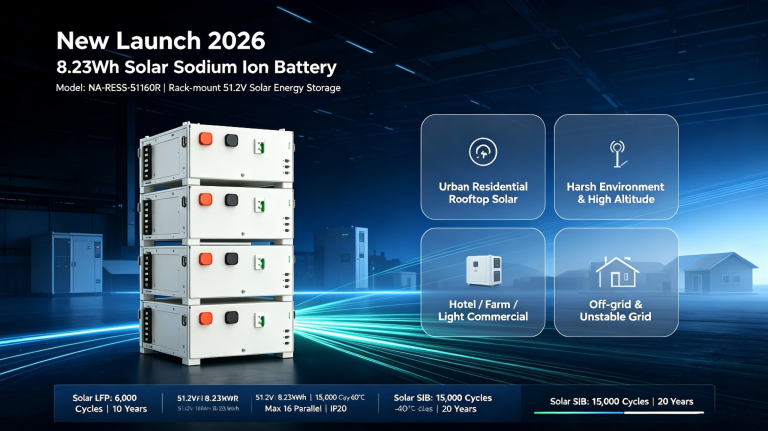
- 48 V 160Ah wall-mount and rack-mount solar batteries (NA-RESS-48160W / -48160R) — about 7.68 kWh each, 3-layer BMS, deep Victron and mainstream-hybrid-inverter compatibility, remote cloud O&M.
- 48 V 160Ah rack residential (up to 20 units in parallel) and 48 V 320Ah floor-standing (15.36 kWh single unit) — whole-home energy hubs that grow with load. A wall-mount residential variant is offered in IP65 for outdoor siting.
Telecom backup and smart storage (NA-TESS)
- 48 V 160Ah (NA-TESS-48160) and 48 V 100Ah smart telecom (NA-TESS-48100) — tower and central-office backup where the -40 C window removes the need for heated shelters.
Commercial and industrial modular systems (NA-MESS)
- Stackable liquid-cooled clusters — 53.76 / 115.2 / 176.64 kWh at 336 / 720 / 1104 V (NA-MESS-16S x7 / x15 / x23), 1.0P charge/discharge, up to 97% round-trip efficiency, indoor IP20 — for factories, parks and VPP participation, expandable cluster by cluster.
Outdoor cabinet BESS (NA-CBESS)
- 76.8 kWh / 480 V / 30 kW (NA-CBESS-76), 115.2 kWh / 720 V (NA-CBESS-115) and 199.68 kWh / 1248 V / 100 kW (NA-CBESS-200A) — all-in-one outdoor cabinets with integrated BMS, thermal management and aerosol fire protection, no equipment room needed. This is the tier whose -40 C story is the headline act: frigid, high-altitude wind and remote sites. → 76kWh · 115kWh · 200kWh
Grid-scale container (NA-CTESS)
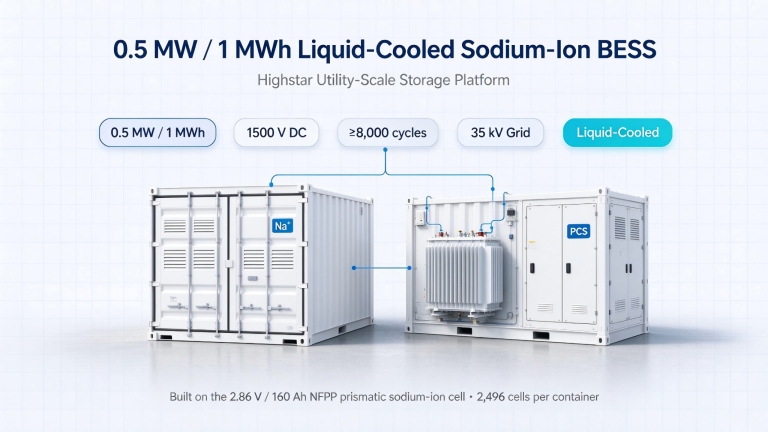
- 2.3 MWh container (NA-CTESS-2300) — 1P416S at ~1198 V, liquid-cooled, CAN/RS485/TCP-IP, automatic fire suppression; a factory-preinstalled utility-scale block for solar-and-wind integration and peak shaving. → 2300kWh container
| Segment | Representative model | Nominal | Energy | Duty |
| Prismatic cell | NaCP71173208-160E3 | 2.86 V | ~458 Wh | cell for all packs below |
| Cylindrical cell | 15Ah NFPP | 3.2 V class | high-rate | start-stop, BBU, AGV |
| Low-voltage pack | NA-LESS-12160 / -24160 | 12 V / 24 V | ~2.0 / 3.8 kWh | motive, lead-acid swap |
| Home / light-C&I | NA-RESS-48160R | 48 V | ~7.68 kWh/unit | rooftop solar, backup |
| Telecom | NA-TESS-48160 | 48 V | ~7.68 kWh | tower & central-office |
| C&I cluster | NA-MESS-16Sx15 | 720 V | 115.2 kWh | factory, park, VPP |
| Outdoor cabinet | NA-CBESS-76 / -200A | 480 / 1248 V | 76.8 / 199.68 kWh | wind, remote, coastal |
| Container | NA-CTESS-2300 | ~1198 V | 2.3 MWh | utility-scale |
Matching Scenario to Product
- Rooftop solar + outage backup, temperate home → NA-RESS 48 V wall/rack; size from ~10 kWh/day draw, add units to 20 parallel as EV or heat-pump load arrives.
- Cold or high-altitude home, farm, telecom site → NA-RESS/NA-TESS 48 V, because the -40 C discharge window and 0 C charge floor beat a heater-dependent LFP rack on real winter yield.
- Factory, park, VPP dispatch, load that keeps growing → NA-MESS liquid-cooled clusters; start at one cluster and add — same platform, incremental CAPEX.
- Wind farm, island, remote microgrid, coastal → NA-CBESS outdoor cabinets (30-100 kW, up to 200 kWh, IP-rated for outdoor deployment).
- Grid-side, 2-8 hour long-duration plant → NA-CTESS-2300 containers.
- UPS rooms, forklifts, AGVs, 12 V/24 V replacement → 15Ah cylindrical cell or NA-LESS low-voltage packs, through your integrator.
Engineering Truths Before You Spec
System voltage is quoted at 3.0 V/cell; the cell is 2.86 V. A “48 V” pack is a 16S string, a “720 V” cluster is 240S. Series counts and BMS voltage windows are chemistry-specific — mechanical drop-in from an LFP design is real, electrical drop-in is not. Any integrator claiming otherwise will overheat your first pilot.
Parallel current adds up. Twenty 48 V 160Ah units can theoretically source ~3,200 A; in practice the inverter caps it. Size fuses, busbars and symmetrical cabling to the battery’s limits, not the inverter’s defaults — asymmetric cabling is the usual cause of imbalance in multi-unit banks.
Indoor vs outdoor is a product choice, not an accessory. The residential and telecom packs are IP20/IP65 as specified; for exposed sites choose the NA-CBESS cabinet, engineered for outdoor duty, rather than field-building an enclosure around an indoor unit.
Certificates vs reports. Product certification (for a range that carries the first TÜV SÜD sodium-ion certificate) and system-level fire-propagation test documentation serve different purposes; the local authority (AHJ) uses the latter to set separation distances. Ask the supplier which documents exist at cell, pack and system level for your exact model.
Shipping changed in 2027. Sodium-ion cells and batteries now move under their own UN numbers (UN 3551 / UN 3552 under the IMDG 42-24 amendment); paperwork written for UN 3480 lithium entries is not valid for sodium shipments.
Frequently Asked Questions
Is sodium-ion cheaper than LFP in 2026? Not yet at parity despite the smaller raw-material base. Sodium wins on lifecycle cost where duty is cold, deep, fast or safety-audited; on a mild-climate, low-cycle rooftop it usually does not yet. Run the scenario, not the slogan.
Can these batteries charge in winter? Discharge is rated to -40 C across the range. The standard charge window starts at 0 C on most models; where a deployment needs sub-zero charging, request the documented low-temperature charge configuration and its test conditions (temperature, C-rate, cycles).
Can old and new modules really mix? The design intent of the modular platforms (parallel residential units, stackable C&I clusters) is incremental growth without replacing installed capacity. Follow same-batch rules for parallel banks unless the BMS profile for your model explicitly supports mixed-age operation.
What does 15,000 cycles mean at two cycles a day? Roughly 20 years at the cell rating; the systems are warranted on the conservative module figure (>=10,000 cycles, 10-year warranty, 20-year design life). We show the arithmetic rather than let it be assumed.
Is “no thermal runaway” accurate? No supplier can promise that. What is accurate and auditable: NFPP onset temperature is materially higher than incumbent chemistries, and production NFPP cells pass nail-penetration testing without fire or explosion.
Where do the real numbers live? Every tier above links to its live product page with full parameter tables. This page is deliberately a map, not a second datasheet. For cell-level picking across long-duration, motive, backup and telecom roles, see the 2026 prismatic-cell selection guide.
Bottom line
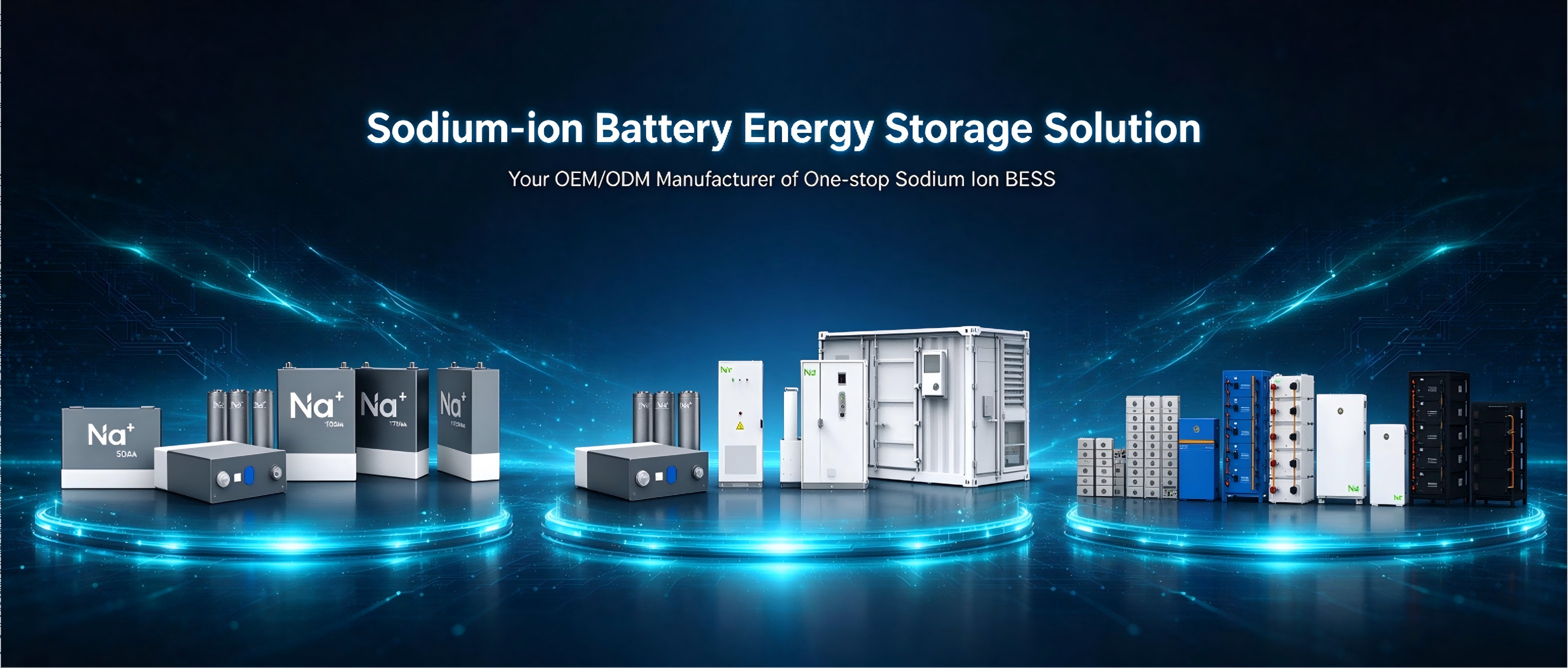
One NFPP platform, spanning a 15Ah cylindrical cell, a 160Ah prismatic cell, 12 V/24 V/48 V packs, residential and telecom storage, C&I clusters, 76-200 kWh outdoor cabinets and a 2.3 MWh container: a sodium-ion range built not to replace lithium everywhere, but to be the only sane answer where winter, fire codes, duty cycles and daily dispatch all vote at once. Pick the product by scenario, verify the numbers on the linked pages, and design the bank against the battery’s physics — not the marketing’s.