HIGHSTAR SODIUM 160Ah Sodium-Ion Cell Passes UL9540A: Why Sodium-Ion Batteries Are the Safest | Sodium-Ion vs LFP Safety Showdown
What UL 9540A Is – and What It Is Not
UL 9540A, Standard Test Method for Evaluating Thermal Runaway Fire Propagation in Battery Energy Storage Systems, is a US and Canadian national standard. It heats a charged cell with a thin film heater until runaway, then quantifies what happens: trigger conditions, vent timing and temperature, gas composition and volume, flammability limits, flame propagation speed, explosion pressure. The output is a dataset that NFPA 855 spacing rules, International Fire Code siting decisions and insurance underwriting consume. [4][7]
There is no pass/fail. There is no certificate. Verdicts run A through F at cell level, and in practice essentially every mainstream commercial chemistry – sodium, LFP, NMC – lands at F: runaway is induced and the vent gas is flammable. F means “proceed to module level”, and that checkbox is ticked on all three of our reports.
Three distinctions buyers should keep straight: UL 9540 is the equipment safety certification for energy-storage systems; UL 1973 is a product certification for stationary-application cells; UL 9540A is the test method that supplies fire-behavior data. An RFP asking for “UL 9540A certification” contains a category error – what it should ask for is the UL 9540A report, tier by tier.
On editions: the 4th edition (2019) governed most LFP testing; the March 2025 revision (cited as Version 6.1 on our report cover) added dedicated fields such as total combustible-gas generation; and on 13 March 2026 UL published the 6th edition (UL 9540A:2026), which elevates installation-level large-scale fire testing (LSFT) from an optional appendix to a mandatory gate. [5][6] The industry direction is unmistakable: the burden of proof is moving from cells to whole systems.
The Sodium Report: What Was Tested, Under What Method
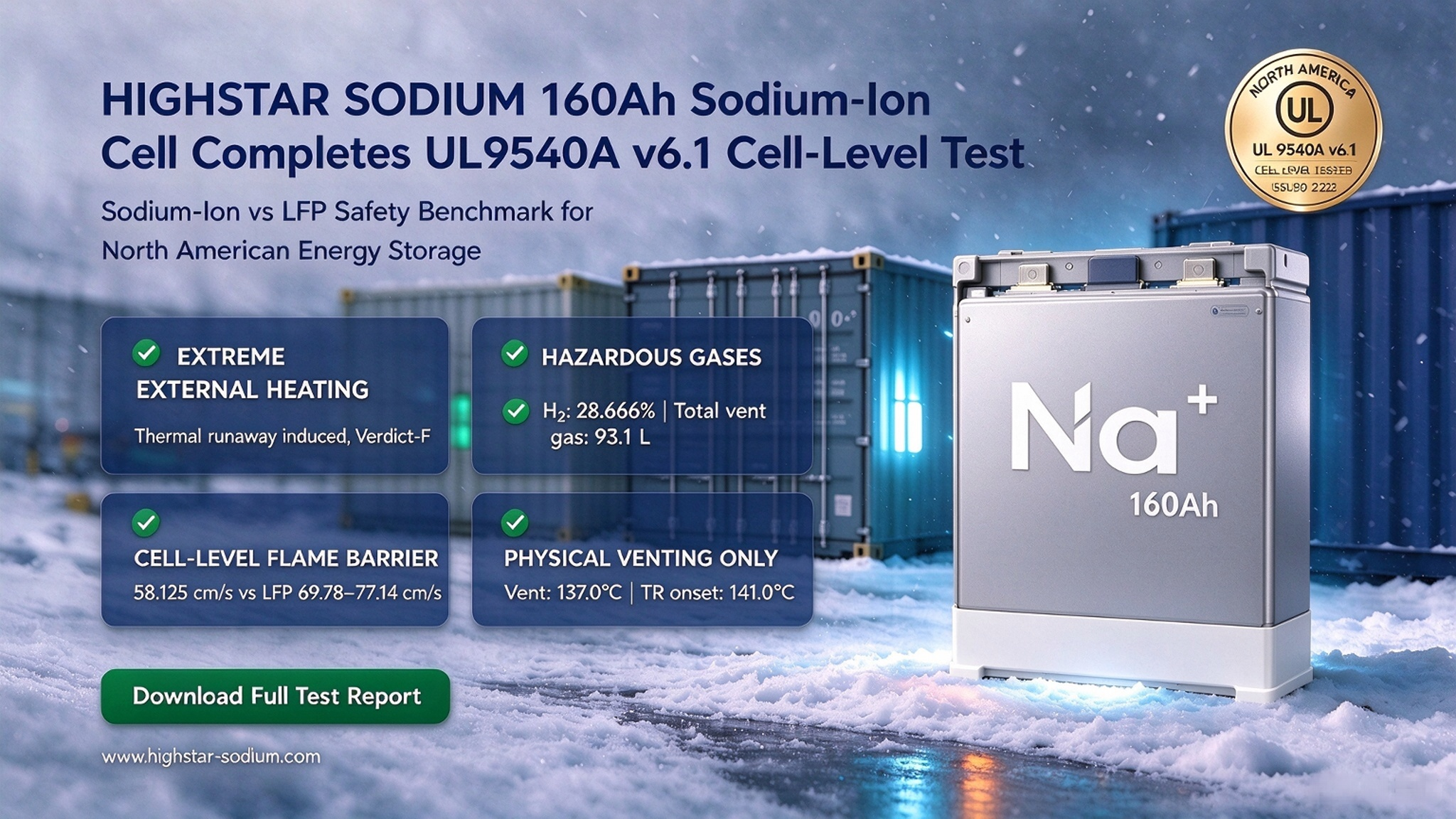
The subject is a 160Ah NFPP (Na4Fe3(PO4)2P2O7-type polyanion) prismatic cell, model NaCP71173208-160E3, tested by CSA Group to the March 2025-edition method (report project 80322411). [1] The headline: Verdict F – thermal runaway induced under the film-heater protocol, flammable vent gas, module-level testing required.
We state it that way on purpose. Completing cell-level testing under the newest, stricter edition is a genuine milestone for sodium-ion technology – one of the first publicly documented completions – but the milestone is the dataset, not a badge. What the dataset unlocks for North American buyers:
- AHJ pre-conversations with third-party numbers instead of marketing adjectives;
- design assumptions (vent composition, flammability window, energy of the failure) for the upcoming module-level program;
- a same-manufacturer baseline: sodium 160Ah vs LFP 280Ah/314Ah from one cell house, which removes the usual vendor-shopping confound.
Key recorded values for the sodium cell: vent onset at an average of 137.0°C with thermal-runaway onset at 141.0°C; total gas generation 137.1 L; combustible gas 93.1 L; sixteen detected species including H2 28.666%, CO 9.712%, CO2 42.506%, CH4 3.679%; flame propagation 58.125 cm/s; LFL 5.9% at ambient (5.5% at vent temperature); peak explosion pressure 6.071 bar. [1]
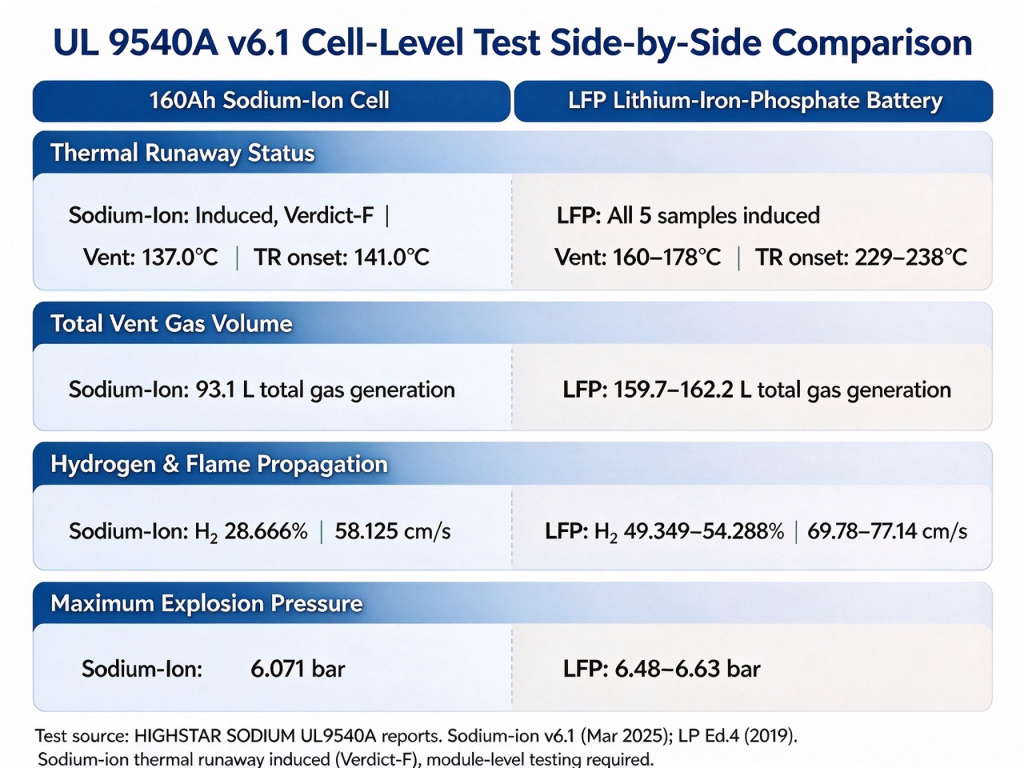
Head-to-Head: The Table You Should Actually Compare
Field against field, with format differences flagged where they exist:
| Metric | Sodium 160Ah | LFP 280Ah | LFP 314Ah |
|---|---|---|---|
| Standard edition | Mar 2025 (report cites V6.1) | Ed. 4 (2019) | Ed. 4 (2019) |
| Verdict | F – runaway induced | F | F |
| Module-level test required | Yes | Yes | Yes |
| Thermal-runaway onset temp | 141.0°C | 238°C | 229°C |
| Total gas generated | 137.1 L | 159.7 L | 162.2 L |
| Combustible gas | 93.1 L (measured field) | not itemized in Ed.4 (~75% by composition ≈ 120 L) | not itemized (~72% ≈ 116 L) |
| Hydrogen share | 28.666% | 54.288% | 49.349% |
| Hydrogen, absolute (calculated) | 39.3 L | 86.7 L | 80.0 L |
| CO share | 9.712% | 10.1% | 12.4% |
| CO2 share | 42.506% | 22.6% | 26.7% |
| Flame propagation speed | 58.125 cm/s | 69.78 cm/s | 77.14 cm/s |
| LFL (ambient / at vent temp) | 5.9% / 5.5% | 7.35% / 6.15% | 7.85% / 7.15% |
| Peak explosion pressure | 6.071 bar | 6.63 bar | 6.48 bar |
Three footnotes before anyone quotes this table: (1) editions differ – the 2025 method has a dedicated combustible-gas field, Ed.4 reports a single gas volume, so the LFP combustible subtotals are compositions-based estimates, not lab measurements; (2) onset-temperature definitions are not identical across editions; (3) the hydrogen absolute line is our arithmetic (share x volume), not a reported figure.
Five Readings That Survive Scrutiny
1. The hydrogen advantage is real – cite the absolute litres
“28.7% vs 49-54%” is the easy half. The harder, better number: 39.3 L of hydrogen vs 80-87 L. Hydrogen is what makes BESS vent gas detonable; sodium’s cell-level output cuts it by more than half. No framing needed.
2. The venting gap is ~14%, not 42% – and the 42% is a field mix-up
Our earlier draft compared sodium’s combustible volume (93.1 L) against LFP’s total volume (159.7/162.2 L) and advertised “42-43% less gas”. That is apples to oranges. Same-field: 137.1 vs roughly 160 – about 14-15%. Smaller, but it is the number that survives a forensic read of the reports, so it is the number we print.
3. The 141°C onset is not the selling point it looks like
Sodium triggers at a lower temperature than LFP’s 229-238°C. In a film-heater test that value largely reflects heater-cell interaction, not an intrinsic ignition-resistance rating. What matters is behavior after triggering – gas, flame, overpressure – and there sodium’s outputs are systematically milder. Selling 141°C as “more stable” would mislead, so we don’t.
4. The LFL row cuts the wrong way – declare it first
At 5.9% (5.5% hot) versus LFP’s 7.35-7.85%, sodium vent gas reaches a flammable state at a leaner concentration: a lower energy threshold before deflagration in a confined enclosure. Every fire-protection engineer scanning the table will find this row. Declaring it ourselves is the entry fee for believing the other four readings – and it is an engineering problem (NFPA 68/69 venting and detection design under the NFPA 855 framework), not a disqualifier. [7]
5. Cross-edition honesty beats cross-edition cherry-picking
Sodium was tested under the newer, stricter method and still produced the mildest post-trigger numbers in the set. Stated precisely – “the sodium cell’s Verdict-F dataset was generated under a stricter edition than the LFP baselines” – this is more persuasive than any claim that the three reports ran “identical standards”, which they did not.
What These Reports Let You Do – and Not Do
They let you: open AHJ pre-consultations with third-party cell-level data; build suppression, venting and spacing assumptions ahead of module testing; benchmark sodium against LFP inside one manufacturer’s cell family without vendor-shopping the result.
They do not let you: claim flame propagation is “tested and passed” at assembly level; claim the cell is “safe” in a system sense; quote 93.1 L against LFP totals; market the 141°C onset as stability; or describe any of these documents as a certification. The report is a test report. The verdict is F. The instruction to continue to module level is ticked. Saying all three, out loud, is what makes the rest of the paragraph credible.
Why North American Buyers Are Looking at Sodium Now
- Fire-behavior magnitudes: half the hydrogen, ~14% less total gas, slower flame – with the LFL caveat engineered through vent design (above).
- Cold without heaters: -40°C discharge retention >75% at the cabinet level (see our base-station whitepaper), removing parasitic heating loads that LFP fleets carry through winter.
- Honest cost position: sodium cell cost currently sits at rough parity with LFP, not below it; the 30%-type advantage is a scale-and-materials trajectory (aluminum cathode current collector, abundant sodium), commonly framed as a 1-2 year path rather than a today fact.
- Supply-chain structure: no cobalt, nickel or lithium means the EU Battery Regulation’s due-diligence and recycled-content burdens structurally miss the main cost drivers of NFPP cells – a compliance tailwind we detail in our sustainability guide. [8]
- Regulatory maturation: China published sodium-specific safety and performance national standards (GB 48072 / GB 48098) in August 2026, tightening nail-penetration requirements beyond the lithium framework. [9]
The Module-Level Roadmap
Verdict F is not a cliff – it is a corridor. The sodium report’s own instruction is to continue at module level; both LFP reports say the same. Our plan: module-level UL 9540A on the production pack configuration, scheduled against the 6th-edition regime that also foreshadows installation-level LSFT expectations. Lab booking and expected report dates: [to be filled before publication]. When module and unit data exist, this page will be updated with them and the table re-baselined – a standing commitment, not boilerplate.
Frequently Asked Questions
Is UL 9540A a certification?
No. UL 9540A is a standardized test method that generates thermal-runaway behavior data used by fire codes and insurers. It has no pass/fail outcome, so ‘UL 9540A certified’ is a category error; ‘UL 9540’ is the separate equipment safety certification.
Why do all three reports say Verdict F?
At cell level, essentially every mainstream commercial chemistry – sodium, LFP, NMC – ends at Verdict F: thermal runaway is induced by the film heater and the vent gas is flammable. F is the entry condition for module-level testing, not a ranking. The differentiation lives in the magnitudes: vent volume, hydrogen share, flame speed, explosion pressure.
Does this make the sodium cell fireproof?
No. Forced into failure it vents flammable gas (H2 28.666%, CO 9.712%) and produces flame propagation at 58.125 cm/s. Versus the same manufacturer’s LFP cells it shows less total venting (137.1L vs 159.7-162.2L), roughly half the absolute hydrogen, and slower flame spread – plus one unfavorable row: a lower LFL of 5.9%. Design validation continues at module and unit level, exactly as the report instructs.
Can cell-level data be used for NFPA 855 layout?
As a starting point, not as a design basis. Spacing, deflagration venting and gas-detection logic depend on assembly-level propagation behavior, which requires module-level (and typically unit-level) UL 9540A results for the exact assembly being deployed.
Why weren’t the LFP cells retested to the 2025 edition?
Both LFP reports predate our access to the 2025-edition method and were executed under the 4th edition then in force. Retesting under the newer method is planned. Until then, the edition row in the table is mandatory reading, and any derived ratio must be quoted with its footnote.
What changed in the sixth edition of UL 9540A?
On March 13, 2026 UL published UL 9540A:2026 (6th edition), which makes installation-level large-scale fire testing (LSFT) a mandatory part of the framework rather than an optional appendix. Our module-level program is scheduled against that newer regime.
Can a buyer see the raw reports?
Yes – the full CSA Group sodium report (Project 80322411) and both UL Changzhou LFP reports (4790860460, 4791247011) are available under NDA, including appendices and gas-chromatograms. The summary table is published openly so the market can check our arithmetic.
References
[1] CSA Group – cell-level UL 9540A test report, Project 80322411, model NaCP71173208-160E3 (160Ah NFPP sodium-ion cell), 2025. Full report available under NDA. [2] UL Solutions (Changzhou laboratory) – UL 9540A 4th edition test report 4790860460, 280Ah LFP cell, 30 Oct 2023. Available under NDA. [3] UL Solutions (Changzhou laboratory) – UL 9540A 4th edition test report 4791247011, 314Ah LFP cell, 27 Aug 2024. Available under NDA. [4] UL Solutions – “UL 9540A Test Method for Battery Energy Storage Systems” (official service page; test method, data for NFPA 855 / IFC): https://www.ul.com/services/ul-9540a-test-method [5] Intertek – “Understanding the 2026 Update to UL 9540A” (6th edition published 13 Mar 2026; LSFT as mandatory gate), 23 Mar 2026: https://www.intertek.com/blog/2026/03-23-understanding-the-2026-update-to-ul-9540a/ [6] Mayfield Energy – “The 6th Edition of UL 9540A is Here”, 25 Mar 2026: https://www.mayfield.energy/technical-articles/the-6th-edition-of-ul-9540a-is-here/ [7] NFPA – NFPA 855, Standard for the Installation of Energy Storage Systems (2026 edition; consumes UL 9540A data; LSFT appendices): https://www.nfpa.org/product/nfpa-855-standard/p0855code [8] HIGHSTAR SODIUM – “Sodium-Ion Sustainability and the EU Battery Regulation”: https://www.highstar-sodium.com/sodium-ion-sustainability-eu-battery-regulation/ [9] CLS / Shanghai Metals Market – “Sodium storage national standards GB 48072 & GB 48098 published Aug 2026” (secondary trade-press reporting): https://www.cls.cn/detail/2506889
Related Reading (same topic cluster)
- Sodium-Ion Base-Station Backup Whitepaper (EN): https://www.highstar-sodium.com
- The Complete Sodium-Ion BESS Guide (pillar): https://www.highstar-sodium.com/products/
- 50Ah High-Rate Sodium Cell for UPS & Forklift: https://www.highstar-sodium.com/product/50ah-nfpp-sodium-ion-prismatic-cell/
- 8.2 kWh Home Solar Rack Battery: https://www.highstar-sodium.com/product/51-2v160ah-rack-mounted-solar-sodium-ion-battery/
- 0.5 MW / 1 MWh Container System: https://www.highstar-sodium.com/introducing-the-0-5-mw-1-mwh-liquid-cooled-sodium-ion-battery-energy-storage-system/