New 180Ah Sodium-Ion Battery Cell: Advantages, Applications, EU Battery Passport Rules, and Samples Now Open
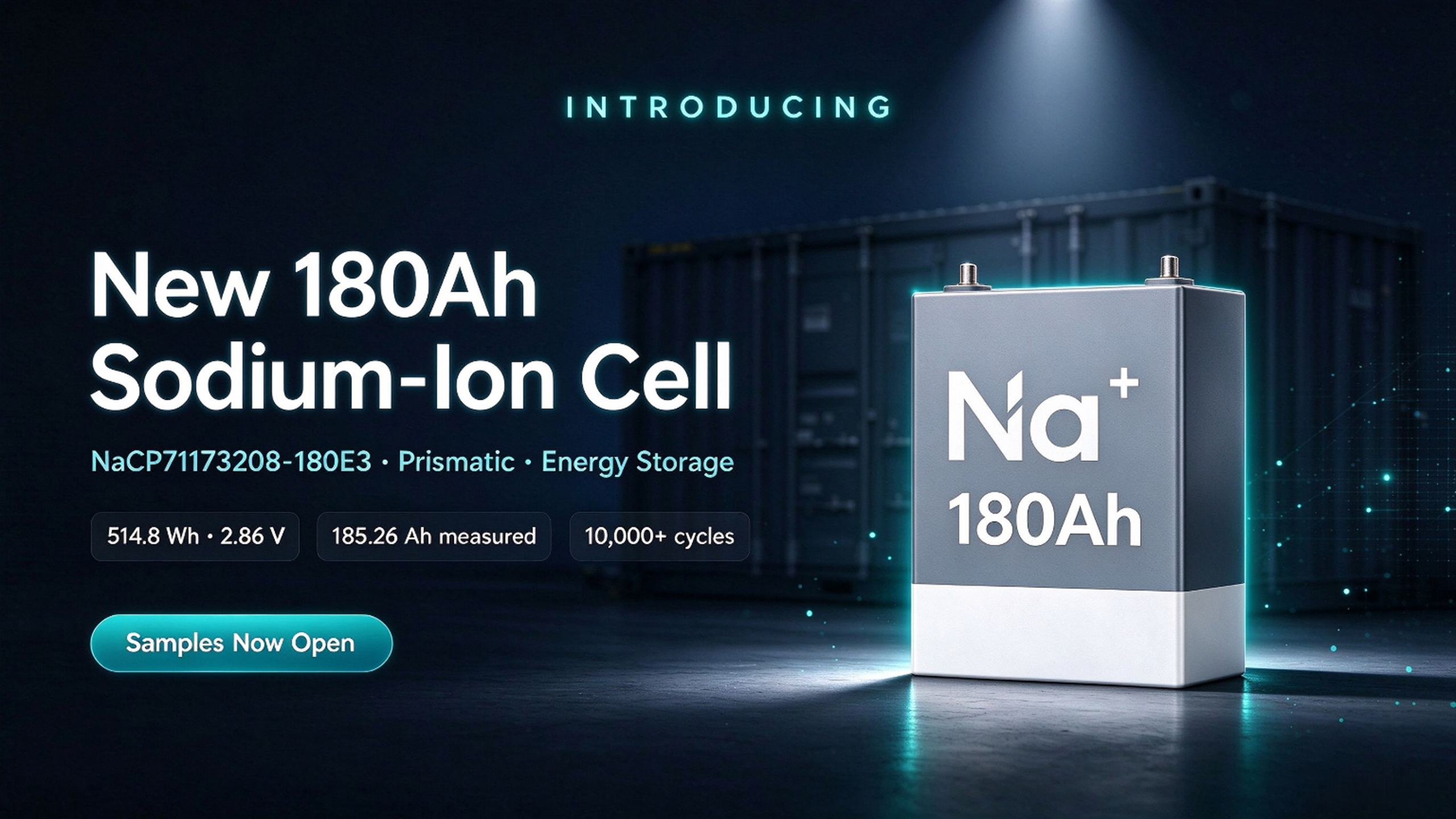
HIGHSTAR SODIUM BATTERY has launched NaCP71173208-180E3, a new 180Ah prismatic sodium-ion battery cell for energy storage. The launch ships with the complete July 2026 test report, a detailed walkthrough of the cell itself (not just a spec table), and an explanation of how the EU Battery Regulation and its Battery Passport apply to sodium-ion storage systems. Test samples are now open for request so your engineering team can verify every number on your own bench; sample quantities, lead time, and commercial terms are arranged through your HIGHSTAR SODIUM BATTERY sales representative.
What Is the NaCP71173208-180E3?
A large-format prismatic sodium-ion rechargeable cell for stationary energy storage, built on an iron-based phosphate cathode that contains no cobalt and no nickel. The product specification sheet (ECN No. Q/KAGG1701-2026) defines it as follows:
| Parameter | Specification |
|---|---|
| Minimum capacity | 180Ah (0.5P, 25±2°C, 1.5–3.45V) |
| Minimum energy | 514.8Wh |
| Average working voltage | 2.86V |
| Charge cut-off (Umax) / discharge cut-off (Umin) | 3.45V / 1.5V |
| Initial AC internal resistance | ≤0.30 mΩ (1 kHz, 15% SOC) |
| Dimensions (with wrap, incl. terminals) | 71.7±0.8 × 173.7±0.5 × 207.0±0.5 mm |
| Weight | 4,700g ± 300g |
| Standard charge / discharge power | 257.4W each (0.5P) |
| Peak rate tested | 514.8W (1P) |
| Operating temperature | Charge 0–60°C; discharge -40–60°C |
| Standard cycle life (25°C) | 6,000 cycles at ≥80% energy retention; 10,000 cycles at ≥70% |
| Shipment state | 2.5–2.7V open-circuit voltage |
| Shelf life at shipment SOC | 1 year at 0–35°C; 1 month at -20–45°C |
| System voltage alarms | 3.30V reduce power / 3.35V stop charge / 3.45V safety protection |
| Clamping requirement | 300 ± 20 kgf during assembly and operation |
| Warranty | 12 months from manufacture date (non-conforming cells replaced free of charge) |
Inside the Cell: What the Numbers Actually Mean
Form factor and mechanical design
The cell is a 71.7 × 173.7 × 207.0 mm prismatic can — roughly the footprint of a hardcover book standing on its end — weighing 4.8 kg, which puts energy density at about 107 Wh/kg (514.8Wh / 4.8kg) and volumetric energy at about 200 Wh/L inside the wrapped envelope (514.8Wh / 2.58L). Two terminal posts sit on the top cap, so a pack builder wires cells in a single plane without the tab-fold gymnastics cylindrical cells require.
The spec sheet is explicit that the 300 ± 20 kgf clamping force is a requirement, not a recommendation: the cycle-life rating of 6,000 cycles at ≥80% retention was measured under that compression, and module fixtures should hold the stack within that band for the life of the system. Under-clamping accelerates capacity fade; over-clamping risks can deformation. The document also states that different part numbers must not be mixed in one battery system, and that the enclosure is responsible for its own waterproofing and dustproofing to the UL/IEC ingress-protection ratings — cell damage caused by enclosure sealing failures falls outside the warranty.
Voltage window and how to use it
Nominal operation sits between 1.5V and 3.45V with an average working voltage of 2.86V. That is a wide, flat plateau: at 2.86V a 1P discharge of 180A delivers 514.8W per cell. For BMS design, the specification provides a three-level alarm ladder — drop power at 3.30V, stop charging at 3.35V, and treat 3.45V as a hard safety boundary. Because sodium-ion cells show a less steep voltage-versus-SOC slope than LFP, the vendor advises against relying on open-circuit voltage alone for state-of-charge estimation; pack-level SOC should be calibrated with coulomb counting, which is standard practice for any sodium chemistry.
Rate capability and heat
Standard operation is defined at 0.5P (90A, 257.4W), and the cell is qualified to a 1P (180A, 514.8W) rate test with 98.24% of reference energy at 92.03% energy efficiency. The practical reason this matters is the initial AC internal resistance: 0.2235 mΩ measured average against a 0.30 mΩ ceiling. At 180A, that resistance produces roughly 7.2W of heat inside the cell (I²R at ~0.22 mΩ) — small enough that a containerized system can be designed with modest cooling capacity and still keep the cell well inside the 60°C ceiling above which the specification requires BMS shutdown.
Temperature behaviour
Discharge is rated from -40°C to +60°C, a 100°C span. Charging is rated 0–60°C, with charge current limited to 0.2P below 10°C; sub-zero charging is handled through project-level low-temperature configuration rather than claimed as a standard feature. At the hot end, the 45°C test showed 97.15% energy efficiency — above the ≥93% requirement — and a 30-day storage at 50°C and 50% SOC recovered 97.5–97.9% of discharge energy back at 25°C. Note that -40°C is the rated discharge floor in the specification; this test report contains no -40°C measured item, and the closest measured cold data point is 95.10% discharge energy retention at 5°C.
Life and calendar behaviour
The standard cycle rating is 6,000 cycles at ≥80% and 10,000 cycles at ≥70% energy retention at 25°C, 0.5P/0.5P, under specified clamping. A long-term endurance test is still running; at the time of the report two samples had reached 1,676 and 1,673 cycles at 97.33% and 97.66% energy retention, tracking ahead of the rating curve, but the final cycle figure is not yet available and we do not publish a projection. On the calendar side, the cell ships at 2.5–2.7V and can be stored at shipment SOC for one year at 0–35°C; the specification also warns against leaving a cell at rest beyond six months before recharging it, and defines a maintenance-charging routine for long-idle inventory. For project developers, that combination of wide shipment window and defined reactivation procedure is what makes banked spares and staged commissioning workable.
Safety design and testing
Beyond the abuse tests reported below (no fire, no explosion), the specification sets acceptance criteria for crush, drop, 130°C thermal exposure, 11.6 kPa low-pressure (air transport) and thermal-propagation-type tests, and requires that cell temperature never exceed 60°C in service with BMS shutdown at that limit. Handling guidance in the document is deliberately conservative — no disassembly, no immersion, no metal contact with terminals, qualified chargers only, and disposal of end-of-life cells under local regulations — and the same instructions travel with every sample shipment.
Six Advantages of This 180Ah Sodium-Ion Cell
1. Big capacity per cell — less integration work
A megawatt-hour-class system built from 514.8Wh cells needs roughly 1,943 cells per MWh (1,000,000 Wh / 514.8 Wh). Every step down in per-cell energy raises that count proportionally — more busbars, more weld points, more BMS sampling channels, more potential failure sites. Integration simplicity is the structural advantage of moving to 180Ah, and it converts directly into assembly labor and quality-control cost.
2. Real capacity above the rating
Production sorting measured an average of 185.26Ah against the 180Ah minimum — about 2.9% more usable energy than the datasheet floor, so packs built from these cells carry an inherent capacity margin instead of a shortfall risk.
3. Ultra-low internal resistance
0.2235 mΩ measured versus a 0.30 mΩ limit, roughly 25% of margin. Less resistance means less self-heating at the same current, a smaller cooling system for the same enclosure, and the efficiency numbers listed below.
4. Efficiency that holds at high, low and hot
| Condition | Standard | Measured |
|---|---|---|
| 45°C charge / discharge energy retention | ≥98% / ≥98% | 98.21% / 101.73% |
| 45°C energy efficiency | ≥93% | 97.15% |
| 5°C charge / discharge energy retention | ≥90% / ≥80% | 99.35% / 95.10% |
| 5°C energy efficiency | ≥83% | 89.46% |
| 1P discharge energy retention | ≥95% | 98.24% |
| 1P energy efficiency | ≥90% | 92.03% |
Full 1P (180A / 514.8W) rate capability backs the 98.24% discharge-energy-retention figure above. A 97.15% round-trip efficiency at 45°C is the single most valuable number for cycle-commerce duty: every percentage point of round-trip efficiency is margin that survives ten thousand charge-discharge repetitions.
5. Abuse-test safety, measured not promised
External short circuit (<1 mΩ, 10 min), overcharge (90A to 5.175V), over-discharge (90A to 0V) and overload (1,029.6W) all ended with no fire and no explosion — and the short-circuited cell peaked at only 21.45°C, barely above ambient. These are four tests actually run and recorded in a dated report, not a marketing claim of safety.
6. Sodium supply chain and a long service horizon
Cobalt-free and nickel-free chemistry sidesteps the two most cost-volatile, geographically concentrated raw materials in lithium-ion, and narrows the declared-substance surface under the EU Battery Regulation (see below; applicability depends on pack configuration). The 6,000-cycle / 10,000-cycle rating gives a long-service baseline that makes the levelized cost per stored kWh competitive over a 10-to-15-year asset life.
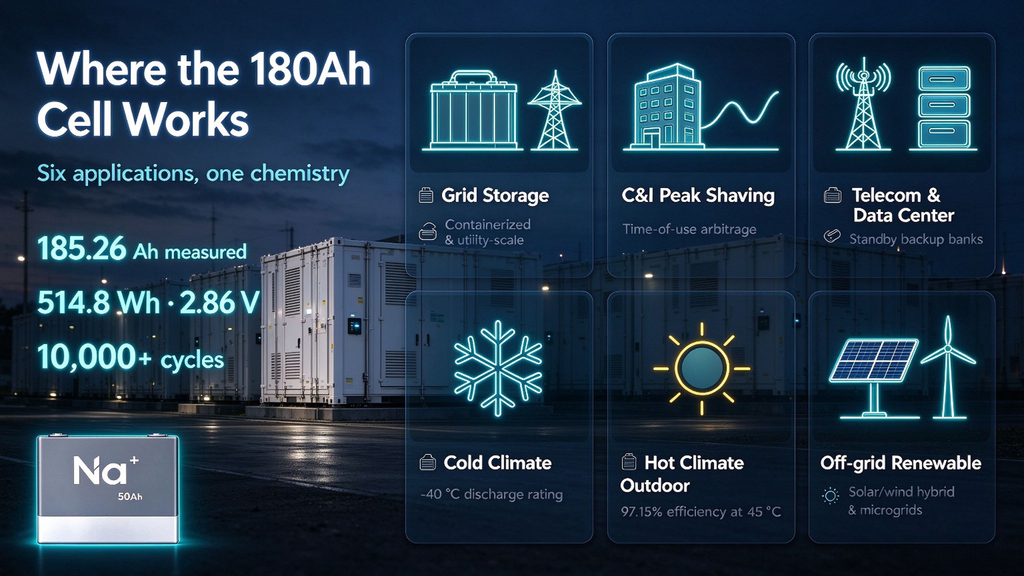
Applications: Where the 180Ah Sodium-Ion Cell Fits
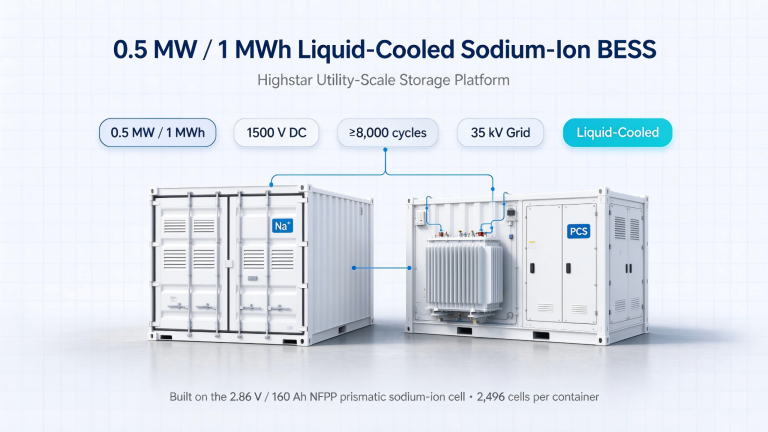
- Grid-scale and containerized storage. High per-cell energy reduces cell count per MWh-class system, simplifying module architecture, busbar layout and enclosure design for 20-foot containers and outdoor cabinets.
- Commercial & industrial storage (peak shaving, demand charge management). 1P-rate discharge with 98.24% energy retention suits daily deep-cycling under time-of-use tariffs, where round-trip efficiency compounds over thousands of cycles.
- Telecom base-station and data-centre backup. After 30 days at full charge at 25°C, discharge energy recovery measured 99.38% — standby banks that sit charged for weeks lose almost nothing, and the -40°C discharge rating covers rooftop and tower installations in cold regions.
- Cold-climate deployment. Rated discharge from -40°C, with 95.10% energy retention already demonstrated at 5°C testing, fits northern and high-altitude outdoor sites without a heated enclosure. Standard charging starts at 0°C; sub-zero charging requires project-level low-temperature configuration.
- Hot-climate and outdoor cabinets. 97.15% energy efficiency at 45°C plus 97.5%+ discharge energy recovery after 30 days at 50°C / 50% SOC storage means desert, tropical and south-facing rooftop duty cycles come with small efficiency and shelf penalties.
- Off-grid and renewable integration. Shipment at 2.5–2.7V, one-year shelf life at shipment SOC and a defined maintenance-charging routine support slow-cycle solar/wind hybrid systems, remote sites and microgrids where inventory sits and commissioning is staged.
EU Battery Regulation and the Battery Passport: What Applies to Sodium-Ion Storage
This section is written for European buyers and system integrators who need to know, before specifying a cell, what documentation the finished system will require. It is a regulatory-information summary, not legal advice — obligations fall on whichever party places the battery on the EU market, and applicability is determined per battery at pack level.
The rule, in one paragraph
Regulation (EU) 2023/1542 replaced the old Battery Directive and applies to essentially every battery type placed on the EU market. It phases in duties across the product life cycle: carbon-footprint declaration, performance and durability labelling, due diligence for supply chains, recycled-content disclosure and, as the centrepiece, the digital Battery Passport — a QR-code-accessible record of the battery’s identity, chemistry, manufacturing, performance and end-of-life data.
Battery passport: date and scope
The Battery Passport becomes mandatory on 18 February 2027 for electric-vehicle batteries, light-mean-of-transport batteries, and rechargeable industrial batteries with a capacity above 2 kWh placed on the EU market. That threshold is the operative line for energy storage: a grid or commercial storage pack — typically tens of kWh to MWh — is squarely inside scope, so a passport will be required for the finished system.
In July 2026 the European Commission published its Digital Battery Passport guidance, which structures the required content into roughly 71 data points organised by battery category (EV, LMT, industrial), covering identity and technical parameters, chemistry and material composition, expected lifetime and performance, circularity and recycled content, carbon footprint, and supply-chain due diligence. Access to those fields is tiered between public, authority and trusted-party levels. The accompanying implementing acts and a DPP registry are being finalised through 2026, so the practical format is still being fixed as we speak.
What “above 2 kWh” means for a single cell
The 2 kWh threshold is assessed at battery/pack level, not at cell level. Two consequences for a buyer evaluating the NaCP71173208-180E3:
- As a component, the cell itself does not carry a passport. A 514.8Wh cell is below the threshold and is not placed on the market as a standalone industrial battery. The passport duty attaches to the assembled system above 2 kWh, and it sits with the party that places that system on the market.
- This is a scope boundary, not an exemption or a loophole. Data obligations do not disappear upstream: cell-level chemistry, performance and traceability data must be captured in a form that feeds the pack-level passport, and the producer remains subject to CE conformity, EPR registration, waste-battery handling, and from August 2023 onward the Regulation’s supply-chain due-diligence duties (phased for the raw materials listed in the rule). A cell vendor that cannot supply clean data will stall its customer’s passport, not its own.
Where sodium-ion chemistry genuinely helps
- Declared-material surface is narrower. Cobalt and nickel are the two substances the Regulation scrutinises hardest, because of both cost/geopolitical risk and mandatory recycled-content floors. This cell contains neither, and no lithium-bearing cathode. The fields most likely to generate audits, corrective requests and disputes are the ones sodium-ion chemistry does not have to fill.
- Carbon-footprint declaration is a methodology question, not a chemistry verdict. Under the Regulation, rechargeable industrial batteries above 2 kWh must declare a life-cycle carbon footprint calculated with the Commission’s method, which runs on the EU electricity-mix and process data sets. Sodium-ion’s advantage — no energy-intensive cobalt/nickel upstream and no lithium — has to be proven batch by batch with plant data and supplier evidence, which is exactly the exercise we are set up to support for integrators who need it.
- Recycled-content floors do not bite on the materials this cell omits. The Regulation’s mandatory recycled-share requirements for cobalt, lead, lithium and nickel enter into force in later phases (from 2031 and 2036). A cell that uses none of cobalt or nickel avoids two of those four obligations by design; aluminium, iron and phosphorus remain within the general circularity and collection/recycling-efficiency targets.
Timeline buyers should watch
| Milestone | Requirement in force |
|---|---|
| 18 Aug 2024 | CE conformity and general labelling regime under the Regulation applies |
| 18 Feb 2025 | Carbon-footprint declaration begins phasing in for EV batteries (format/methodology acts apply per category) |
| From 2025 | Supply-chain due-diligence duties phase in for listed raw materials |
| Aug 2026 | Performance and durability labelling / carbon-footprint information on label expected |
| 18 Feb 2027 | Battery Passport mandatory: EV, LMT, and rechargeable industrial batteries above 2 kWh |
| 18 Aug 2028 | Recycled-content disclosure requirements |
| 2031 / 2036 | Mandatory minimum recycled shares for cobalt, lead, lithium, nickel |
Two of these dates are cited inconsistently across secondary sources (carbon-footprint start dates for industrial batteries, and the August 2026 labelling milestone, for which some sources report a possible slip). We flag them as “verify against the current Commission guidance” rather than asserting a single date — the same care we applied to the test data in this launch.
What HIGHSTAR SODIUM BATTERY supplies to integrators targeting the EU
Cell-level composition and performance data in structured form, batch traceability, the specification sheet and test report as engineering evidence, and support for the data requests your passport platform or notifier will need. Confirm the exact field list against the Commission guidance for your battery category during project qualification — and start the data collection early, because the bottleneck in practice is not generating the passport but assembling clean, verifiable upstream data inside a cross-border data-transfer framework.
Samples Available on Request
Sample applications for the NaCP71173208-180E3 are open as of this announcement:
- Standard test cells ship at 2.5–2.7V open-circuit voltage with the activation, clamping and storage guidelines from the specification sheet;
- Full document set with every sample — specification sheet plus the measured July 2026 test report, for like-for-like bench comparison;
- Built for real validation: pack prototyping, BMS matching and balancing-strategy checks, cell-consistency evaluation, shipping and long-storage simulations, and 1P thermal-soak verification;
- Application engineering support: our team walks your engineers through clamping force (300 ± 20 kgf), the charge-temperature window and current limits below 10°C, so integration is not left to trial and error.
Sample quantities, lead time, and commercial terms are subject to discussion with your HIGHSTAR SODIUM BATTERY sales representative. Contact us via www.highstar-sodium.com to open a request.
Frequently Asked Questions
How do I get samples of this 180Ah sodium-ion cell?
Sample applications are open now. Contact HIGHSTAR SODIUM BATTERY through the official website or your sales representative; quantities, lead time and commercial terms are arranged case by case. Every sample ships with the specification sheet and the test report.
Does this cell need an EU Battery Passport?
Not on its own — the passport duty under Regulation (EU) 2023/1542 starts on 18 February 2027 for EV, LMT and rechargeable industrial batteries above 2 kWh, and it applies to the battery placed on the market. This 514.8Wh cell is a component below that threshold. That is a scope boundary, not an exemption: the obligation sits with whoever places the assembled battery on the EU market, and HIGHSTAR SODIUM BATTERY supplies the cell-level data that feeds the pack passport.
How does sodium-ion chemistry help with EU battery compliance?
The cell contains no cobalt and no nickel, which removes them from material-scrutiny and future recycled-content obligations, and narrows the declared-substance surface. Carbon-footprint and passport data duties still apply to systems above 2 kWh and must be evidenced with production data, not claimed by chemistry alone.
What is the measured capacity of the NaCP71173208-180E3?
The rated minimum is 180Ah. July 2026 production sorting averaged 185.26Ah, about 2.9% above the rating.
What applications is this sodium-ion cell suited for?
Grid and containerised storage, commercial and industrial energy storage, telecom and data-centre backup, cold-climate and high-temperature installations, and off-grid renewable systems.
Can these cells work in cold weather?
The discharge window covers -40°C to 60°C, and 5°C testing showed 95.10% discharge energy retention. Standard charging operates from 0°C, with charge current limited to 0.2P below 10°C; sub-zero charging requires project-level configuration.
How many cells are needed for a 1 MWh system?
At the 514.8Wh minimum rating, roughly 1,943 cells per MWh (1,000,000 / 514.8) before accounting for enclosure, wiring and operating-window margins. Lower-capacity cells raise that count proportionally, which is why higher per-cell energy simplifies pack architecture.
References
- HIGHSTAR SODIUM BATTERY. NaCP71173208-180E3 Test Report, 30 July 2026.
- HIGHSTAR SODIUM BATTERY. NaCP71173208-180E3 Product Specification Sheet, ECN No. Q/KAGG1701-2026.
- European Commission, Directorate-General for Internal Market, Economy and Investment. Batteries — Digital Product Passport. https://single-market-economy.ec.europa.eu/single-market/digital-product-passport/batteries_en
- European Commission. Guidance Document: Digital Batteries Passport — data points by category, Version 1.0, July 2026 (71 data points).
- Regulation (EU) 2023/1542 of the European Parliament and of the Council of 12 July 2023 concerning batteries and waste batteries.
- HIGHSTAR SODIUM BATTERY official website: www.highstar-sodium.com