180Ah Sodium-Ion Cell Cycle Life, Measured: 25°C, 45°C and 60°C Early-Cycle Data, Round-Trip Efficiency, and 60°C Full-Charge Storage
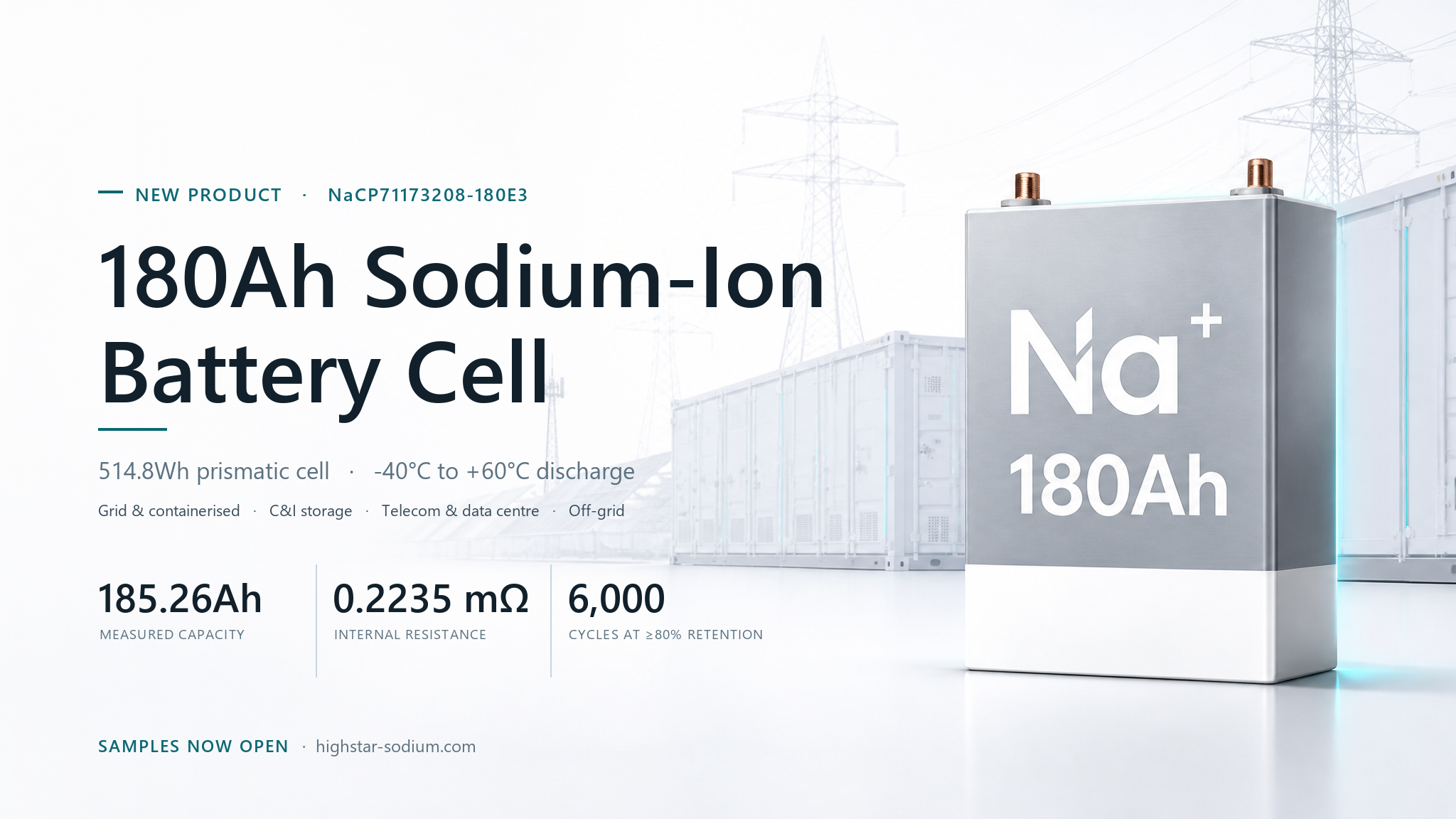
HIGHSTAR SODIUM BATTERY publishes a set of early-cycle measurements for its 180Ah NFPP sodium-ion prismatic cell (NaCP71173208-180E3): capacity retention at 25°C, 45°C and 60°C over the first ~200 cycles, round-trip efficiency across the same three temperatures, and a 6-month storage record at 60°C and 100% state of charge. The point of publishing raw curves rather than a single headline number is simple: cycle life is a curve, not a sticker, and system designers deserve to see its shape. Test samples remain open for request so your team can reproduce these numbers on your own cycler; sample quantities, lead time and commercial terms are arranged through your HIGHSTAR SODIUM BATTERY sales representative.
What Was Tested, and Under What Conditions
All cycle data below come from a supplier-comparison test campaign run on production 180Ah cells at 0.5P charge/discharge, with individual cell identifiers logged (cells 012# at 25°C, 0056# at 45°C, 028# at 60°C). The 60°C storage record tracks two cell lots (67 and 52) held at full charge, 3.45–1.5V window, 257.4W charge/discharge power, for six months.
Two disclosure notes before the numbers. First, every curve at this stage is an early-cycle record: the far end of the rated life (6,000 cycles at ≥80% energy retention, 10,000 at ≥70%) is still being accumulated on long-term benches, and this article reports only what has been measured, with no extrapolation. Second, sample sizes at this stage are small — single-cell traces for the 180E3 curves and two-to-three cells for the comparison group — so the curves show behaviour, not statistics; that is exactly why we ship samples with the raw data instead of asking buyers to trust a chart.
Capacity Retention: The First ~200 Cycles at Three Temperatures
| Condition | Test cell(s) | Retention at end of record | Shape of the curve |
|---|---|---|---|
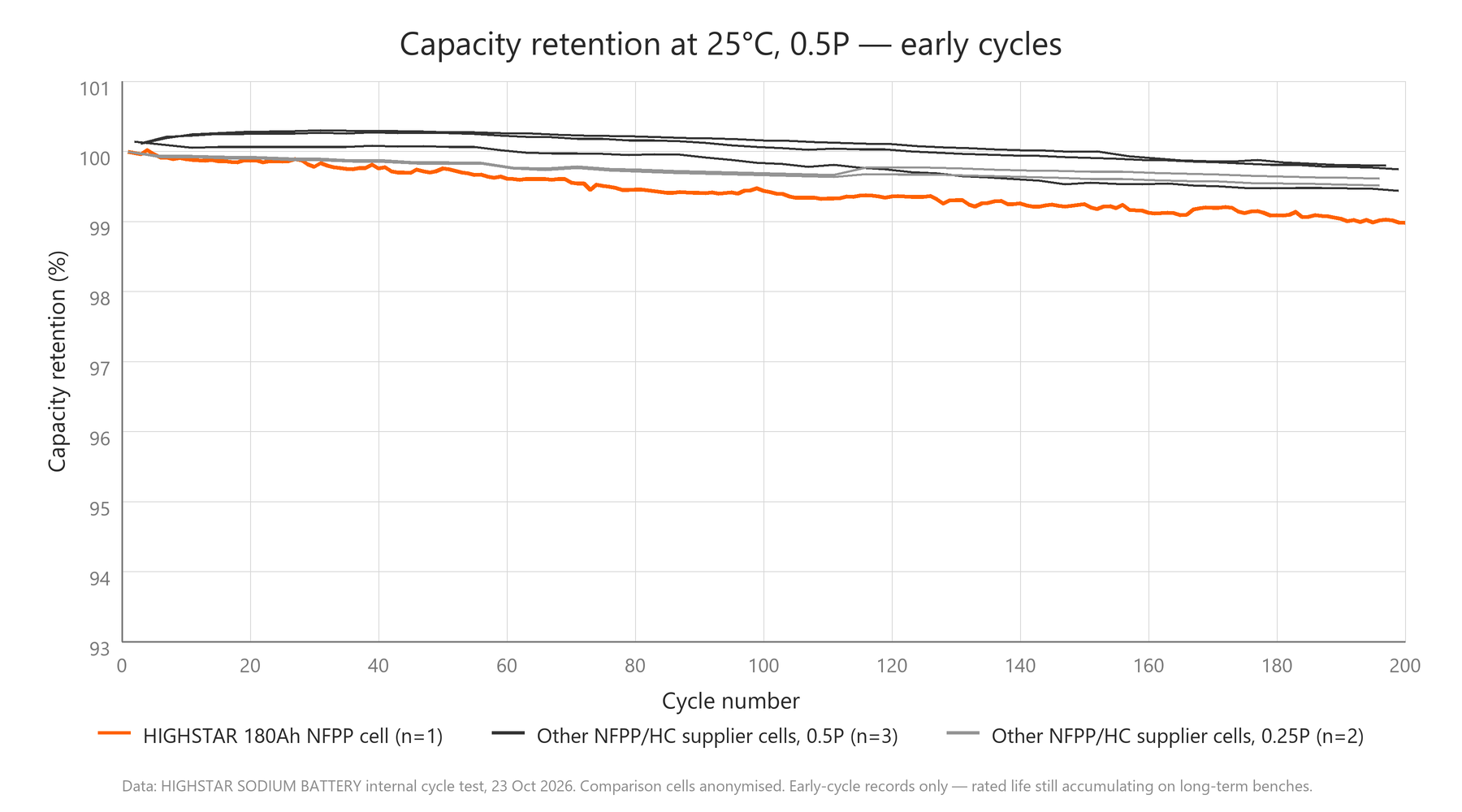
| 25°C, 0.5P | StarNa 180E3, n=1 | ≈99.0% at cycle 200 | Gentle, near-linear fade from 100% |
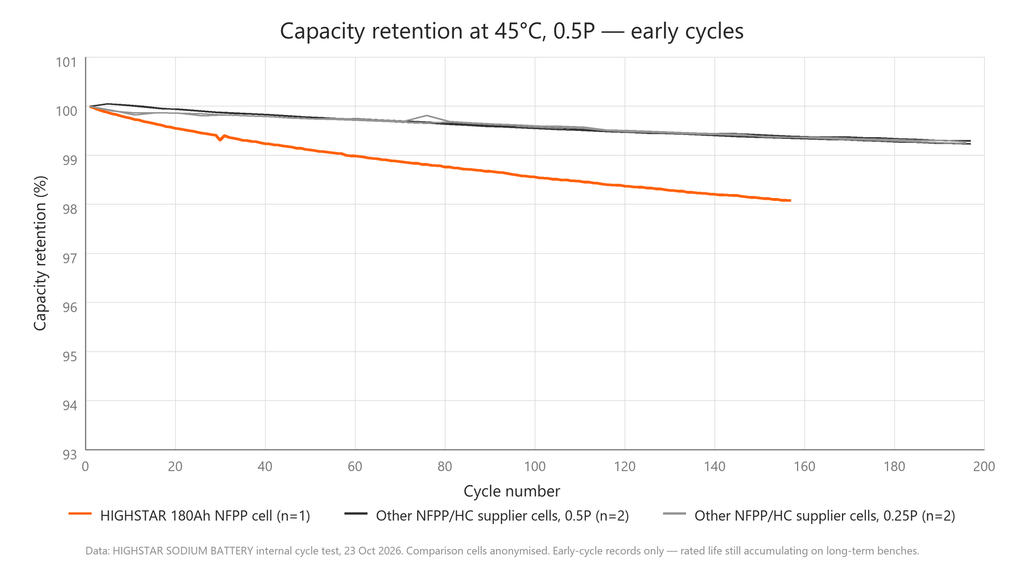
| 45°C, 0.5P | StarNa 180E3, n=1 | ≈98.1% at cycle ~157 (record ends early) | Smooth decline, ~1.9% loss over the recorded span |
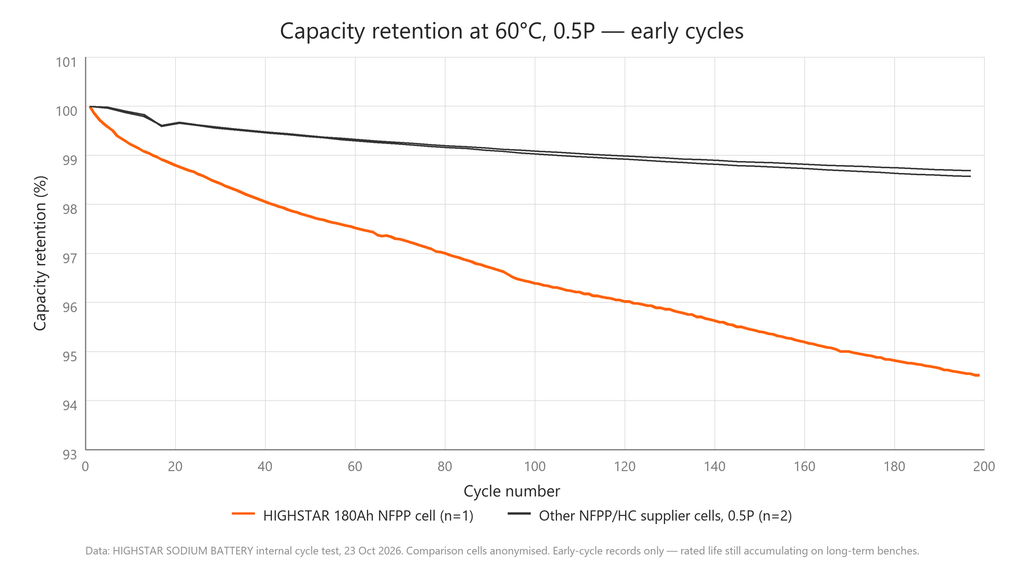
| 60°C, 0.5P | StarNa 180E3, n=1 | ≈94.5% at cycle 200 | Steepest of the three: ~5.5% loss, front-loaded in the first ~40 cycles |
Three observations that matter for system design:
1. Room temperature is a non-event. At 25°C the cell loses roughly one percent of capacity over 200 daily-equivalent cycles. For a storage asset that cycles once a day, that is a fade rate your degradation budget can absorb for a decade without redesigning the energy margin.
2. 45°C costs about one extra percentage point over the same span. Retention ends near 98.1% around cycle 157 where this particular record stops (the cell continues on test; the trace published here simply ends earlier than the 25°C and 60°C traces). For containerised systems in warm climates, that difference versus 25°C is the price of running without aggressive cooling — a real, but bounded, cost.
3. 60°C is honest work, not a marketing claim. The 60°C trace drops to roughly 94.5% by cycle 200, with most of the loss arriving in the first 40 cycles before the slope flattens. This is the number to plan around for desert installations, south-facing cabinets and any site where cell temperature cannot be held below 60°C: budget a larger initial capacity margin, or invest in cooling, and the rest of the curve behaves.
How the cell sits against other NFPP/hard-carbon samples
The same campaign cycled anonymous NFPP/hard-carbon comparison cells (n=2–3) from other suppliers at 0.5P and 0.25P under the same protocol. The picture differs by temperature: at 25°C the comparison group holds a modest edge (their traces sit roughly 0.5–0.8 percentage points above the 180E3 at cycle 200); at 45°C the gap widens to about 1.2–1.4 points (comparison traces near 99.2–99.4% against the 180E3’s 98.1% at the end of its record); at 60°C the comparison group degrades far more slowly, ending near 98.6% versus the 180E3’s ~94.5%. We publish this because it is the most useful sentence in the document for a buyer: at sustained 60°C the current 180Ah generation trades capacity retention for its other properties, and any vendor whose 60°C curve looks flat at this cycle count is either cooling the cell or not publishing the trace. Where your application sits on the temperature axis should decide which cell you qualify.
Round-Trip Efficiency: 25°C, 45°C and 60°C Over 200 Cycles
| Condition | Round-trip efficiency band (measured) |
|---|---|
| 25°C, 0.5P (cell 012#) | ≈95.9–96.1%, stable across 200 cycles |
| 45°C, 0.5P (cell 0056#) | ≈97.0%, flat from cycle 1 to ~157 |
| 60°C, 0.5P (cell 028#) | ≈92.8–93.2%, drifting down ~0.4 point over 200 cycles |
Round-trip efficiency is where the money actually is in arbitrage duty cycles: every point of efficiency is margin earned twice a day, every day, for years. Two things stand out in these traces. At 45°C the cell is at its most efficient (~97%), because elevated temperature lowers internal resistance — the same 0.2235 mΩ measured average reported in the launch test data works even harder when warm. At 60°C efficiency settles near 93%, still above the ≥93% requirement line recorded in the July 2026 report, and the drift over 200 cycles is under half a percentage point. At 25°C the ~96% band matches the specification’s standard-condition expectation.
The practical takeaway: if your business case is daily cycling under a time-of-use tariff, the efficiency story holds from 25°C to 45°C without cooling investment; at sustained 60°C you give up roughly three points of round-trip efficiency plus the faster capacity fade above, which is why thermal design — not cell selection alone — sets the economics of hot-climate storage.
The Storage Test Nobody Publishes: 6 Months at 60°C, Fully Charged
Calendar ageing at full state of charge is the harshest realistic storage condition, and it is the one most relevant to two common situations: spares banked in a hot warehouse, and standby banks that sit charged for months (telecom backup, UPS-style duty). The campaign held two 180E3 lots (67 and 52) at 100% SOC and 60°C for six months, with before/after measurements at 28-day checkpoints:
| Lot | Capacity retention after 6 months @60°C, 100% SOC | Charge-energy recovery | Discharge-energy recovery |
|---|---|---|---|
| 67 | 90.15% | 91.44% | 91.06% |
| 52 | 90.06% | 91.44% | 91.16% |
Two lots, same answer: about 10% of capacity after half a year parked hot and full. Cell thickness grew from ~71.4–71.8 mm to ~72.0–73.1 mm and internal resistance stayed essentially flat (0.201→0.214 mΩ and 0.207→0.214 mΩ respectively), which is consistent with calendar-side SEI-type growth rather than mechanical damage. Read this table as an operating instruction, not a boast: storing sodium-ion cells at 60°C and full charge for months costs you about a tenth of the capacity — so don’t. Ship and warehouse at partial state of charge (the specification’s 2.5–2.7V shipping window and one-year shelf life at 0–35°C exist precisely for this), keep standby banks on a maintenance-charge routine, and reserve the 60°C envelope for operating duty where the cells are cycling and earning, not sitting.
What This Means for System Designers: Five Practical Rules
- Size the fade into the energy margin. Use ~1%/200 cycles at 25°C and ~5.5%/200 cycles at sustained 60°C as planning inputs; do not apply a single “cycle life” number across climates.
- Let temperature pick the cooling budget. Between 25°C and 45°C the cell gains efficiency and loses little retention; above that, cooling pays for itself in both retention and efficiency.
- Treat 60°C full-charge storage as prohibited inventory practice. Partial-SOC warehousing per the shipping specification is the cheap fix for a 10%-per-half-year problem.
- Calibrate SOC with coulomb counting. The flat voltage plateau that makes these retention curves smooth also makes open-circuit-voltage SOC estimation unreliable — a standard sodium-ion integration rule that these curves reconfirm.
- Ask every vendor for the curve, not the sticker. Early-cycle shape, sample counts and test conditions (rate, temperature, SOC window) are the only comparable units; a datasheet cycle count without them is not data.
Frequently Asked Questions
How much capacity does the 180Ah sodium-ion cell lose in the first 200 cycles?
About 1% at 25°C (≈99.0% retention at cycle 200), about 1.9% at 45°C over the recorded span to ~cycle 157, and about 5.5% at sustained 60°C (≈94.5% at cycle 200), all at 0.5P.
What is the round-trip efficiency of this sodium-ion cell?
Measured bands: ≈95.9–96.1% at 25°C, ≈97.0% at 45°C, ≈92.8–93.2% at 60°C, stable over 200 cycles at 0.5P.
Can these cells be stored long-term at high temperature and full charge?
They survive it — about 90% capacity after 6 months at 60°C and 100% SOC — but we recommend against it: warehouse and ship at partial state of charge per the specification (2.5–2.7V shipping window, one-year shelf life at 0–35°C) and use the maintenance-charge routine for idle inventory.
Is the 6,000-cycle rating shown in these curves?
No. These are early-cycle records (first ~200 cycles). The rated life — 6,000 cycles at ≥80% energy retention and 10,000 at ≥70% at 25°C — is being accumulated on long-term benches; long-term traces will be published as they mature, and samples are available for independent verification now.
How do I get test samples and the raw data?
Sample applications are open at HIGHSTAR SODIUM BATTERY. Every sample ships with the specification sheet and the measured test report; quantities, lead time and commercial terms are arranged with your sales representative via www.highstar-sodium.com.
References
- HIGHSTAR SODIUM BATTERY. StarNa 180E3 supplier-comparison cycle-life campaign, internal test charts, 23 October 2026: capacity retention at 25°C / 45°C / 60°C (0.5P), round-trip efficiency at 25/45/60°C (cells 012#, 0056#, 028#).
- HIGHSTAR SODIUM BATTERY. 60°C full-charge storage record, lots 67 and 52, 6-month checkpoints, 9.11–10.28 window.
- HIGHSTAR SODIUM BATTERY. NaCP71173208-180E3 Test Report, 30 July 2026 (efficiency requirements, 0.2235 mΩ measured internal resistance, abuse-test results).
- HIGHSTAR SODIUM BATTERY. NaCP71173208-180E3 Product Specification Sheet, ECN No. Q/KAGG1701-2026 (cycle rating, shipping window, clamping and storage rules).
- HIGHSTAR SODIUM BATTERY official website: www.highstar-sodium.com