Why the 160Ah NFPP Sodium-Ion Cell Is a Better Choice Than the 314Ah LFP Cell in 2026
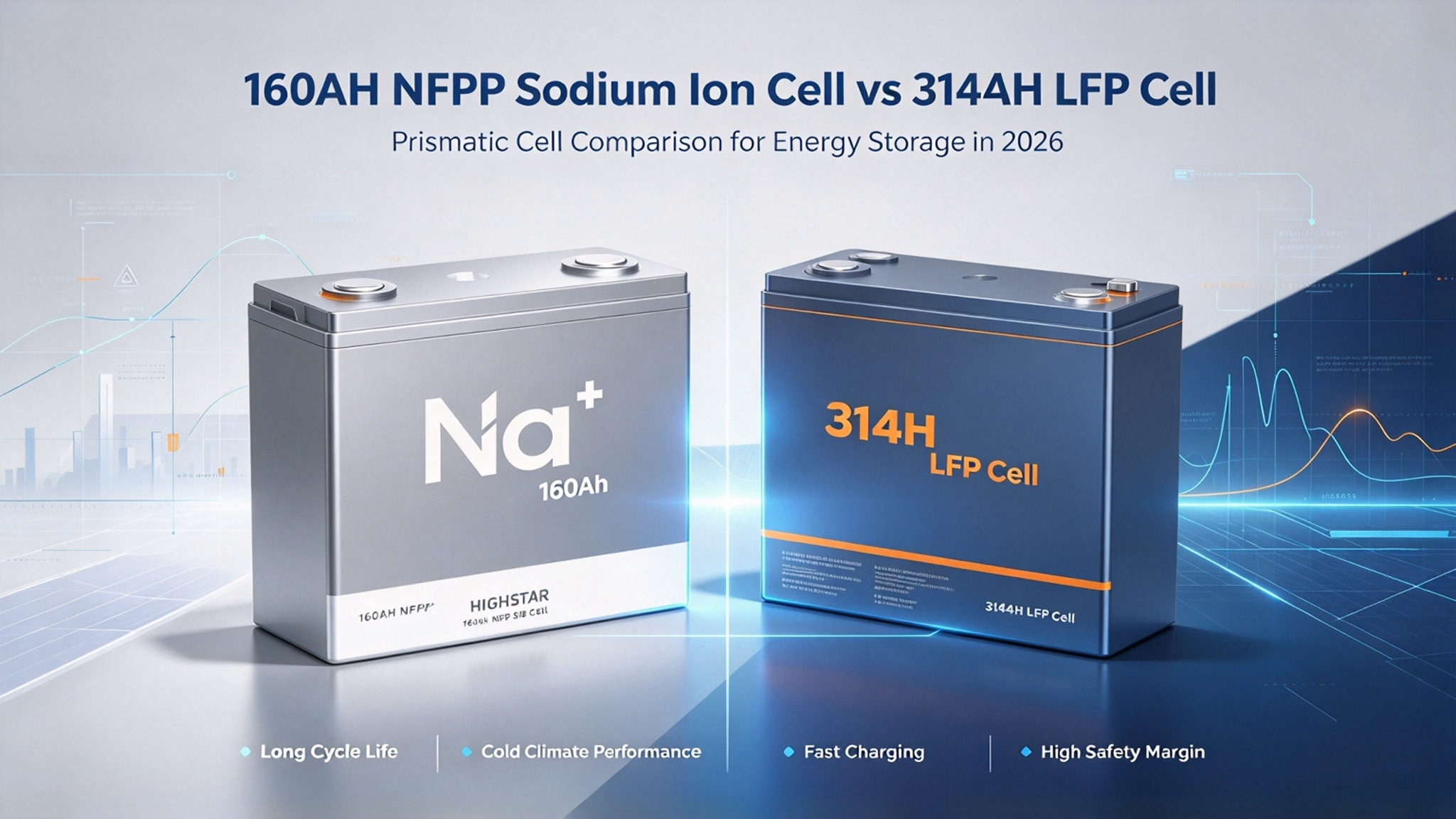
The 314Ah LFP (lithium iron phosphate) cell has long been the benchmark for household, industrial, and low-voltage energy storage. But as NFPP (sodium-ion) technology moves into mass production in 2026, a head-to-head cell- and pack-level comparison shows that the 160Ah NFPP sodium-ion (SIB) cell is not a smaller copy of LFP — it is a purpose-built alternative that wins decisively in cold climates, high-safety environments, fast-charging duty cycles, and long-life applications.
This guide compares the 314Ah LFP cell against the 160Ah NFPP sodium-ion cell — dimension by dimension, cycle by cycle, and at both the cell level and the 48V pack level — so you can choose the right chemistry for your 2026 project.
Table of Contents
- Cell-Level Comparison: 314Ah LFP vs 160Ah SIB
- Pack-Level Comparison: 48V LFP vs 48V SIB
- Where the 160Ah NFPP SIB Wins in 2026
- Where the 314Ah LFP Still Fits
- FAQ
1. Cell-Level Comparison: 314Ah LFP vs 160Ah SIB
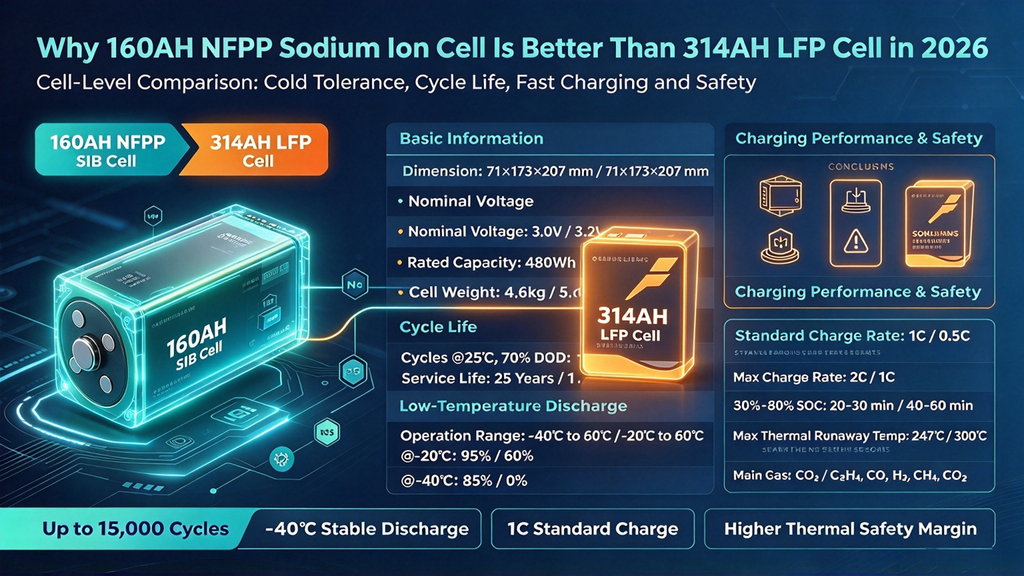
Both cells share the identical prismatic footprint of 71 × 173 × 207 mm, which is what makes a like-for-like pack swap possible. The differences lie in chemistry, voltage, energy, temperature tolerance, cycle life, and safety.
Basic Specifications
| Item | 314Ah LFP Cell | 160Ah NFPP SIB Cell |
|---|---|---|
| Dimension | 71 × 173 × 207 mm | 71 × 173 × 207 mm |
| Nominal Voltage | 3.2 V | 3.0 V |
| Rated Energy | 1005 Wh | 480 Wh |
| Energy Density (Cell) | 170 Wh/kg | 103 Wh/kg |
| Energy Density (Pack) | 120 Wh/kg | 110 Wh/kg |
| Cell Weight | 5.6 kg | 4.6 kg |
Read-out: LFP still leads on gravimetric energy density (170 vs 103 Wh/kg at cell level). But at the pack level the gap narrows sharply (120 vs 110 Wh/kg), because the sodium-ion pack needs less thermal-management and structural overhead for its operating envelope.
Cycle Life & Service Life
Tested at 25 °C, 70% DOD:
| Item | 314Ah LFP Cell | 160Ah NFPP SIB Cell |
|---|---|---|
| Cycle Life @25 °C, 70% DOD | 8,000 cycles | 15,000 cycles |
| Service Life | 15 years | 25 years |
The 160Ah SIB delivers roughly 1.9× the cycle life and a 25-year service life versus 15 years for LFP — a decisive advantage for daily-cycled energy storage where levelized cost (LCOS) matters more than upfront Wh/kg.
Low-Temperature Discharge
| Item | 314Ah LFP Cell | 160Ah NFPP SIB Cell |
|---|---|---|
| Operating Temperature Range | –20 °C ~ 60 °C | –40 °C ~ 60 °C |
| Discharge Capacity @ –20 °C | 60% | 95% |
| Discharge Capacity @ –40 °C | 0% | 85% |
This is the single biggest gap. At –20 °C the LFP cell falls to 60% capacity while the SIB holds 95%; at –40 °C the LFP cell cannot discharge at all (0%) while the SIB still delivers 85%. No heating system is needed for SIB operation in cold climates.
Charging Performance
| Item | 314Ah LFP Cell | 160Ah NFPP SIB Cell |
|---|---|---|
| Standard Charging Rate | 0.5C | 1C |
| Max Charging Rate | 1C | 2C |
| 30%→80% SOC Charging Time | 40–60 minutes | 20–30 minutes |
Sodium ions have lower solvation energy and faster diffusion, so the 160Ah SIB charges in 20–30 minutes versus 40–60 minutes for LFP — nearly twice as fast — and accepts up to 2C maximum charging versus 1C.
Thermal Runaway & Safety
| Item | 314Ah LFP Cell | 160Ah NFPP SIB Cell |
|---|---|---|
| Peak Temperature During Thermal Runaway | 300 °C | 247 °C |
| Gas Analysis | C₂H₄, CO, H₂, CH₄, CO₂ | CO₂ only |
During abuse-driven thermal runaway, the SIB peaks at 247 °C versus 300 °C for LFP, and its vented gas is dominated by CO₂ only — versus LFP’s mixture containing combustible gases (C₂H₄, H₂, CH₄) plus CO. This materially lowers fire and explosion risk at the material level.
2. Pack-Level Comparison: 48V LFP vs 48V SIB
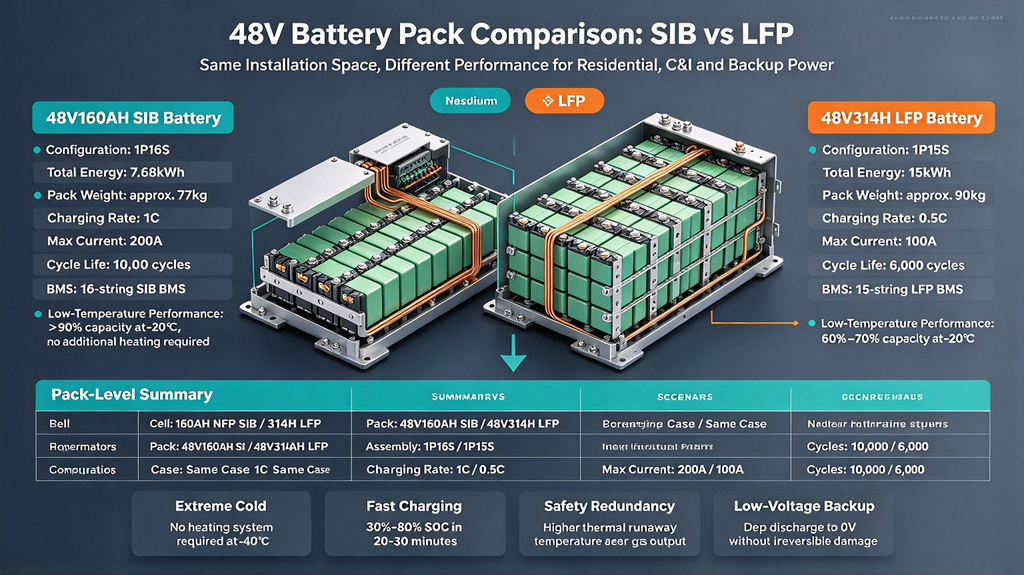
Because both cells share the same 71 × 173 × 207 mm prismatic footprint, they can drop into the same 48V pack case. The difference is in series configuration, electrical parameters, and BMS requirements.
48V314Ah LFP Pack (1P15S)
- Configuration: 15 series / 1 parallel (1P15S), giving 48V 314Ah — the mainstream, mature architecture for household and industrial low-voltage storage.
- Electrical parameters: System nominal voltage 48 V; working range 37.5 V – 54.75 V; total capacity 314 Ah; total system energy ≈ 15 kWh, fully covering the voltage compatibility window of 48 V storage equipment.
- Integration: Each cell weighs ≈ 5.5 kg; total pack weight ≈ 90 kg. Cells are fixed with ABS independent card trays and 304 stainless-steel straps, with a 2 mm thermal-expansion gap between cells to prevent vibration displacement and thermal-expansion cracking.
- BMS & accessories: A 15-string LFP BMS supporting 0.5C continuous charge/discharge, 150 A peak. 16 mm² (or larger) copper-core cables; compatible with 5–7 kW inverters, covering typical household backup loads.
- Implementation advantages: No parallel strings, eliminating multi-string circulating-current risk. Cell matching requires only ≤ 1 Ah capacity spread and ≤ 0.05 mΩ internal-resistance spread; pack cycle life exceeds 8,000 cycles, with long-term operating voltage spread held within 10 mV.
48V160Ah SIB Pack (1P16S)
- Configuration: 16 series / 1 parallel (1P16S), giving 48V 160Ah.
- Electrical parameters: System nominal voltage 48 V; working range 24 V – 58.4 V; total capacity 160 Ah; total system energy ≈ 7.68 kWh.
- Integration: Each cell weighs ≈ 4.5 kg; total pack weight ≈ 77 kg. Structural parts can be reused from the standard 48V314Ah package dimensions — no re-tooling required — and it fits the existing storage-cabinet installation space.
- BMS & accessories: A 16-string SIB-specific BMS that matches the sodium-ion voltage curve, supports the wide-temperature characteristics of sodium chemistry, and provides charge/discharge protection at –40 °C. 10 mm² copper-core cables; compatible with 3–5 kW inverters.
- Implementation advantages: Starts normally without auxiliary heating at –20 °C with capacity retention above 90%, and delivers three times the discharge power of the 48V LFP pack at low temperature — directly solving the northern-winter freezing problem.
Pack-Level Summary
| 314Ah LFP Pack | 160Ah NFPP SIB Pack | |
|---|---|---|
| Cell | 314Ah LFP | 160Ah NFPP Sodium-Ion |
| Pack | 48V314Ah LFP Battery | 48V160Ah SIB Battery |
| Assembly | 1P15S | 1P16S |
| Capacity / Energy | 15 kWh | 7.68 kWh |
| Pack Case | Same case | Same case |
| Charging Rate | 0.5C | 1C |
| Max Current | 100 A | 200 A |
| Cycle Life (Pack) | 6,000 cycles | 10,000 cycles |
| BMS | LFP BMS | SIB BMS |
Key takeaway: The SIB pack uses the same mechanical case as the LFP design but nearly doubles the max current (200 A vs 100 A) and charges at 1C versus 0.5C, while reaching 10,000 pack cycles versus 6,000.
3. Where the 160Ah NFPP SIB Wins in 2026
The 160Ah NFPP sodium-ion cell and its 48V160Ah pack have built differentiated advantages in high-temperature operation, low-temperature operation, fast-charging performance, and safety redundancy — making them the better choice in cold, hot, and high-security scenarios.
Outstanding Cold-Weather Performance — No Heater Needed
- At –20 °C: 160Ah SIB capacity retention exceeds 90%, while the 314Ah LFP holds only 60%–70%. No winter range loss or charging stall.
- At –40 °C: The SIB still discharges stably with retention above 88%. No battery heating system is required, directly saving the energy and hardware cost of LFP low-temperature heating — the preferred solution for high-altitude sites and communication base stations.
Faster Charging and More Stable High-Rate Discharge
- Sodium ions have lower solvation energy and faster diffusion, so the 160Ah SIB reaches 30%→80% in 20–30 minutes — nearly twice as fast as equivalent LFP — for significantly better energy-replenishment efficiency.
- Under high-rate discharge the response is faster and peak power output more stable. Unlike the 314Ah LFP, the SIB does not show accelerated capacity decay after prolonged fast charging.
Higher Safety Redundancy, Lower Thermal-Runaway Risk
- The SIB’s thermal-runaway trigger temperature exceeds 247 °C — about 50 °C higher than the 314Ah LFP. In abuse tests (puncture, crush, overcharge), most configurations achieve smoke-free, fire-free operation, reducing fire and explosion risk at the material level.
- The dominant off-gas is CO₂, with no explosive, vigorous reaction. The safety margin is much higher than the 314Ah LFP for household energy storage and densely populated scenarios.
Friendlier Low-Voltage Behavior — No Over-Discharge Anxiety
- The 160Ah SIB supports deep discharge: draining to 0 V does not cause irreversible cell damage. It will not “starve” even after months of idle storage, and its monthly self-discharge rate is far lower than the 314Ah LFP — making maintenance extremely easy in remote and backup-power applications.
- Both positive and negative electrode current collectors can use low-cost aluminum foil, with no dependence on LFP-specific copper foil. This further simplifies the material system and eases long-term recycling and environmental disposal.
Where the 314Ah LFP Still Fits
For balance, the 314Ah LFP cell remains the right choice where energy density is the dominant requirement:
- Electric vehicles (EVs) and mobile applications where Wh/kg directly determines range.
- Large-scale grid energy storage projects that prioritize maximum Wh per kilogram and per cubic meter.
The 160Ah SIB, by contrast, is the better fit for high-temperature areas, cold regions, telecom sites, AIDC (AI data-center) backup, commercial & industrial storage, and residential storage with extremely high safety-redundancy requirements.
FAQ
Is a 160Ah sodium-ion cell really better than a 314Ah LFP?
“Better” depends on the scenario. The 314Ah LFP still wins on energy density (170 vs 103 Wh/kg) and absolute pack energy (15 vs 7.68 kWh per 48V pack). The 160Ah NFPP sodium-ion wins decisively on cycle life (15,000 vs 8,000), service life (25 vs 15 years), low-temperature performance (85% at –40 °C vs 0% for LFP), fast charging (20–30 min vs 40–60 min), and safety (CO₂-only off-gas).
Can a 48V160Ah sodium-ion pack replace a 48V314Ah LFP pack?
Mechanically, yes. Both cells share the same 71 × 173 × 207 mm prismatic footprint, so the SIB pack reuses the same case and cabinet mounting with no re-tooling. Electrically, the SIB pack uses a 1P16S configuration and requires a SIB-specific BMS tuned to the sodium voltage curve and –40 °C protection, plus 10 mm² cabling matched to 3–5 kW inverters.
How does sodium-ion perform at –40 °C compared to LFP?
At –40 °C the 160Ah SIB still delivers 85% of its capacity (and above 88% in pack-level deep-discharge use), whereas the 314Ah LFP drops to 0% and cannot discharge. At –20 °C the SIB holds ~95% (above 90% in pack use) versus only 60% for LFP. No auxiliary heater is required.
Is sodium-ion safer than LFP in thermal runaway?
In this comparison, the SIB peaks at 247 °C during thermal runaway (vs 300 °C for LFP) and emits CO₂ only, versus LFP’s mix of C₂H₄, CO, H₂, CH₄ and CO₂. In puncture, crush, and overcharge abuse tests, most SIB configurations remain smoke-free and fire-free.
Why does sodium-ion charge faster than LFP?
Sodium ions have lower solvation energy and faster diffusion kinetics than lithium ions. The 160Ah SIB accepts 1C standard / 2C max charging and reaches 30%→80% SOC in 20–30 minutes, versus 0.5C / 1C and 40–60 minutes for the 314Ah LFP.
What is the cycle life of the 160Ah NFPP sodium-ion cell?
At 25 °C and 70% DOD, the cell reaches 15,000 cycles with a 25-year service life, versus 8,000 cycles and 15 years for the 314Ah LFP. At the 48V pack level, this translates to roughly 10,000 SIB pack cycles versus 6,000 LFP pack cycles.
Does a sodium-ion battery suffer over-discharge damage?
No. The 160Ah SIB tolerates deep discharge down to 0 V without irreversible damage, has a much lower monthly self-discharge rate than LFP, and survives months of idle storage — making it ideal for remote sites, telecom standby, and UPS backup.
Conclusion
In 2026, the choice between the 160Ah NFPP sodium-ion cell and the 314Ah LFP cell is no longer “newer vs older” — it is a chemistry match to the duty cycle:
- Choose 314Ah LFP when energy density and per-kWh volumetric efficiency dominate (EVs, ultra-large grid storage).
- Choose 160Ah NFPP SIB when you need 25-year life, –40 °C operation without heating, near-2× faster charging, 200 A pack current, CO₂-only off-gas safety, and 0 V over-discharge tolerance — across telecom, AIDC/UPS, C&I storage, residential systems, and cold or high-safety environments.
Because both cells share the same 71 × 173 × 207 mm prismatic case, switching from LFP to NFPP sodium-ion in 2026 is a drop-in mechanical upgrade, not a redesign — the only true change is the BMS.