
2.3MWh Sodium-Ion Storage at Three German Factories: A HIGHSTAR Sodium Battery Success Story

HIGHSTAR SODIUM BATTERY has deployed its 2.3MWh sodium-ion containerized energy storage system at three factory sites of Isel-automation in Germany. Each site is configured at 1.25MW / 2.3MWh, using 160Ah NFPP prismatic cells, liquid cooling, and layered fire protection, with Salzstrom handling on-site delivery and operations. This is a verifiable industrial energy storage success story — not a single demonstration unit.
HIGHSTAR SODIUM BATTERY is a manufacturer focused on NFPP sodium-ion cells and energy storage systems. The NA-CTESS-2300 is its 2.3MWh containerized storage product for industrial park microgrids and self-consumption of rooftop solar.
Project Overview: Three Sites, One Replicated Configuration
What matters most in this project is not a single specification, but the ability to replicate the same model and configuration across three consecutive sites. For an industrial park owner, replicability means the design, spare parts, O&M manuals, and commissioning process can be reused rather than starting from scratch at every site.
| Project element | Detail |
|---|---|
| Case type | HIGHSTAR SODIUM BATTERY success story; three factories, identical configuration |
| End user | Isel-automation, an industrial company in Germany |
| Number of sites | 3 factory parks |
| Existing solar per site | 500kW rooftop PV |
| Storage per site | 1.25MW / 2.3MWh sodium-ion containerized ESS |
| Battery system | HIGHSTAR NA-CTESS-2300, 160Ah NFPP prismatic cells |
| DC architecture | 1P416S, nominal 1198V |
| Protection & thermal management | Liquid cooling, IP54, C5 corrosion protection, automatic fire suppression |
| Delivery split | HIGHSTAR supplies the DC-side battery system; Salzstrom handles on-site delivery and operations |
Note: the project brief states 7.2MWh across three sites; 2.3MWh × 3 sites equals 6.9MWh. The official figure should follow the project party’s confirmed documentation.
The load profile at the three factories is typical: rooftop solar generates during the day, nighttime demand remains significant, and generation and load curves are misaligned. The storage system here is not designed for short, high-rate response, but for one full charge-discharge cycle per day and more than a decade of continuous park-level regulation.

Why Sodium-Ion: Three Considerations for the Park Scenario
The selection logic here was not “replace lithium with sodium,” but matching battery characteristics to the park load. For factory sites with one cycle per day and a service life beyond ten years, cycle life, temperature window, and material dependency matter more than instantaneous power.
- Cycle life. The cell is rated for over 15,000 cycles at cell level; the system is rated for no less than 10,000 cycles at 25°C and 70% DoD, with a 10-year warranty. These figures come from the product datasheet; actual life depends on temperature, depth of discharge, and dispatch strategy, so buyers should request warranty terms for the corresponding operating conditions.
- Temperature window. The system is specified for charging at 0–55°C, discharging at −20–60°C, and storage at −20–40°C. Winter ambient temperatures below −10°C are not uncommon at some German sites; as long as the minimum site temperature does not fall below −20°C, discharge remains within specification. Sub-zero charging is a project-level question and cannot be answered with nominal parameters alone.
- Material cost. The NFPP cathode contains no lithium, cobalt, or nickel, reducing the cell cost’s coupling to lithium carbonate price indexes. For park owners planning depreciation over a decade or more, this reduces the uncertainty of “upfront cost determined by an external price index.”
How Safety Is Implemented: From Intrinsic Material Safety to System Protection
This case breaks safety down into three verifiable layers: intrinsic material safety, layered fire defense, and liquid cooling with structural protection. Each layer has clear boundaries, and each comes with documents a buyer should ask the supplier about.
Material layer: NFPP lowers the starting risk but does not replace system-level validation
The NA-CTESS-2300 uses a sodium iron phosphate pyrophosphate (NFPP) cathode, free of lithium, cobalt, and nickel. According to product materials, the cell passes a nail-penetration test without fire or explosion. This is a valuable cell-level conclusion, but it is not equivalent to a system-level conclusion.
System-level safety also depends on module structure, high-voltage connections, thermal runaway propagation barriers, detection and venting logic, fire suppression interlocks, and O&M strategy. A technical review should ask specifically: what was tested, against which standard, what the report number is, and whether the test conditions are close to real operating conditions. Intrinsic material safety lowers the starting risk but cannot replace system-level protection.
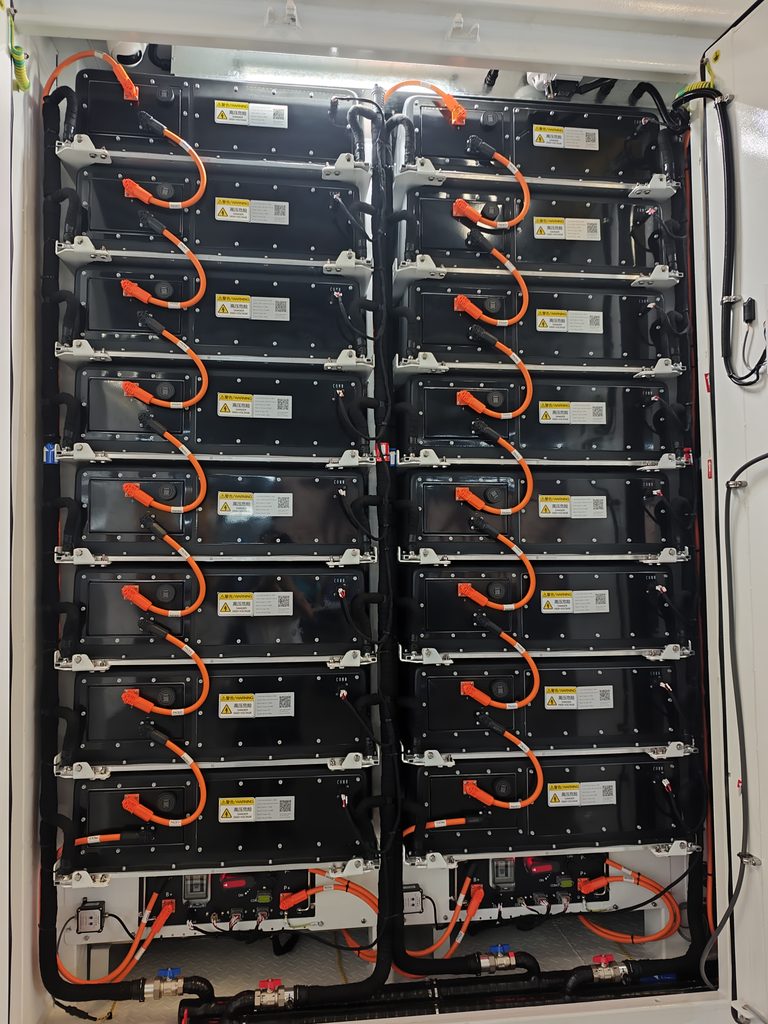
Fire layer: layered configuration, not simply “it has an extinguisher”
The product materials list three explicit mechanisms: PACK-level detection and venting, compartment-level passive gas suppression, and water-spray interlock; the system is also noted as having an automatic fire suppression system, described in the materials as a “four-layer design.” The specific definition of the fourth layer is not detailed in the materials and should follow the project’s fire protection documentation.
For German industrial parks, energy storage approvals are often accompanied by fire-safety questions. Reviewers care about detection, suppression, isolation, interlocks, and the action logic under auxiliary power failure — not a vague claim of “having fire protection.” The project FAQ also mentions that PACK-level detection can operate without external power; this matters for auxiliary power failure scenarios, but it should be captured in drawings, test reports, or the fire protection plan rather than verbal statements.
Test reports and certification documents must also be distinguished: UL 9540A is a test method that produces a report, not a certificate; UL 1973 and IEC 62619 are certification-type documents. Give the reviewer the report when a report is requested, and the certificate when a certificate is requested — the two cannot substitute for each other.

Thermal management and structure: liquid cooling, IP54, and C5 corrosion protection
The system uses low-resistance liquid cooling, with coolant removing heat from inside the PACK rather than relying on compartment air circulation. This narrows the temperature difference between cells and makes high-season degradation and low-season available capacity more controllable. The materials do not provide a complete power derating curve; during selection, buyers should request the high-temperature derating point and the corresponding operating conditions.
Structural and protection parameters are also part of the safety checklist: IP54, C5 corrosion protection, 75dB, dimensions of 6058 × 2550 × 2896mm, and a weight of no more than 43t. CAN, RS485, and TCP-IP communication interfaces make it easy to integrate with park monitoring and dispatch systems.

How Delivery Works: What HIGHSTAR and Salzstrom Each Handle
The delivery boundary in this project is clear: HIGHSTAR is responsible for the DC-side battery system, while Salzstrom is responsible for on-site implementation and long-term operations. This division answers a common concern among overseas owners — once Chinese equipment arrives in Europe, who is responsible for commissioning it.
- Factory assembly and functional testing. Cell grouping, PACK assembly, liquid cooling pipe connections, fire protection installation, and full-system functional testing are all completed in the factory.
- Whole-unit shipping. The system ships as a complete container with accompanying documentation; the specific shipping method and declaration follow the project logistics plan.
- Site arrival and positioning. On arrival, the unit is lifted into place and connected to the AC-side cables and communication lines.
- Commissioning and grid connection. Salzstrom completes system commissioning, grid interconnection testing, and operating strategy configuration.
- Operations management. After commissioning, Salzstrom manages operations, with HIGHSTAR providing technical support at the battery system level.
According to the product materials, on-site installation time can be reduced by about 40%; the actual schedule is still constrained by civil works, grid approval, and fire inspection. Interfaces must be frozen in advance: communication protocols, start-stop logic, protection settings, and fault-signal point lists — leaving any of these to be discussed on site can turn into schedule delays.

What Buyers Should Verify: Four Numbers
Before replicating this project, confirm four numbers rather than looking only at the 2.3MWh nameplate figure.
- Capacity basis. The project brief states 7.2MWh across three sites, while 2.3MWh/site × 3 sites equals 6.9MWh. Keep a note of the discrepancy rather than picking one number as fact.
- Cluster topology. At 160Ah × 1198V, a single string is about 191.7kWh, roughly 12 times smaller than the nominal 2.3MWh. A reasonable inference is that 1P416S describes a single battery cluster and the full cabinet has about 12 clusters in parallel, but the datasheet does not specify the number of parallel clusters or the total cell count. Buyers should request the full grouping topology diagram, cluster-level fusing, and parallel circulating-current suppression scheme.
- Power matching. At 0.5C continuous charge-discharge, 2.3MWh corresponds to about 1.15MW of DC-side power; this project uses 1.25MW conversion equipment per site, indicating the bottleneck is not on the battery side but in the PCS and grid connection conditions.
- Cycle life. Over 15,000 cell cycles, no less than 10,000 system cycles at 25°C / 70% DoD, and a 10-year warranty are all manufacturer claims. Actual life depends on temperature, depth of discharge, and dispatch strategy; buyers should require warranty terms for the corresponding operating conditions.
Frequently Asked Questions
What battery does the 2.3MWh system use?
It uses HIGHSTAR’s own NaCP71173208-160E3 prismatic sodium-ion cell, with an NFPP cathode and 160Ah capacity per cell. The system is grouped in 1P416S, nominally 1198V and 2.3MWh.
Why do all three factories use the same configuration?
Using the same model allows shared design, spare parts, O&M manuals, and commissioning processes, reducing multi-site management complexity. All three sites in this project use 500kW of PV plus 1.25MW / 2.3MWh of storage, showing the solution was replicated from a single park load model rather than three separate custom designs.
What fire protection does a sodium-ion container ESS need?
The project materials list PACK-level detection and venting, compartment-level passive gas suppression, water-spray interlock, and an automatic fire suppression system. The materials describe a “four-layer design,” but the fourth layer’s definition must follow the project fire protection documentation. Buyers should ask for evidence layer by layer rather than accepting a number.
What do HIGHSTAR and Salzstrom each handle?
HIGHSTAR SODIUM BATTERY supplies the DC-side battery system and is responsible for product performance, documentation, and factory condition. Salzstrom handles equipment arrival, engineering implementation, product commissioning, and operations management, and is responsible for on-site delivery and long-term operation.
How long does on-site installation take?
The system is fully assembled and functionally tested in the factory; on site it only needs to be lifted into place and connected to AC-side cables and communication lines. According to the product materials, installation time can be reduced by about 40%; the actual schedule depends on civil works, grid approval, and fire inspection progress.
Conclusion
The value of HIGHSTAR’s 2.3MWh sodium-ion storage project at three German factories lies not in a single specification, but in replicated configuration, clear safety boundaries, and well-defined delivery responsibilities. For owners evaluating industrial park storage, this case offers a verifiable path: first confirm the boundaries of material and system safety, then check fire protection, thermal management, and topology documentation, and finally write on-site delivery and operations responsibilities into the contract.
To request the NA-CTESS-2300 datasheet or discuss a park solar-plus-storage solution, contact the HIGHSTAR SODIUM BATTERY technical team: info@highstar-sodium.com, or for solution consulting: sales@highstar-sodium.com.
Further Reading
– 2300kWh Container Sodium-Ion BESS product page: full specifications and applications of the NA-CTESS-2300. – What is containerized sodium-ion storage?: basics of NFPP cells, liquid cooling, and fire protection. – 160Ah NFPP sodium-ion prismatic cell product page: cell-level parameters and safety test information. – Contact HIGHSTAR SODIUM BATTERY: submit a project inquiry or document request.
Author: HIGHSTAR SODIUM BATTERY technical content team | Published: November 24, 2026 | Sources: project brief “Container Storage Case – Salzstrom” and the NA-CTESS-2300 product datasheet.
