
HIGHSTAR’s 30 MWh Sodium-Ion System at China’s National Storage Test Base

HIGHSTAR SODIUM BATTERY supplied the 30 MWh sodium-ion battery energy storage system for the dedicated sodium lane at China’s National Advanced Energy Storage Innovation Center in Baiyun District, Guangzhou. Configured at four-hour duration for roughly 7.5 MW on NFPP chemistry, it is one of six battery technologies being measured side by side on a shared 35 kV bus — a rare case where a sodium-ion system is validated against lithium and flow batteries under the same dispatch, the same weather and the same grid faults.
That is the headline: a Chinese sodium-ion manufacturer won a 30 MWh lane inside a national demonstration base, and the data will be public rather than promotional. For buyers evaluating grid-scale sodium storage, this is the kind of reference that changes a procurement conversation — not a claim in a datasheet, but a system under independent measurement.
The project at a glance
| Item | Detail |
|---|---|
| Project | Guangdong integrated storage demonstration for multi-scenario grid resilience |
| Location | Renhe Town, Baiyun District, Guangzhou (Airport Economic Zone South) |
| Investor and site owner | National Advanced Energy Storage Innovation Center (NAESIC) |
| EPC contractor | China Energy Engineering Group Guangdong Electric Power Design Institute |
| Total site scale | 300 MW / 600 MWh |
| Phase 1 built and connected | 150 MW / 300 MWh, energised January 2026 |
| Commercial operation | September 2026, after a 168-hour trial run |
| Grid connection | 110 kV booster station |
| Technology lanes | LFP, sodium-ion, semi-solid, supercapacitor, vanadium flow, aqueous organic |
| HIGHSTAR sodium-ion unit | 30 MWh, four-hour duration, ~7.5 MW, NFPP chemistry |
| Battery-system supplier | HIGHSTAR SODIUM BATTERY |
| Article status | Written November 2026; verification data not yet published |
Two facts behind this table define what the case actually proves.
First, the sodium system is one of six lanes, not a standalone display. The base runs lithium iron phosphate, sodium-ion, semi-solid, supercapacitor, all-vanadium flow and aqueous organic batteries on a shared 35 kV bus through a common architecture the project team calls a “universal socket,” supervised by one EMS. Every chemistry sees the same dispatch curve and the same grid events. A sodium-ion result from this site is therefore comparable with an LFP result from the same site — something two separate vendor reports can never be.
Second, the 30 MWh / four-hour configuration was sized deliberately. Four hours covers one full valley-charge, peak-discharge cycle within a single day, the dominant pattern for independent storage in China’s spot and ancillary-service markets. It leaves enough power headroom for secondary frequency regulation, and it is large enough that a single underperforming rack cannot hide inside the average. This is a scale at which a sodium system must do everything a grid-side asset is asked to do.
The scope boundary, stated once
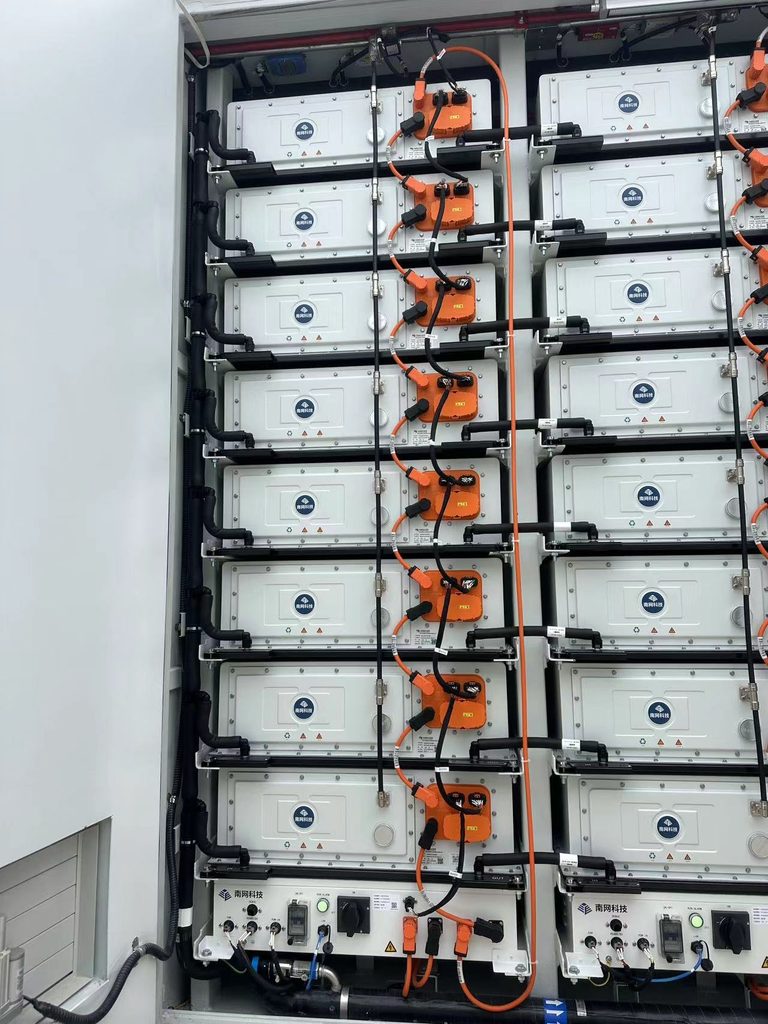
Utility-scale projects have segmented supply chains, and a case study is only useful if the responsibilities are clear. HIGHSTAR supplied the 30 MWh NFPP sodium-ion battery system — cells and battery system — and stands behind that scope, its documentation and its performance. The enclosures were manufactured and integrated by China Southern Power Grid Technology, which is why the containers carry its branding together with the National Advanced Energy Storage Innovation Center logo in the photographs. NAESIC owns the base and runs the verification programme.
This is a normal division on utility-scale work: the battery-system manufacturer delivers the DC side, and the integrator carries the enclosure and site accountability. Our claim in this project is the sodium-ion battery system — not the plant, and not the enclosures. The site’s as-built configuration is governed by the integrator’s published specification.
For a technical reference on the containerised platform HIGHSTAR sells, see the 2300kWh container sodium-ion BESS product page, which documents the NA-CTESS-2300 built on the same NFPP chemistry. It is a sizing reference, not the as-built list for this site.
Hardware: the NFPP platform and a reference specification
The chemistry behind this lane is sodium iron phosphate pyrophosphate (NFPP), a polyanionic iron-based cathode containing no lithium, cobalt or nickel, with aluminium foil usable on both current collectors. HIGHSTAR’s 160Ah NFPP sodium-ion prismatic cell is the production cell at the centre of this platform; our guide to why NFPP suits stationary storage sets out the trade-offs against layered-oxide sodium and LFP.
The parameters below are the published NA-CTESS-2300 reference specification, not the site’s configuration list. They show how this technology route behaves at container scale.
DC and battery parameters (NA-CTESS-2300, per product page)
| Parameter | Value |
|---|---|
| Model | NA-CTESS-2300 |
| Cell | NaCP71173208-160E3, 160 Ah NFPP prismatic |
| Cell chemistry | Sodium iron phosphate pyrophosphate — no lithium, cobalt or nickel |
| Configuration | 1P416S |
| Nominal system voltage | 1198 V |
| Rated energy | 2.3 MWh per container |
| Charge cut-off | 1435.2 V, or any cell reaching 3.45 V |
| Discharge cut-off | 665.6 V, or any cell reaching 1.6 V |
| Standard continuous charge / discharge | 0.5C / 0.5C |
Environmental and mechanical parameters
| Parameter | Value |
|---|---|
| Charge temperature | 0–55 °C |
| Discharge temperature | -20–60 °C |
| Storage temperature | -20–40 °C |
| Thermal management | Liquid cooling, low flow resistance |
| Fire protection | Automatic suppression, four-layer design |
| Ingress protection | IP54 |
| Corrosion class | C5 |
| Noise | 75 dB |
| Dimensions | 6058 × 2550 × 2896 mm |
| Weight | ≤43 t |
| Communication | CAN, RS485, TCP/IP |
At 2.3 MWh per container, 30 MWh corresponds to roughly thirteen containers of capacity (calculated: 30 ÷ 2.3 ≈ 13.0). That is a sizing illustration, not the unit count at this site, which follows the integrator’s design.
Two engineering judgements matter more than the count.
The 0.5C rating is not the binding constraint. At 0.5C continuous, each container delivers about 1.15 MW DC (calculated). A four-hour, roughly 7.5 MW requirement across 30 MWh sits comfortably inside the battery’s continuous rating. On a project like this the bottleneck is the PCS and the grid-connection study, not the cells.
Container count is a maintenance variable, not just a cost variable. Thirteen containers on this platform would mean thirteen replaceable units: any one can be isolated, lifted out and serviced while the rest keep running. For a demonstration site, that granularity lets “something is being examined” and “the plant stays online” both be true at once.

What the sodium lane is actually measuring
The project brief lists five verification tracks. Each maps onto a question a real buyer eventually asks.
1. Long-run performance under a real dispatch curve
The unit runs continuously against actual grid dispatch for 6 to 24 months while four quantities are logged: DC-side round-trip efficiency, usable capacity fade rate, cell-to-cell consistency drift, and auxiliary power consumption as a share of throughput.
The fourth is routinely ignored in datasheets and routinely decisive in economics. A system can show excellent round-trip efficiency at the terminals and still lose several percentage points to pumps, fans and controls running around the clock. On a four-hour asset cycling once a day, that parasitic load compounds over fifteen years.
The programme also separates calendar ageing from cycle ageing — the distinction behind a question every owner asks and few suppliers answer honestly: how much degradation comes from using the battery, and how much from the battery simply existing? The remedies differ: one is a scheduling problem, the other a procurement problem.
2. Grid-interconnection performance
Measured items include primary frequency-response time and accuracy, AGC tracking deviation, reactive power range, and voltage and frequency ride-through. The purpose is to establish whether a sodium-ion system behaves within the envelopes grid codes assume — particularly in weak-grid conditions where short-circuit capacity is low and converter behaviour under disturbance matters more than steady-state efficiency.
3. Grid-forming capability
Under grid-forming control, the unit is tested for inertia support, short-circuit current injection, black start and islanded operation. This is the track where sodium-ion’s high-rate characteristics could become a genuine advantage: a chemistry that delivers high power without the thermal penalty lithium cells carry at the same C-rate has a natural role in power-type support services. Whether it performs there is exactly what the test establishes. Our UL 9540A safety testing explanation covers the underlying cell-level safety case.
4. Safety under realistic failure conditions
Thermal runaway triggering and propagation tests, fire-suppression effectiveness verification, and evaluation of immersion liquid cooling as an alternative thermal-management approach. Operating data is streamed to the Guangdong provincial storage safety supervision platform for pre-warning and emergency response.
The immersion-cooling item is worth flagging: it is not the architecture in the delivered containers — those are liquid-cooled through cold plates and coolant loops, as the photographs show. Immersion is being evaluated at the base as a candidate for future designs.
5. Pre-commercial grid trial
The base offers what the project team calls a grid-trial service: a manufacturer can bring a product that is finalised but not yet in volume production, run it against reproduced real-world grid conditions and typical fault events, and obtain documentation of how it behaved — in effect, a grid-connection passport issued before commercial launch.
For HIGHSTAR this is the most commercially significant of the five tracks. It shortens the distance between a product being technically ready and a grid operator being willing to accept it.

Why the validation route matters more than the megawatt-hours
A 30 MWh order is a respectable reference. What makes this one useful to a buyer in Europe, the Middle East or Southeast Asia is not its size — it is where the results go.
The site was designed to produce documents, not press releases. The base was specified with input from the Ministry of Emergency Management’s safety research institute, TÜV, UL and CQC. The stated objective is a verification framework the participants describe as “certified in China, applicable globally.” Test conclusions from the sodium lane are intended to feed directly into standard drafts rather than stopping at a project report.
That matters because sodium-ion’s weak point has never been laboratory performance. It has been the absence of long-duration, third-party, grid-connected operating data that an insurer, a lender or a grid operator will accept. A cell-level certificate tells a bank relatively little. Eighteen months of dispatch-verified throughput, capacity retention and safety-event logs tell it considerably more.
The output is intended for three downstream uses: an empirical report for independent-storage project applications and grid-company equipment admission; input to standards work on long-duration and high-safety storage; and due-diligence support for leasing and fund investment. Those three uses are almost exactly the three gatekeepers that slow any new chemistry entering a conservative market.

What this four-hour sodium asset implies for your project
Five observations from this deployment that transfer beyond China.
- Four hours is where sodium-ion’s economics start working. At one hour you are buying power and sodium’s energy-density penalty is irrelevant anyway; at eight hours and beyond, capex per kWh and footprint dominate. The four-hour band is where cycle life, wide-temperature operation and lithium-price decoupling pull in the same direction.
- Container count drives your O&M model — decide it early. A thirteen-container installation and a three-container installation need different spares strategies, lifting plans and staffing. On this site the granularity is a design feature; on a constrained urban site it may be a liability.
- Ask for the auxiliary load figure, not just round-trip efficiency. It is the number most likely to be missing from a proposal and most likely to decide whether your business case survives year ten.
- Separate calendar ageing from cycle ageing in the warranty. A supplier who cannot tell you which mechanism dominates under your duty cycle cannot price a warranty honestly.
- Treat grid-forming as a test result, not a feature list. “Grid-forming capable” appears on nearly every datasheet now. Inertia support, black start and islanded operation either work under fault conditions or they do not — ask for the report and the test conditions.
For the wider product context, HIGHSTAR’s sodium-ion storage range spans cells, racks, cabinets and containers; the SALT110 liquid-cooled sodium-ion cabinet shows the same NFPP and liquid-cooling approach at a smaller scale, and our container sodium-ion basics guide explains the architecture in plain terms.
Frequently asked questions
How much sodium-ion storage did HIGHSTAR supply for this project?
A 30 MWh NFPP sodium-ion battery energy storage system, configured at four-hour duration for roughly 7.5 MW. It forms the dedicated sodium-ion technology lane within a 300 MW / 600 MWh national demonstration base in Baiyun District, Guangzhou.
Is this the same as the 2.3 MWh container on your website?
Not exactly, and the distinction matters. This project’s scope was a 30 MWh polyanionic sodium-ion battery system; the containers were manufactured by the integrator, China Southern Power Grid Technology. NA-CTESS-2300 is the containerised platform we sell, built on the same NFPP cell chemistry. At 2.3 MWh per container, 30 MWh corresponds to roughly thirteen containers of capacity — useful for sizing your own site. The as-built unit count follows the integrator’s design.
Are the test results available?
No. The verification programme runs for 6 to 24 months against real dispatch curves, and no verified dataset had been published as of November 2026. This article describes the configuration and the measurement plan, not outcomes. We will publish measured figures when they are released by the operating body.
Why do the containers in the photos carry another company’s logo?
Because China Southern Power Grid Technology is the system integrator and contract counterparty for the site, the containers are branded accordingly alongside the National Advanced Energy Storage Innovation Center logo. HIGHSTAR supplied the sodium-ion battery system inside them. Branding on a utility-scale enclosure normally reflects the integrator or the site owner, not the cell manufacturer.
What chemistry does the system use, and why NFPP?
NFPP — sodium iron phosphate pyrophosphate, a polyanionic iron-based cathode — in 160 Ah prismatic cells. There is no lithium, cobalt or nickel in the cathode, and aluminium foil can be used for current collectors. It is the storage-oriented sodium route: our NFPP versus LFP comparison explains where the advantage lies and where it does not.
Conclusion
HIGHSTAR’s 30 MWh sodium-ion system at China’s national storage test base is a success case measured in scope and method as much as in megawatt-hours: a Chinese sodium manufacturer supplying a dedicated lane inside a 300 MW / 600 MWh national base, validated against five other chemistries under identical grid conditions, with results intended for standards and equipment admission rather than a brochure.
For project owners, the transferable lesson is to buy the validation route as well as the hardware: confirm the chemistry route, ask for auxiliary load and ageing separation, treat grid-forming as a tested behaviour, and write the supply boundary into the record.
To request the NA-CTESS-2300 datasheet, a sizing study or commercial terms, contact HIGHSTAR SODIUM BATTERY: info@highstar-sodium.com, or sales@highstar-sodium.com. You can also send a project enquiry through the contact page.
A note on the data in this article. Site scale, phase dates, technology lanes, verification scope and the supply split come from the project brief and public reporting; product parameters come from the NA-CTESS-2300 datasheet published on our website. Calculated figures are labelled as such. No test results or performance outcomes are claimed, because none have been published.
Author: HIGHSTAR SODIUM BATTERY technical content team | Published: 24 November 2026 | Sources: project brief, public project reporting and the NA-CTESS-2300 product datasheet.
Sources
1. HIGHSTAR SODIUM BATTERY — 2300kWh container sodium-ion BESS product page: https://www.highstar-sodium.com/product/2300kwh-container-sodium-ion-bess/
2. Project brief “Container BESS case — China Southern Power Grid” (supplied by the project team; source for site scale, phase dates, technology mix, sodium-lane configuration and verification scope)
3. China Energy Engineering Group — EPC contractor notice on the Guangdong grid-resilience integrated storage demonstration project: http://www.cpecc.ceec.net.cn/art/2026/1/12/art_29047_2522756.html
4. Polaris Storage — project enters commercial operation after 168-hour trial run: https://chuneng.bjx.com.cn/news/20260908/1511884.shtml
5. National Advanced Energy Storage Innovation Center — background and mandate: https://www.news.cn/20260210/651381a8fbfe43709b48416b8cf0a050/c.html
6. NA-CTESS-2300 product datasheet (HIGHSTAR SODIUM BATTERY)
