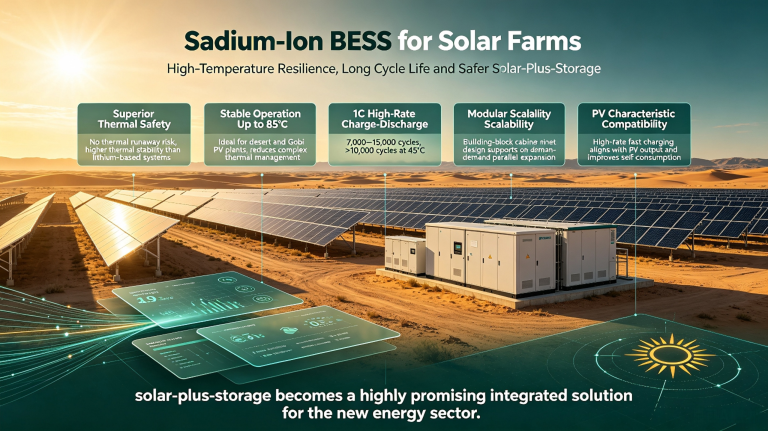
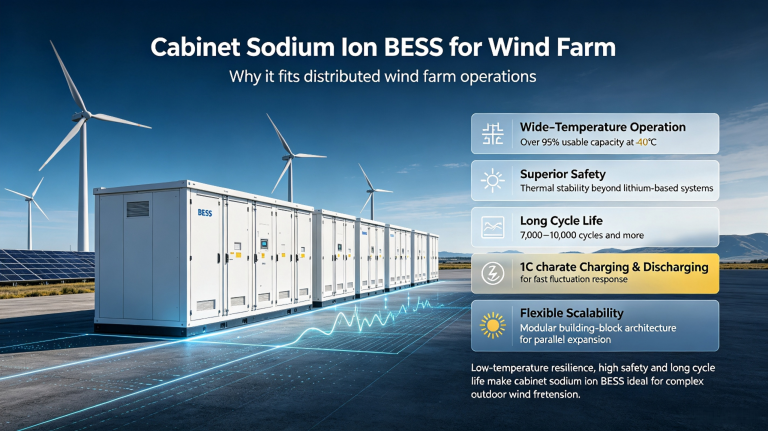
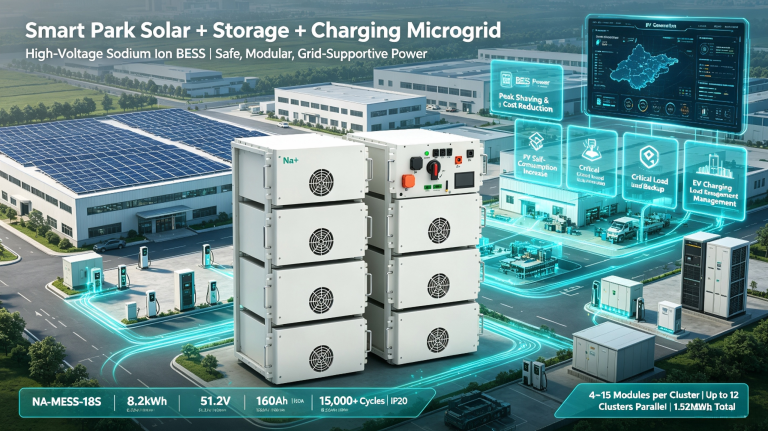
What is container sodium ion BESS?
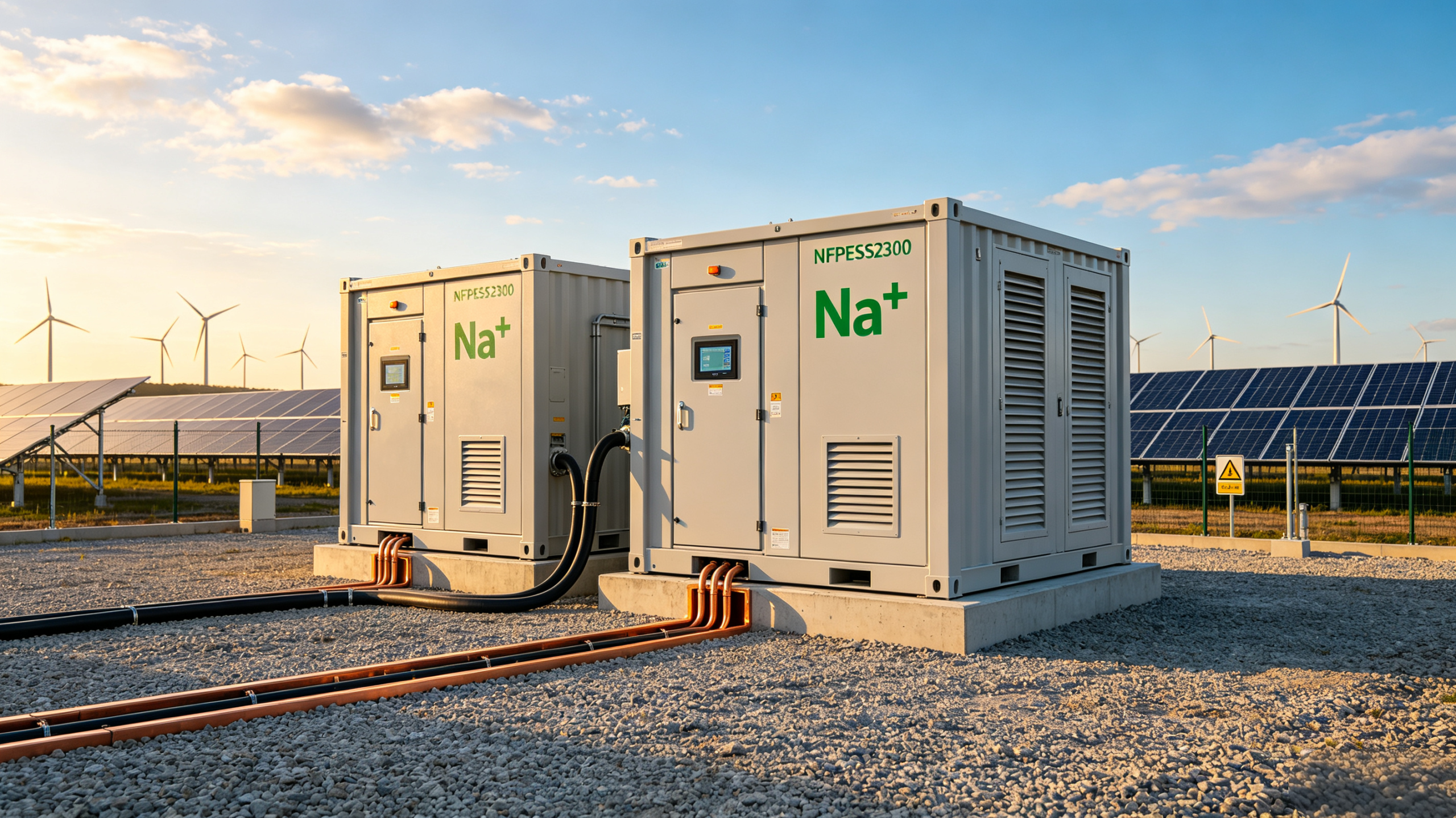
What is container sodium ion BESS?
In 2026, there are fire and explosion incidents of lithium-ion battery container BESS occurred in Poland, UK, USA and other countries. There are still following issues of Li-ion container BESS
1. Lithium-ion batteries are inherently unsafe, posing risks of overheating, explosion, and fire. Factors such as internal short circuits, overcharging, over-discharging, or external crushing can trigger thermal runaway, which rapidly spreads to adjacent modules, which will release large volumes of high-temperature, combustible gases in a short period, causing explosions and fires. Furthermore, lithium-ion battery fires are prone to reignition and are difficult to extinguish completely by using conventional agents.
2. There are compatibility issues in extreme operating environments. At temperatures below -10°C, charge and discharge efficiency drops to 50%. Conversely, at temperatures above 40°C, the electrolyte decomposes more rapidly during charging and discharging, potentially triggering thermal runaway.
3. Poor cell consistency leads to a decline in cycle life and service life. As charge and discharge cycles accumulate, structural collapse of electrode materials and thickening of the SEI layer cause gradual capacity loss. Compounded by inherent initial variations in internal resistance and capacity, these differences widen over time, resulting in poor cell consistency; this reduces the container’s usable capacity and accelerates the degradation of overall performance.
To meet the requirement for safe energy usage, we have developed an extremely safe Container Sodium-Ion BESS, by integrating prismatic sodium-ion cells, and comprehensively redesigning the architecture across the prismatic sodium ion cell, sodium ion battery module, and sodium ion cluster levels—all based on ultra-safe sodium-ion battery technology.
l Designed specifically for containerized energy storage applications, this product provides a safe, reliable, stable, and green power solution that meets safety requirements. Its standout feature is its ability to serve as a easy replacement for “unsafe lithium-ion container energy storage systems,” ensuring stable and reliable power supply even under extreme climatic conditions, such as high or low temperatures.
Why chose solar sodium ion battery?
- Safest NFPP SIB technology, never fire nor explosion
Based on sodium Ion battery technology, 2.3NWH container sodium ion BESS is made of 160AH NFPP Sodium Ion Prismatic Cell, this mass-produced and needle-punched smokeless cells have fully passed rigorous safety testing,no risk of fire or explosion
- All-weather operation, adaptable to extreme climates.
2.3MWH container sodium-ion battery can discharge from -40℃ to 60℃,it ensures stable operation even in harsh winters or scorching summers, It provides safe, reliable, stable, and environmentally friendly power for home and light commercial users under varying operating temperatures.
- Full levels safety from cell, module, pack and system
2.3MWH container sodium ion BESS is built-in multi-layer battery management system protection functions, that can ensure safe operation under any operating conditions. There are aerosol fire extinguisher with module, to ensure rapid and effective response in emergencies. Meanwhile,IP65 protection not only provides dust and water resistance but also withstands harsh weather conditions such as sandstorms, eliminating any risk.
- Self-healing system boosts the site’s overall uptime.
Featuring an innovative site-level redundant self-healing solution, combined with fiber optics, dual-redundant GOOSE communication, and a hybrid star-ring topology, which makes the system isolates faults within 100ms and restores power to unaffected areas in 200ms, completing the entire fault handling process in just 3000ms.
- Ultra-low energy consumption.
We employ a unique top-exhaust design for the units that fundamentally eliminates the heat island effect; combined with a high-efficiency water cooling system, the overall power consumption is nearly 20% lower than that of traditional Li-ion battery solutions. Consequently, power consumption has dropped from the industry average of 2% to just 1.5%. For large-scale, long-duration energy storage projects, this feature alone can yield operational cost savings in the order of millions of dollars.
The Offered Models for your choice
| Sr. | Item | Parameter |
| 1 | Cell Capacity | 160Ah |
| 2 | Battery grouping | IP416S |
| 3 | System nominal voltage | 1198V |
| 4 | Nominal capacity of the system | 2.3MWh |
| 5 | Charging cutoffvoltage | 1435.2V or any one cell reaches 3.45V |
| 6 | Discharge Cut-off Voltage | 665.6V or any one cell reaches 1.6V |
| 7 | Standard continuous charging rate | 0.5C |
| 8 | Standard continuous discharge rate | 0.5C |
| 9 | Charge Temperature | 0℃~55℃ |
| 10 | discharge temperature | -20℃~60℃ |
| 11 | Storage Temperature Range | -20℃~40℃ |
| 12 | communication model | CAN,RS485,TCP/IP |
| 13 | Heat dissipation method | Liquid cooling |
| 14 | Fire Protection System | Automatic fire extinguishing system |
| 15 | System protection level | IP54 |
| 16 | noise | 75dB |
| 17 | Overall size | 6058*2550*2896 |
| 18 | weight | ≤43t |
| 19 | Anti corrosion grade | C5 |