2.427MWh vs 2.3MWh Sodium-Ion BESS: What’s the Difference? A Plain-Language Guide to Capacity, Cells and DC-Side Containers
We’re often asked: you offer a 2.3MWh and a 2.427MWh sodium-ion energy storage system — the names differ by only a hair, so what actually sets them apart?
Both models belong to the same NFPP sodium-ion containerized product line and look and operate much alike, so they’re easy to confuse. Let’s take a step back to the fundamentals and look at what each of these numbers really means.
By the end, you’ll know where the 0.127MWh gap comes from, what the 160Ah and 170Ah cells mean, and why we keep describing both systems as “DC-side energy storage systems.”

First, a basic concept: what is a MWh?
MWh (megawatt-hour) is a unit of energy — think of it as “how much electricity a battery can hold.”
1MWh = 1000kWh, or one million watt-hours. A typical household uses roughly 10–20kWh a day, so 1MWh is about a day’s consumption for several dozen homes.
So how big is the gap between 2.3MWh and 2.427MWh? It’s 0.127MWh — that is, 127kWh, or about 5.5%. It looks small on paper, but behind it sits a generational change in the cells.
Difference 1: Cells upgrade from 160Ah to 170Ah
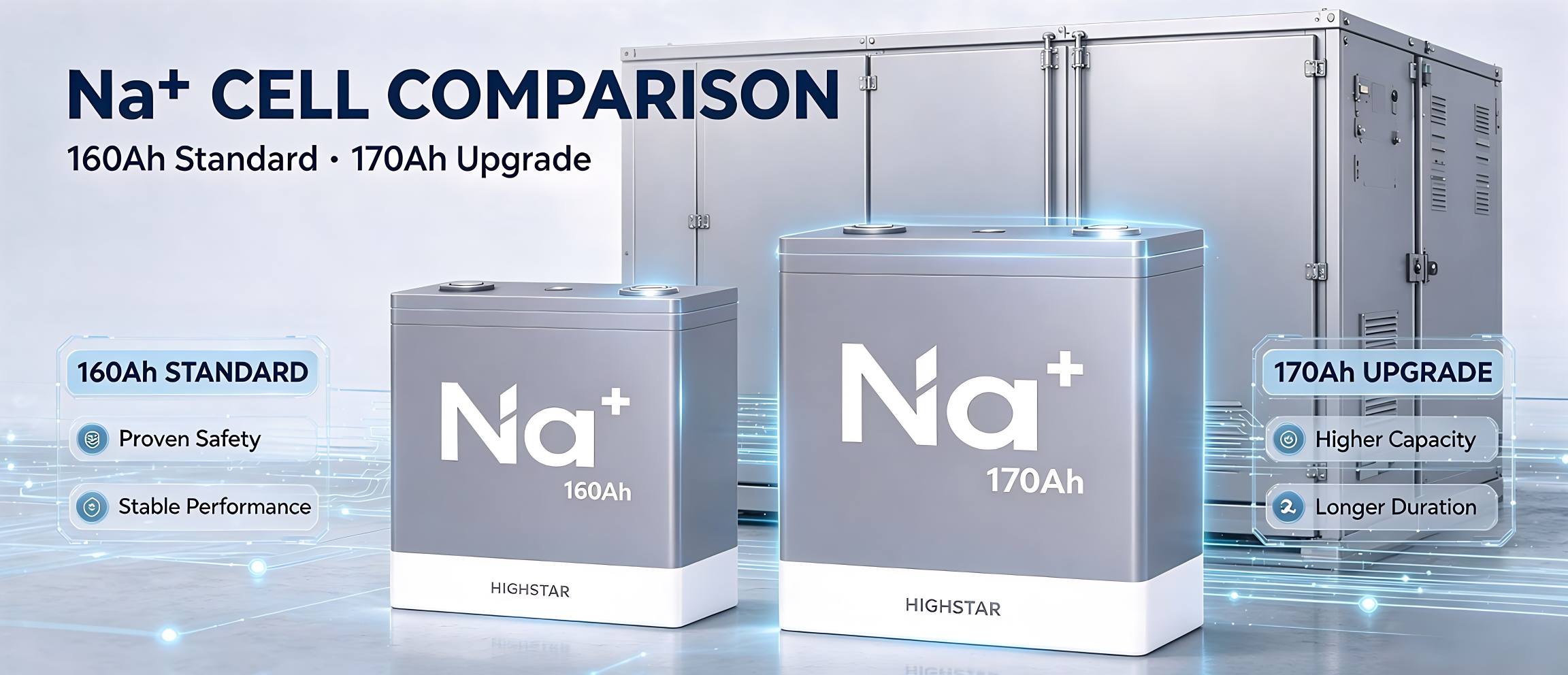
The cell is the smallest energy-storage unit in the system. Ah (ampere-hour) measures charge — roughly, “how much electricity one cell can hold.” At similar voltage, the higher the Ah rating, the more energy each cell stores.
- 2.3MWh model: uses 160Ah NFPP sodium-ion cells (model NaCP71173208-160E3) — a mature, standard cell that’s been on sale on our website.
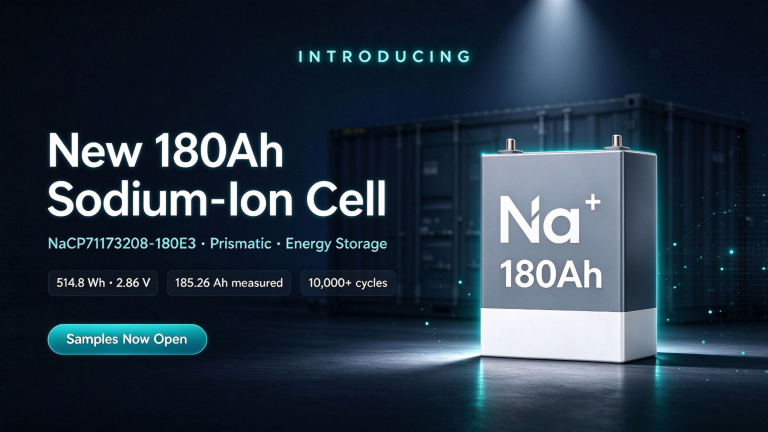
- 2.427MWh model: uses the next-generation 170Ah NFPP cell, 2.86V / 486.2Wh per cell.
It’s this 170Ah cell that delivers the roughly 5.5% gain in system capacity.
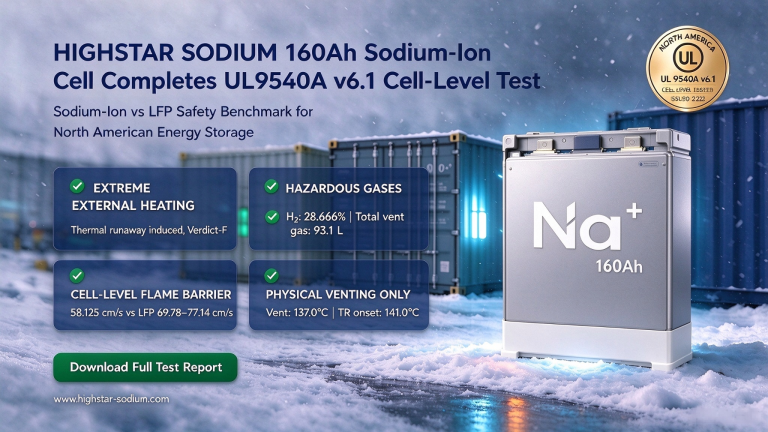
One point that’s easy to overlook but matters a lot for export projects: the 160Ah cell is the one that has obtained the North American passport. It completed cell-level testing under UL 9540A:2025 and received a laboratory test data report from CSA Group, which can support compliance filings for North American ESS projects. The 170Ah, as a next-generation cell, still has its certification status subject to the final technical documentation — worth confirming up front when you select a configuration.

Difference 2: Same “1P416S,” more energy stored
1P416S describes how the cells are arranged: 416 cells in series (S), one cell per string (P).
- 2.3MWh system: 1P416S, nominal voltage 1198V.
- 2.427MWh system: 1P416S (12 racks × 48 × 1P104S sub-racks), nominal voltage 1189.76V, operating range 832–1414.4V.
Interestingly, both use nearly the same number of cells in series, yet the difference in individual cell capacity opens up the gap in total system energy. Think of it as the same number of buckets — make each bucket a little bigger, and you hold more water overall.
Difference 3: Charge/discharge rate — what do 0.5C and 0.25C mean?
The C-rate describes how fast a battery charges or discharges. 1C means fully charging or discharging in one hour; 0.5C means two hours, and 0.25C means four hours.
- 2.3MWh model: 0.5C continuous charge/discharge — a higher-power standard configuration.
- 2.427MWh model: the specification states 0.25C — better suited to “slow charge, slow discharge, long-duration storage” use cases.
Which one you choose depends on whether your project values power response or long, stable energy delivery.
Difference 4: Which handles the cold better? A 20°C gap
The temperature range is a key indicator of whether a storage system can work in severe cold.
- 2.3MWh model: charge 0–55°C, discharge −20–60°C.
- 2.427MWh model: charge 0–60°C, discharge −40–60°C.
In other words, the 2.427MWh model discharges down to −40°C — 20°C lower than the 2.3MWh model. In cold markets such as Mongolia, northern Canada and northeast China, this often matters more than capacity itself.
Difference 5: Efficiency and cycle life — always check the test conditions
The 2.427MWh model is rated at ≥90% efficiency, with cycle life of 6,000 cycles @80% capacity retention or 10,000 cycles @70%, under conditions of 0.5P, 25°C and 95% DOD (depth of discharge).
A word of caution: cycle life means nothing without its test conditions. The same “10,000 cycles” can translate to very different real-world lifetimes at 25°C versus 45°C, or at 95% DOD versus 50% DOD. Always read the conditions alongside the number.
Difference 6: Fire safety, two different approaches
The biggest fear in energy storage is thermal runaway, so fire protection is a top priority.
- 2.3MWh model: four-layer fire protection — pack-level detection and sprinkler, container-level gaseous suppression, and water-spray interlock.
- 2.427MWh model: perfluorohexanone pack-level suppression with a 65°C fusible link interlocked to the BMS, container-level smoke/heat/combustible-gas detection, and a reserved water-spray interface.
Perfluorohexanone is a clean agent commonly used for electrical fires — non-conductive and with little residue. Both approaches follow the same design philosophy: detect early, suppress early, protect in layers.
Difference 7: Communications, dimensions and delivery
- Communications: 2.3MWh supports CAN / RS485 / TCP/IP; 2.427MWh supports CAN / LAN, with a 1500Vdc / 250A high-voltage box.
- Dimensions: 2.3MWh is 6058 × 2550 × 2896mm, ≤43t, IP54 / C5 anti-corrosion; 2.427MWh is 6058 × 2438 × 2896mm, about 38t fully loaded.
- Delivery: 2.3MWh is 100% factory-prefabricated — only lifting and cabling on site, cutting installation time by about 40%; 2.427MWh comes with general assembly drawings and foundation construction drawings for Container A, with A/B containers placeable side by side and doors on the same side.
What they share: both are “DC-side energy storage systems”
This point is important, and it’s one we keep emphasizing: both products are 20-ft liquid-cooled prefabricated containers built on NFPP sodium-ion cells, fully integrated and tested at the factory, and delivering DC output. They do not include a PCS (power conversion system) and do not output AC power — an external PCS is required to form a complete AC storage solution.
So the accurate description is “DC-side energy storage system,” not “AC/DC integrated cabinet” or “complete storage container.” This isn’t wordplay — if you order assuming it’s a complete system, you’ll find a PCS missing on site.
Which to choose? It depends on your project
For a mature standard product, fast delivery and proven references → choose 2.3MWh. It’s our commercially available model (NA-CTESS-2300), with published specifications and three deployed sites in Germany — ideal if you want to reduce selection risk and shorten decision cycles.
For larger capacity, severe cold, next-generation cells, and site-specific container customization → choose 2.427MWh. The 170Ah cells bring about 5.5% more capacity, discharge down to −40°C, and come with foundation drawings and A/B side-by-side layouts — suited to cold regions or customized C&I and grid-scale projects.
Worth noting: the 2.427MWh is a project-oriented customized solution; final configuration and parameters are subject to the signed technical agreement.
Want to dig deeper?
- Product page: 2300kWh Container Sodium Ion BESS
- Cell page: 170Ah NFPP Sodium Ion Prismatic Cell
To discuss project specifications, request documentation or arrange a technical review, contact us at info@highstar-sodium.com or sales@highstar-sodium.com.