Sodium Ion Battery Energy Storage for Solar Farm
Why sodium ion BESS is suitable for solar farm
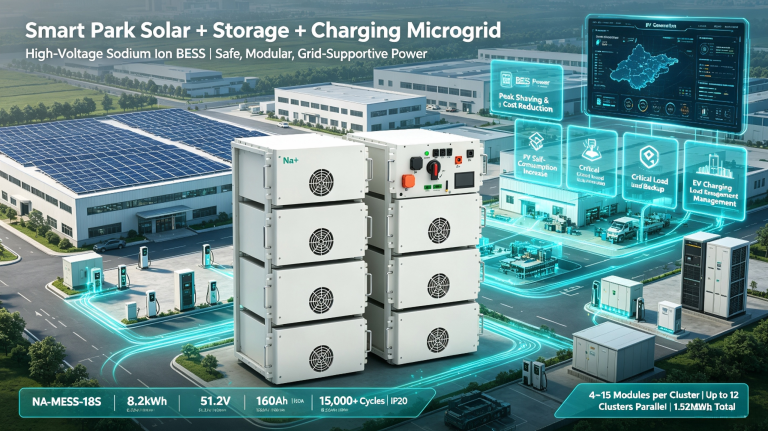
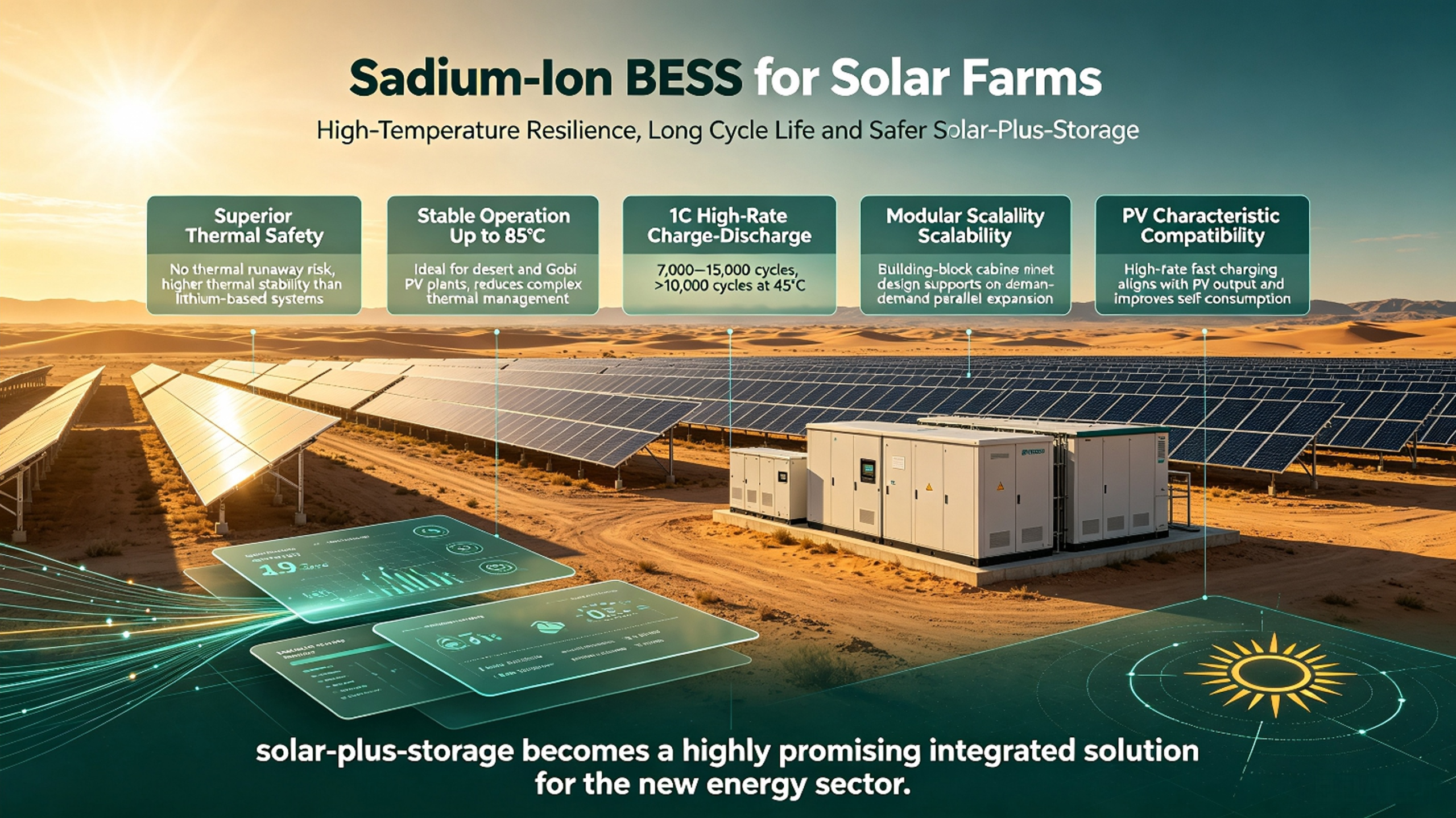
By 2026 in China, the combination of distributed solar power and sodium-ion battery energy storage systems has emerged as the most promising technological pathway for growth in the new energy sector. Thanks to core advantages such as high-temperature resilience, high safety, and long cycle life, sodium-ion batteries along with its outdoor cabinet BESS are ideally suited to the complex outdoor operating conditions of distributed solar power and solar farm, which are rapidly transitioning from demonstration projects to large-scale commercial deployment.The combination of solar and sodium-ion batteries represents a highly promising integrated solar-plus-storage solution in the new energy sector, it effectively addresses the challenges of intermittency and volatility associated with solar power generation, while significantly enhancing the stability and economic viability of new energy systems.
Why is the core technical benefit of sodium ion BESS for solar farm
The core parameters of sodium-ion batteries along with cabinet sodium ion BESS align perfectly with the requirements of distributed solar power applications:
- Superior Safety Ability: Sodium ion Battery Cell along with cabinet sodium ion BESS pose no risk of thermal runaway and offer significantly higher thermal stability than lithium-based batteries, fundamentally mitigating safety hazards associated with outdoor distributed solar power deployments.
- Stable operation under high-temperature conditions: Thanks to Sodium ion electrolyte technology, the operating temperature range extends up to 85℃, eliminating the need for energy-intensive, complex thermal management systems and making the technology suitable for high-temperature photovoltaic plant environments such as deserts and Gobi regions.
- Long Cycle Life: Cabinet Sodium Ion BESS offer a cycle life of 7,000-15,000 cycles, exceeding 10,000 cycles at high temperatures (45℃), with full-life cycle performance far surpassing that of traditional lead-acid batteries and LFP batteries.
- High-rating charging and discharging performance. Outdoor cabinet sodium ion BESS supports 1C charging and 1C discharging, Capable of high-current, rapid charge and discharge, the system efficiently absorbs peak photovoltaic generation during midday surges, reduces curtailment, and enhances the power plant’s overall returns.
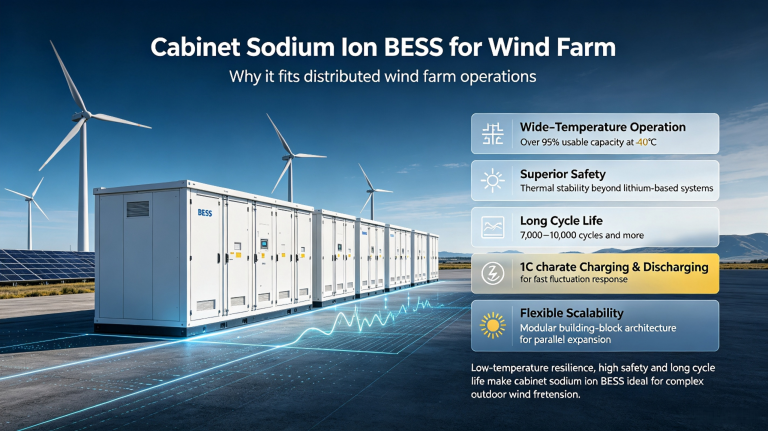
- Flexible scalability: Cabinet sodium ion BESS is modular design, the capacity of each unit is 200KW/200KW, based on building-block architecture, it supports parallel expansion on demand, eliminating the need for major overhauls of the overall control system and meeting the requirements of phased distributed wind power development.
- Compatibility with PV Characteristics: High-rate fast-charging capabilities allow for the efficient absorption of peak midday solar generation, significantly reducing curtailment rates. With a verified cycle life exceeding 15,000 cycles—translating to over 25 years of stable operation based on a daily charge-discharge cycle—the system aligns closely with the 25-year design life of solar PV.
How to configure Sodium ion BESS for different solar farm.
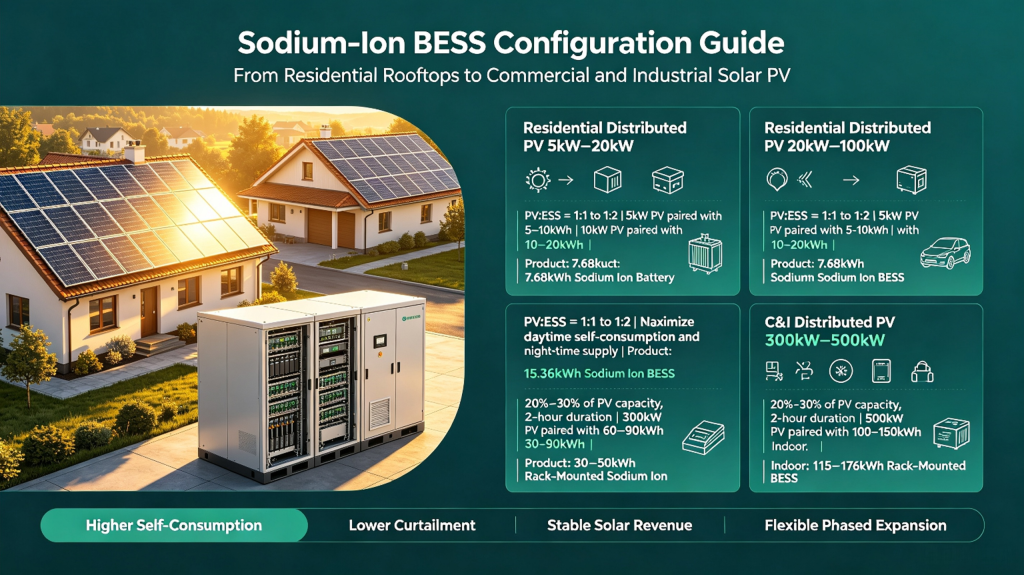
When configuring sodium-ion batteries for photovoltaic (PV) projects of varying capacities, the core logic involves matching PV output profiles, meeting specific application-scenario electricity demands, and managing investment payback periods; mature, differentiated configuration solutions have already been established, ranging from residential distributed systems to gigawatt-scale wind-solar mega-bases.
Solar Sodium ion battery for distributed PV of residential (5KW–20KW)
- Typical Configuration: PV installed capacity is paired with sodium-ion energy storage capacity at a ratio of 1:1 to 1:2; for instance, a 5 kW PV system is paired with 5–10 kWh of sodium-ion battery energy storage, and a 10 kW PV system with 10–20 kWh sodium-ion battery energy storage.
- Operational Logic: Fully consumes daytime PV generation from residential rooftops and discharges stored energy at night, enabling self-consumption without feeding excess power back to the grid, thereby significantly reducing household electricity costs.
- Product Select: 7.68KH Sodium Ion Battery
- 48V160AH Wall-mounted Solar Sodium ion Battery
- 48V160AH Rack-mounted Solar Sodium ion Battery
Residential Sodium ion battery for distributed PV of residential (20KW–100KW)
- Typical Configuration: PV installed capacity is paired with sodium-ion energy storage capacity at a ratio of 1:1 to 1:2
- Operational Logic: Fully consumes daytime PV generation from residential rooftops and discharges stored energy at night, enabling self-consumption without feeding excess power back to the grid, thereby significantly reducing household electricity costs.
- Product Select: 15.36KWH Sodium Ion BESS.
- 48V320AH Floor-standing residential Sodium ion Battery
- Recommended sodium-ion battery BESS configuration: 20%–30% of the installed photovoltaic (PV) capacity, with a storage duration of 2 hours. For example, a 300 kW PV system would be paired with 60–90 kWh sodium-ion storage
- Suitable applications: Small processing plants, retail shops, office buildings, and similar sites characterized by moderate daytime electricity loads and limited need for peak-valley price arbitrage. The primary objective is to increase the self-consumption rate of generated solar power and minimize losses associated with feeding surplus electricity back into the grid.
- Product Select: Rack-Mounted Sodium Ion BESS.
- 30KWh-50KWH Sodium ion BESS
Sodium ion BESS for Commercial and Industrial Distributed PV (100KW -300KW)
- Recommended sodium-ion battery BESS configuration: 20%–30% of the installed photovoltaic (PV) capacity, with a storage duration of 2 hours. For example, a 500 kW system would be paired with 100–150 kWh sodium-ion storage
- Suitable applications: Small processing plants, retail shops, office buildings, and similar sites characterized by moderate daytime electricity loads and limited need for peak-valley price arbitrage. The primary objective is to increase the self-consumption rate of generated solar power and minimize losses associated with feeding surplus electricity back into the grid.
- Product Select: Rack-Mounted Sodium Ion BESS( Indoor)
- 115KWh-1765KWH Sodium ion BESS
- Product Select: Cabinet Sodium Ion BESS( Outdoor)
- 115KWh Cabinet Sodium ion BESS