Cabinet Sodium Ion BESS for Wind Farm
Why cabinet sodium ion BESS is suitable for wind farm
By 2026 in China, the combination of distributed wind power and sodium-ion battery energy storage systems has emerged as the most promising technological pathway for growth in the new energy sector. Thanks to core advantages such as low-temperature resilience, high safety, and long cycle life, sodium-ion batteries along with its outdoor cabinet BESS are ideally suited to the complex outdoor operating conditions of distributed wind power and are rapidly transitioning from demonstration projects to large-scale commercial deployment.
Why is the core technical benefit of cabinet sodium ion BESS for wind farm
The core parameters of sodium-ion batteries along with cabinet sodium ion BESS align perfectly with the requirements of distributed wind power applications:
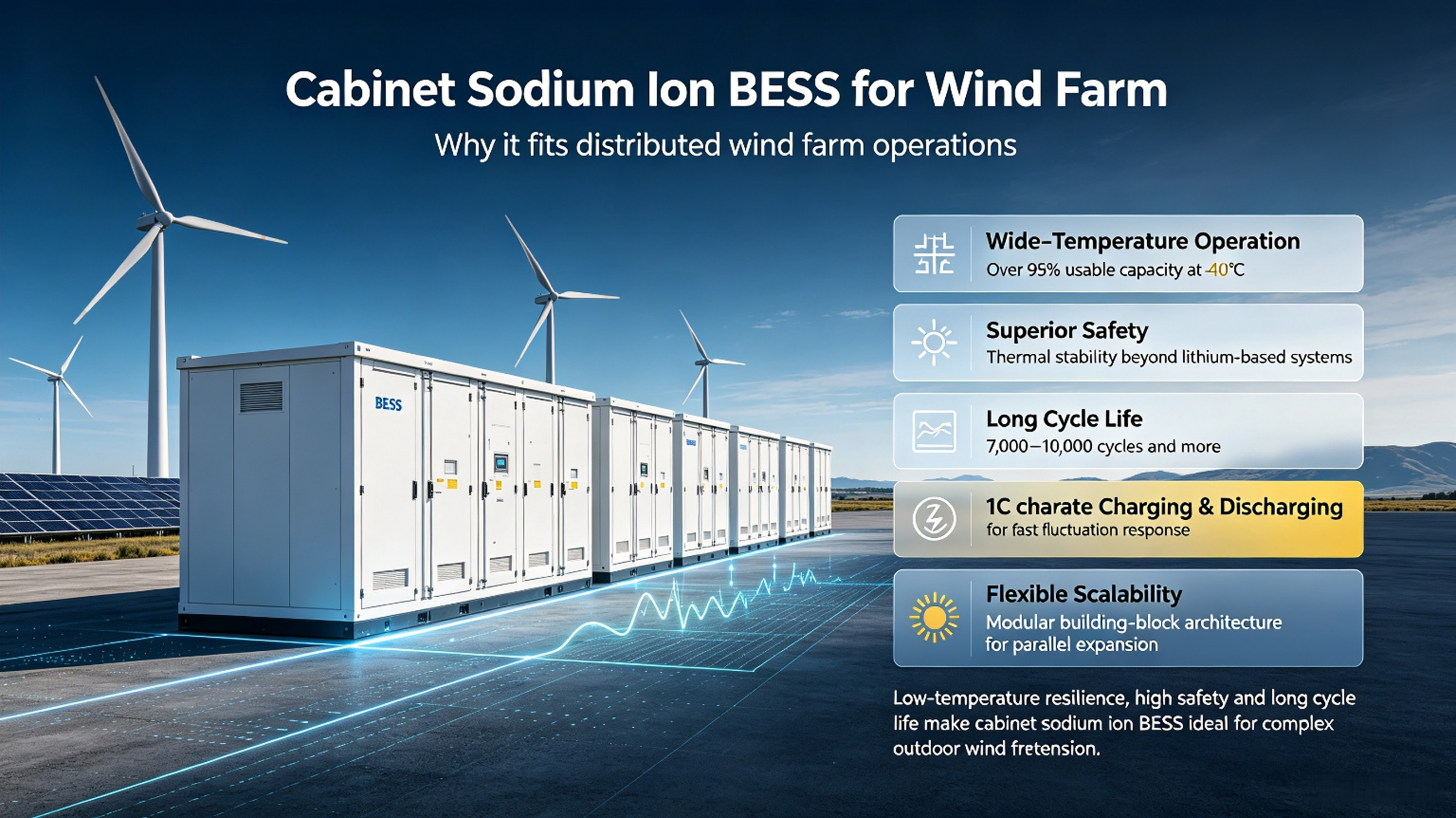
- Exceptional Wide-Temperature Operation Performance. Cabinet Sodium Ion BESS retains over 95% of usable capacity in -40℃, which is far surpassing the 60%–70% retention rate of LFP (Lithium Iron Phosphate) batteries, which is making them ideally suited for winter operations at high-altitude, frigid wind farms.
- Superior Safety Ability: Sodium ion Battery Cell along with cabinet sodium ion BESS pose no risk of thermal runaway and offer significantly higher thermal stability than lithium-based batteries, fundamentally mitigating safety hazards associated with outdoor distributed wind power deployments.
- Long Cycle Life: Cabinet Sodium Ion BESS offer a cycle life of 7,000-10,000 cycles, exceeding 10,000 cycles at high temperatures (45℃), with full-life cycle performance far surpassing that of traditional lead-acid batteries.
- High-rating charging and discharging performance. Outdoor cabinet sodium ion BESS supports 1C charging and 1C discharging, it can respond to instantaneous fluctuations in wind power output, controlling the power fluctuation rate of the distributed wind power system to within ±2%/min, thereby fully meeting grid interconnection compliance requirements.
- Flexible scalability: Cabinet sodium ion BESS is modular design, the capacity of each unit is 200KW/200KW, based on building-block architecture, it supports parallel expansion on demand, eliminating the need for major overhauls of the overall control system and meeting the requirements of phased distributed wind power development.
How to configure cabinet Sodium ion BESS for 20kW–100kW wind turbines?
Battery Type
Selection. Sodium-ion batteries are the preferred choice: By 2026, the system cost for mass-produced sodium-ion batteries is projected to be reduced. Sodium ion battery offers a capacity retention rate of ≥95% at -40°C, making them suitable for the harsh, cold outdoor environments of northern regions. With a cycle life of ≥10,000 cycles and outdoor O&M costs 30% lower than those of LFP batteries, they are ideally suited for the complex field conditions associated with small-scale distributed wind power.
PCS Selection
Grid-tied scenario: Select a bidirectional grid-tied energy storage PCS with the appropriate power rating. It features a peak conversion efficiency of ≥98.5%, supports direct connection to a 400V low-voltage grid, and offers a response time of ≤10ms. It enables millisecond-level smoothing of wind power output fluctuations and fully complies with the GB/T 34133 low-voltage ride-through (LVRT) standard.
Off-grid scenario: Select a grid-forming PCS with the appropriate power rating. It supports virtual synchronous machine (VSM) technology, independently maintains local voltage and frequency stability, enables seamless switching between grid-tied and off-grid modes, and ensures a stable power supply for loads in areas without grid access.
Operational Requirements
- The Cabinet Sodium Ion battery energy storage system features an IP65 enclosure rating, enabling direct outdoor deployment without the need for a dedicated equipment room; for coastal areas with high salinity, it meets the C5-M corrosion resistance standard to withstand harsh environmental conditions.
- The intelligent Energy Management System (EMS) integrates real-time wind turbine operational data and weather forecasts to optimize charge/discharge strategies, smoothing wind power output fluctuations—reducing volatility by over 50%—and significantly enhancing grid stability.
- Equipped with multiple safety protection mechanisms, the system offers millisecond-level response to over-voltage, over-current, and short-circuit events, fully complying with the local mandatory fire safety standards for energy storage systems.
| Wind Turbine | Sodium Ion BESS Configuration | Recommend Cabinet Sodium ion BESS | Application Scenario | ||
| Rated Power | On-Grid | Off-Grid | Model | Refer Link | |
| 20kW | 10-20kW/ 20-40kWh | 20-30kW/ 80-120kWh | 30KW/76KWH | https://www.highstar-sodium.com/product/76kwh-cabinet-sodium-ion-bess/ | Smoothing out wind power fluctuations and increasing the self-consumption rate to over 90%. |
| 30kW | 15-30kW/ 30-60kWh | 30-45kW/ 120-180kWh | 30KW/76KWH | https://www.highstar-sodium.com/product/76kwh-cabinet-sodium-ion-bess/ | Meet the base-load power supply requirements of industrial and commercial parks. |
| 50kW | 25-50kW/ 50-100kWh | 50-75kW/ 200-300kWh | 100KW/115KWH | https://www.highstar-sodium.com/product/115kwh-cabinet-sodium-ion-bess/ | Meets the round-the-clock green electricity needs of medium-sized farms and small factories. |
| 100kW | 50-100kW/ 100-200kWh | 100-150kW/ 400-600kWh | 160KW/200KWH | https://www.highstar-sodium.com/product/200kwh-cabinet-sodium-ion-bess/ | Covers village-level microgrids and provides independent power supply for all island-based scenarios. |