High-Voltage Sodium-Ion Battery Energy Storage System: Smart, Stacked, Safe
Commercial and industrial energy storage entered 2026 with two problems it did not have three years ago.
The first is chemistry. High-voltage LFP systems are pushed further from their comfort zone every year — higher bus voltages, denser packs, tighter thermal margins — and each step increases the engineering required to keep them safe and consistent.
The second is revenue. Since 1 March 2026, when China’s Basic Rules for the Medium- and Long-Term Electricity Market (发改能源规〔2025〕1656号) took effect, administrative fixed time-of-use pricing no longer applies to market-participating users. Eleven provinces have now implemented the change. The predictable peak-valley spread that underwrote most C&I storage business cases has been replaced by prices that move with real-time supply and demand.
Both problems point at the same answer: a storage system that survives high voltage without safety compromise, and that responds fast enough to chase market prices rather than a published tariff schedule.
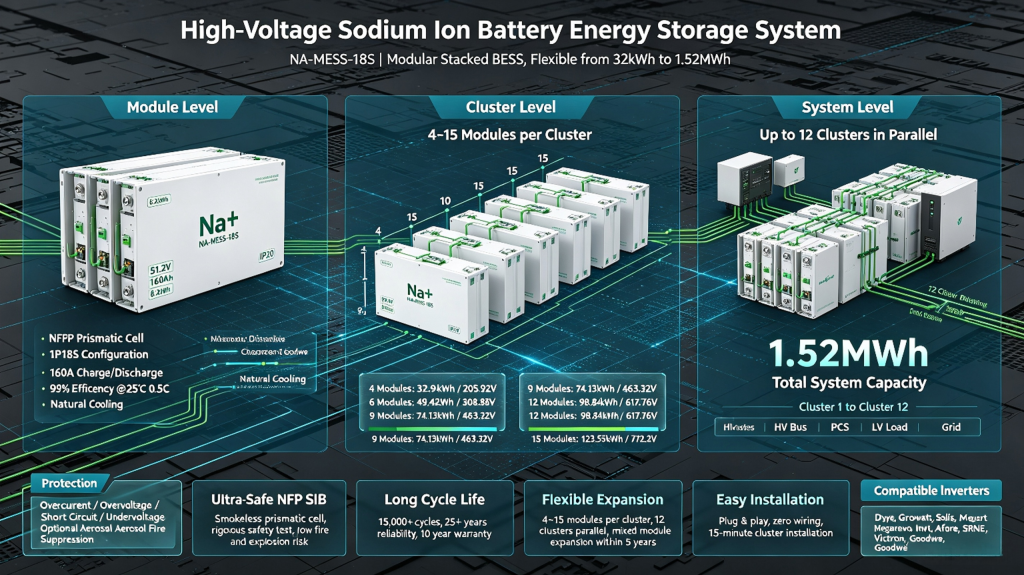
That is the design brief behind this high-voltage sodium-ion battery energy storage system — a smart, stacked, modular platform built on self-produced NFPP sodium-ion prismatic cells, scaling from 32.94 kWh to 1.48 MWh.
What Goes Wrong When You Push LFP to High Voltage
Material level
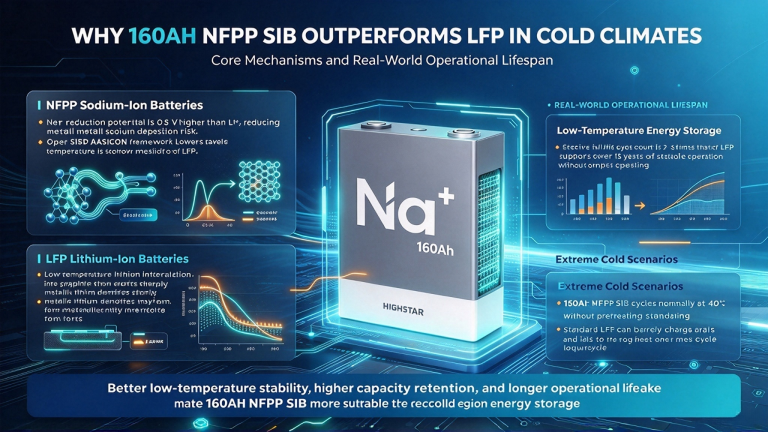
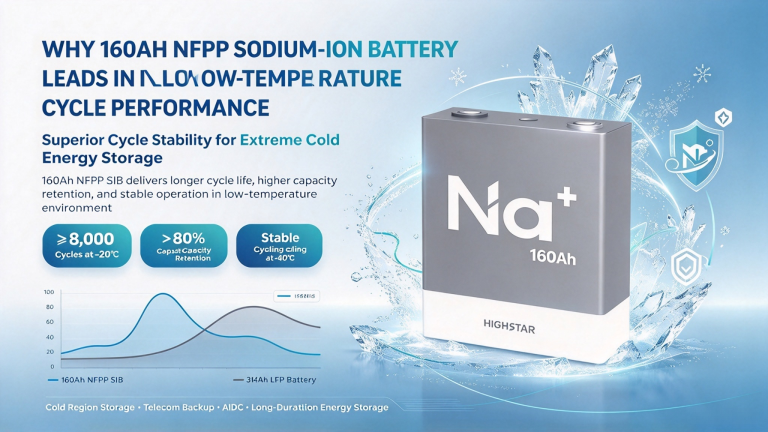
Lithium-ion chemistry becomes progressively less forgiving as operating voltage rises, and the risks that matter in the field are thermal: overheating, venting, and fire. Layered on top is a temperature problem that runs in both directions. In cold winters, LFP power capability falls sharply and charge acceptance collapses. In hot summers, sustained high temperature accelerates degradation and forces derating. A C&I system that loses power in January and derates in July has a revenue problem in both seasons.
Cell level
At elevated voltage, LiPF₆-based electrolyte becomes prone to oxidative decomposition. The decomposition products attack the electrode, driving rapid capacity fade and, in the worst cases, cell swelling and electrolyte leakage. This is not a marginal effect — it is the dominant ageing mechanism once a cell operates near the top of its voltage window, and it compounds with temperature.
Pack level
This is where high-voltage architectures hurt most. An 800 V-class LFP system requires roughly 250 prismatic cells in series (800 V ÷ 3.2 V per cell). In a long series string the pack is only as good as its weakest cell:
- Any single-cell deviation propagates through the whole string.
- Voltage balancing across 250 cells is a continuous energy drain, not a one-time correction.
- Pack-level SOC and SOH estimation degrades, because the estimator must infer the state of 250 cells from terminal measurements.
- One failed cell can take down an entire cluster.
Series count is the hidden cost of high-voltage LFP. The higher the bus is pushed, the longer the string, and the more fragile the consistency problem becomes.
The sodium-ion architecture described here reaches 772.2 V nominal using 270 cells (15 modules × 18S) — a similar order of magnitude in cell count, but with the series string broken into 15 independently managed modules rather than one monolithic string. That is a structural difference in how consistency is controlled, and it is the reason a modular high-voltage sodium-ion design can be built without inheriting the balancing burden of a single long LFP string.
Application level
The duty on C&I storage has changed. The National Energy Administration reported in August 2026 that China’s combined wind and solar capacity reached 1.953 billion kW by the end of June 2026 — about 48.3% of total installed generation capacity — and that single-day renewable output swings can exceed 70% of installed capacity. Virtual power plants are now aggregating distributed storage into dispatchable resources: Shandong targets 40 VPPs participating routinely in the electricity market in 2026 with 1.5 GW of regulation capability, rising to 4 GW by 2030, and Fujian’s VPP Construction and Operation Management Measures took effect on 5 August 2026.
A storage asset in this environment must coordinate with PV generation, EMS scheduling, PCS control and site inverters — under price signals that change intraday. Buyers are no longer purchasing a battery. They are purchasing a dispatchable asset carrying a 20-year revenue obligation.
Why 2026 Is the Year for High-Voltage Sodium-Ion C&I Storage
The technology crossed from demonstration to procurement during 2026. Bernstein research cited by People’s Daily in June 2026 reported that sodium-ion battery shipments doubled to 9 GWh in 2025, with 2026 shipments expected to reach at least 25 GWh — energy storage accounting for more than 50% of that demand. CATL launched the world’s first field-validated station-level sodium-ion BESS in Munich in June 2026, declaring the technology commercially mature.
On the demand side, China’s C&I storage installations are projected at 19.25 GWh for 2026, within a global total of 30.14 GWh — up 59% year on year.
Two developments reshaped the architecture conversation at SNEC 2026. All-in-one liquid-cooled cabinets became the mainstream C&I format, with 261 kWh units dominating vendor booths and liquid cooling reaching 92.7% of newly commissioned projects. Alongside that, stacked modular designs re-emerged as a distinct product category — platforms such as SigenStack and RisenStack — because they solve a problem all-in-one cabinets cannot: they let a site expand capacity incrementally without replacing the whole unit, and they fit narrow, irregular, or space-constrained sites.
Sodium-ion suits the stacked format particularly well, because the chemistry’s thermal stability reduces the cooling burden that makes high-density stacking difficult. This platform is deliberately positioned not against the 261 kWh liquid-cooled cabinet on raw energy density, but for sites that weight incremental expansion, intrinsic safety, mixed-generation module compatibility and cold-climate performance above maximum kWh per square metre.
System Architecture: Cell → Module → Cluster → System
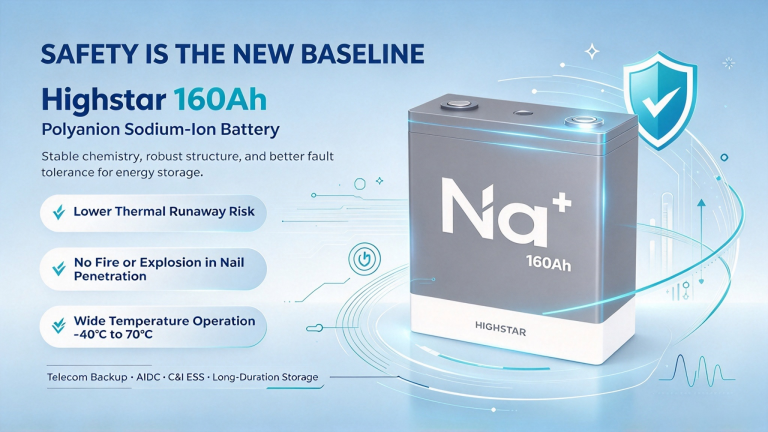
The cell. Self-produced NaCP71173208-160E3 prismatic sodium-ion cell, 160 Ah, on the NFPP (polyanionic) technology route. NFPP is selected for cycle life and thermal stability rather than energy density — the right trade for a stationary asset that cycles daily for two decades. Mass-produced cells have passed nail-penetration testing without fire or explosion, consistent with NFPP’s higher thermal runaway trigger temperature.
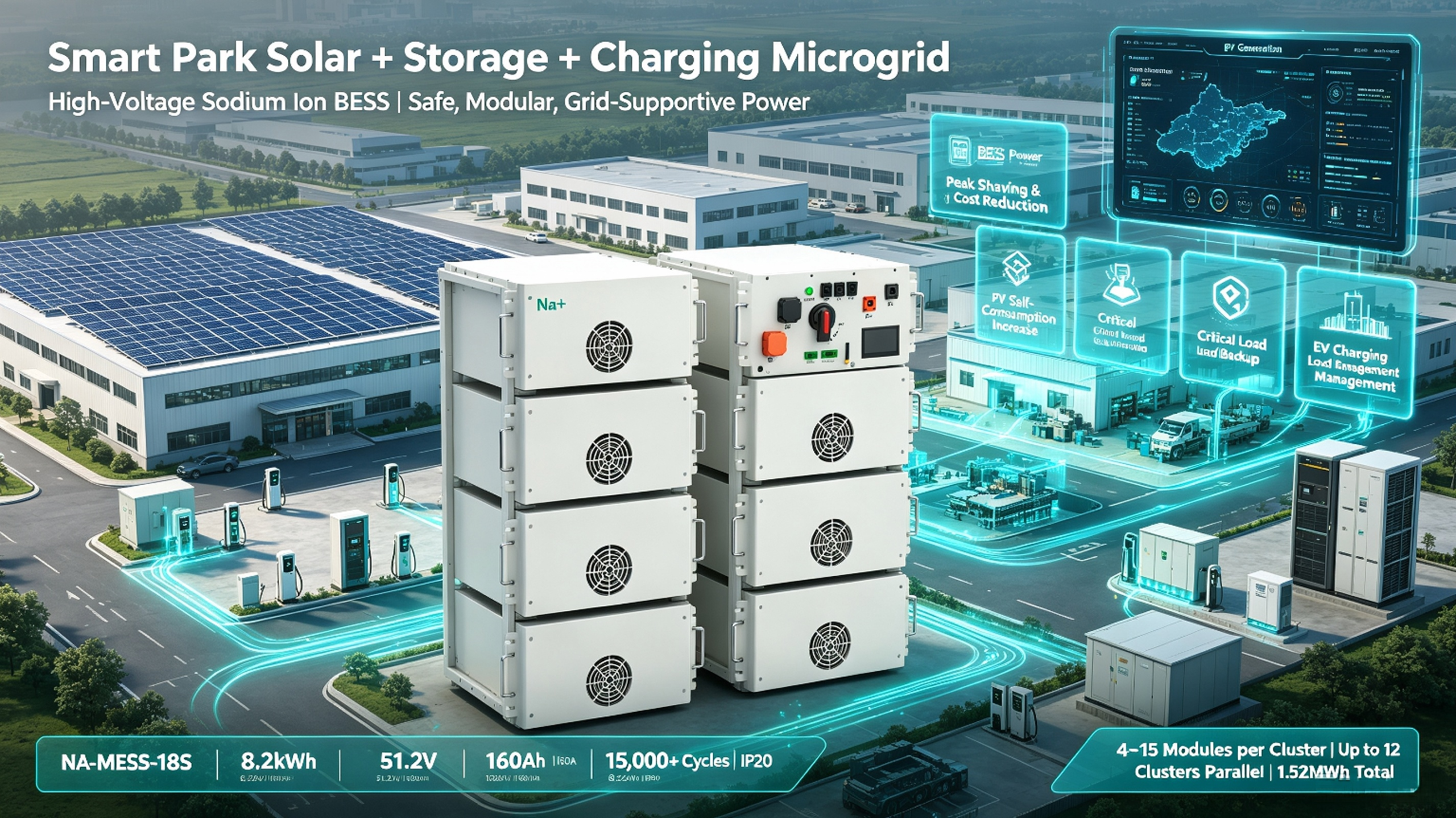
The module. 1P18S configuration → 51.2 V / 160 Ah → 8.2 kWh nominal (model NA-MESS-18S). A built-in square steel frame provides stable load-bearing for vertical stacking, while frameless stacking between modules cuts installed footprint and structural cost. Modules interconnect plug-and-play.
The cluster. Up to 15 modules in series → 772.2 V nominal / 123.55 kWh, operating range 594–918 V.
The system. Up to 12 clusters in parallel → 1.48 MWh total installed capacity.
Power scales with cluster count. Each 15-module cluster delivers up to 123.6 kW at the 160 A maximum continuous current, so a full 12-cluster system reaches approximately 1.48 MW — a 1C system able to fully charge or discharge within one hour. At the recommended 80 A (0.5C) continuous rating, a single cluster delivers 61.8 kW and a full system 741 kW.
This range spans the practical C&I spectrum: commercial buildings, industrial parks, large residential and villa installations, and AIDC power backup.
Six Advantages of the High-Voltage Sodium-Ion Platform
1. Certified safety, from cell to pack
Self-produced NFPP prismatic cells pass nail-penetration testing without fire or explosion. Certification and test documentation spans cell and pack level:
| Standard | Type | What it covers |
|---|---|---|
| UL 1973 | Product safety certification (listing) | Stationary battery systems for ESS, data centres, wind turbines and UPS applications |
| UL 9540A | Test method (produces a test report) | Thermal runaway fire propagation assessment; the data basis for IFC and NFPA 855 compliance |
| IEC 62619 | Product safety certification | Industrial secondary cell and battery safety requirements |
| CE | Conformity marking | European market access |
UL 9540A is a test method rather than a certification scheme: it produces a fire-propagation test report that authorities having jurisdiction rely on when assessing compliance with NFPA 855 and the International Fire Code. UL 9540 (without the A) is the corresponding product safety standard, and it requires a UL 1973-listed battery — which this platform holds.
An optional built-in aerosol fire suppression device activates automatic extinguishing within 2 seconds. This aligns with GB/T 51048-2025 Design Standard for Electrochemical Energy Storage Stations (effective 1 April 2026), which extends explicitly to sodium-ion technology and requires automatic fire suppression in lithium and sodium battery rooms and prefabricated cabins, mandates thermal-runaway early warning with CO/CO₂/H₂ gas monitoring, sets ventilation at six air changes per hour or more, and prohibits underground or semi-underground siting of sodium-ion storage rooms.
2. Modular frameless stacking
Each 8.2 kWh module carries its own structural steel frame, so modules stack vertically without a separate rack. This removes rack hardware cost, reduces installed footprint, and allows capacity to be added one module at a time rather than in whole-cabinet increments.
3. Scalability across a 45× range
From a single 4-module cluster (32.94 kWh) to a 12-cluster parallel system (1.48 MWh), the same module, the same BMS logic and the same installation procedure apply throughout. There is no product-family break between the small commercial unit and the industrial system.
4. Efficiency and rate capability
Modules support up to 160 A continuous charge and discharge (1C), with 80 A (0.5C) as the recommended continuous rating. Module-level round-trip efficiency is 99% at 25 °C and 0.5C; system-level round-trip efficiency, including PCS conversion and auxiliary loads, is correspondingly lower and should be quoted separately in tender responses. The 1C rate capability is what allows the system to follow intraday market prices rather than a fixed tariff schedule — a materially more valuable capability in 2026 than in 2024.
5. 25-year design life with a 10-year warranty
NFPP sodium-ion chemistry is credited with 15,000+ cycles at cell level; the module specification guarantees ≥10,000 cycles at 25 °C and 70% DoD. At one full cycle per day, 10,000 cycles corresponds to roughly 27 years of cycling service — the basis for the 25-year design life. A 10-year warranty backs it commercially. Sites running two cycles per day reach 10,000 cycles in approximately 14 years, so daily cycle count should be part of any lifecycle discussion; with market-based dynamic pricing replacing fixed tariffs in eleven provinces, some sites will cycle more aggressively than the historical peak-valley model assumed.
6. Mixed-generation module compatibility
New modules can be installed alongside modules deployed up to 5 years earlier. This is the platform’s most differentiated capability, and the strongest argument for the stacked architecture. Capacity can be added in year three or year four without replacing or stranding existing assets, and without the capacity mismatch that arises when ageing and new modules are paralleled. Expansion becomes an operational top-up rather than a capital project, reducing lifetime O&M cost.
Key Features
| Feature | Specification |
|---|---|
| Flexible expansion | Up to 15 modules per cluster (123.55 kWh); up to 12 clusters in parallel (1.48 MWh) |
| Safety | Nail-penetration tested cells with no fire or explosion observed; optional aerosol suppression with 2-second automatic activation |
| Installation | Frameless rack-free stacking; plug-and-play module interconnection; a 15-module cluster is mechanically assembled in approximately [TBC] hours |
| Design life | Grade A+ self-produced 160 Ah prismatic sodium-ion cell; ≥10,000 cycles at module level; 10-year warranty; 25-year design life at ~1 cycle/day |
| Mixed modules | New and existing modules (within 5 years) may be installed together |
| Cooling | Natural convection — no coolant, pumps, heat exchangers, or their maintenance and parasitic load |
| Enclosure | IP20 module, for indoor or in-cabinet installation |
Natural convection cooling eliminates the liquid-cooling plant that 92.7% of newly commissioned 2026 projects now carry. The trade-off is lower energy density per unit volume than a liquid-cooled all-in-one cabinet; for sites with adequate indoor space, removing coolant, pumps and heat exchangers — along with their maintenance schedule and standby power draw — is usually the better trade over a 25-year asset life.
Because the module is rated IP20 and specified for indoor or in-cabinet use, outdoor deployment requires an appropriately rated enclosure. For coastal sites, specify C5-M corrosion protection on that enclosure.
Technical Parameters — 8.2 kWh Sodium-Ion Battery Moduhttps://www.highstar-sodium.com/product/1p16s-sodium-ion-battery-air-cooled-model/le (NA-MESS-18S)
| Parameter | Specification |
|---|---|
| Model | NA-MESS-18S |
| Battery type | NFPP (polyanionic sodium-ion) |
| Battery configuration | 1P18S |
| Nominal energy | 8.2 kWh |
| Rated capacity | 160 Ah |
| Nominal voltage | 51.2 V |
| Voltage range | 39.6 – 61.2 V |
| Recommended charge/discharge current | 80 A |
| Max. continuous charge/discharge current | 160 A |
| Efficiency | 99% (@25 °C, 0.5C), module level |
| Cycle life | ≥10,000 (@25 °C, 70% DoD) |
| Operating condition | Indoors / in cabinet |
| Installation | Frameless stacking (module-integrated steel frame) |
| Relative humidity | <95% RH |
| Cooling | Natural convection |
| Altitude | ≤2,000 m |
| IP rating | IP20 |
| Charge temperature | 0 °C – 60 °C |
| Discharge temperature | −40 °C – 60 °C |
| Storage temperature | 20 °C – 45 °C |
| Communication | CAN / RS485 |
| Weight | ≤130 kg |
| Dimensions (L×W×H) | 887.5 × 496 × 235 mm |
| Battery pack series quantity range | 4 – 15 |
| Protection mode | Triple hardware protection |
| Battery protection | Overcurrent / overvoltage / short circuit / undervoltage |
| Recommended compatible inverter brands | Deye, Growatt, Solis, Megarevo, INVT, Afore, SRNE, Victron, Goodwe |
A note on the temperature ratings. The −40 °C rating applies to discharge. Charge temperature begins at 0 °C, because sodium-ion cells cannot be safely charged at sub-zero temperature — sodium plating occurs below the charge threshold. In cold-climate C&I and off-grid applications this is a design input, not a limitation to work around: a site discharging at −30 °C still requires charge-temperature protection or an overnight heating strategy. This platform’s advantage over LFP is that it delivers full discharge capability at −40 °C without a heating loop, cutting both the parasitic load and a failure mode that LFP installations in northern regions must carry year-round.
System Configuration by Module Quantity
| Modules | Nominal Energy | Nominal Voltage | Operating Voltage Range |
|---|---|---|---|
| 4 | 32.94 kWh | 205.92 V | 158.4 – 244.8 V |
| 5 | 41.18 kWh | 257.40 V | 198.0 – 306.0 V |
| 6 | 49.42 kWh | 308.88 V | 237.6 – 367.2 V |
| 7 | 57.65 kWh | 360.36 V | 277.2 – 428.4 V |
| 8 | 65.89 kWh | 411.84 V | 316.8 – 489.6 V |
| 9 | 74.13 kWh | 463.32 V | 356.4 – 550.8 V |
| 10 | 82.36 kWh | 514.80 V | 396.0 – 612.0 V |
| 11 | 90.60 kWh | 566.28 V | 435.6 – 673.2 V |
| 12 | 98.84 kWh | 617.76 V | 475.2 – 734.4 V |
| 13 | 107.07 kWh | 669.24 V | 514.8 – 795.6 V |
| 14 | 115.31 kWh | 720.72 V | 554.4 – 856.8 V |
| 15 | 123.55 kWh | 772.20 V | 594.0 – 918.0 V |
12 clusters in parallel → 1.48 MWh maximum system capacity, ≈1.48 MW at 1C.
Inverter Compatibility: Check the Maximum Battery Voltage First
The 15-module configuration reaches 918 V at maximum operating voltage. This is the most common cause of field incompatibility in high-voltage stacked storage, and it should be resolved at design stage rather than discovered during commissioning.
Most high-voltage residential and light-commercial hybrid inverters specify battery voltage windows in the 150–600 V, 160–700 V or 200–800 V range. A 918 V maximum exceeds all three.
- 4–10 modules (158.4–612.0 V operating range) are compatible with the majority of high-voltage residential and light-C&I hybrid inverters from the recommended brands. This is also the practical envelope for large residential and villa applications.
- 11–15 modules (435.6–918.0 V) require inverters explicitly rated for ≥1000 V DC battery input — typically three-phase commercial units. Confirm against the specific model datasheet rather than the brand, since several recommended manufacturers serve both segments with different model families.
A full module-count-to-inverter-model compatibility matrix is available on request. [TBC]
Frequently Asked Questions
Why sodium-ion rather than LFP for a high-voltage C&I system? Three reasons that compound at high voltage. NFPP sodium-ion has a higher thermal runaway trigger temperature and passes nail-penetration testing without fire or explosion. It discharges to −40 °C where LFP power capability collapses. And its 10,000–15,000 cycle life roughly doubles the cycling service life available from typical LFP at the same duty. LFP retains an energy-density advantage, which is why the two chemistries are complementary rather than substitutable across all applications.
Is sodium-ion cheaper than LFP today? Not on cell price alone — reported sodium-ion system costs sit slightly above LFP. Cost parity has been projected around end-2026, with a clear advantage expected by 2027 as volumes scale toward the 25 GWh forecast. Today’s economic case rests on cycle life, cold-climate discharge capability, natural cooling, simplified fire protection, and the ability to mix module generations rather than replace the system when expanding.
What is the maximum system size? 15 modules per cluster (123.55 kWh), with up to 12 clusters in parallel, for 1.48 MWh total and approximately 1.48 MW maximum power at 1C.
Can I add capacity later? Yes. The system supports 4 to 15 modules per cluster and up to 12 parallel clusters, and permits mixing new modules with modules installed up to five years earlier. Expansion is incremental rather than a replacement project.
Does it need liquid cooling? No. The modules use natural convection cooling, eliminating coolant, pumps, heat exchangers and their associated maintenance and parasitic load. The trade-off is lower energy density per unit volume than a liquid-cooled all-in-one cabinet; for sites with adequate indoor space this is usually the right trade.
Is it suitable for outdoor installation? The module is rated IP20 and specified for indoor or in-cabinet use. Outdoor deployment requires an appropriately rated enclosure, with C5-M corrosion protection recommended for coastal sites.
Can it be charged at −40 °C? No. The −40 °C rating applies to discharge; charge temperature begins at 0 °C. Sub-zero charging causes sodium plating, so cold-climate installations require charge-temperature protection or an overnight heating strategy. Discharge capability at −40 °C without a heating loop remains a substantive advantage over LFP.
Which inverters are compatible? Deye, Growatt, Solis, Megarevo, INVT, Afore, SRNE, Victron and Goodwe are recommended. Verify the specific model’s maximum battery voltage — configurations above ten modules can exceed 700 V and reach 918 V at fifteen modules.
How does this work with a virtual power plant? The EMS coordinates with PV generation and site loads, and 1C rate capability allows the system to follow intraday price signals rather than a fixed tariff schedule. That matters more in 2026 than it did in 2024: with administrative fixed time-of-use pricing withdrawn for market participants in eleven provinces, revenue now depends on responding to dynamic prices, which favours systems with fast, high-rate response and long cycle life.
Conclusion
High-voltage LFP storage is not obsolete. But pushing it to 800 V means managing a 250-cell series string, an electrolyte that oxidises at the top of its window, and a chemistry that loses power in winter and derates in summer — while the revenue model underneath shifts from published tariffs to market prices.
Sodium-ion on the NFPP route resolves the safety and temperature constraints structurally rather than through added engineering, and the stacked modular architecture resolves the expansion problem that all-in-one cabinets cannot. At 32.94 kWh to 1.48 MWh, with 10,000+ cycle modules, natural cooling, mixed-generation module compatibility, and UL 1973 listing supported by a UL 9540A fire-propagation test report, this platform serves the C&I, large-residential and AIDC segments where incremental scalability and intrinsic safety carry more weight than maximum energy density.
The economics are not yet won on cell price. They are won on 25-year design life, on capacity that can be added in year four without stranding year-one assets, and on a chemistry that performs identically in January and July.