Sodium-Ion Battery Energy Storage for Solar Farms: Why Sodium-Ion BESS Is the Right Fit
Why Sodium-Ion BESS Is Suitable for Solar Farms
By 2026 in China, the combination of distributed solar power and sodium-ion battery energy storage systems has emerged as the most promising technological pathway for growth in the new energy sector.
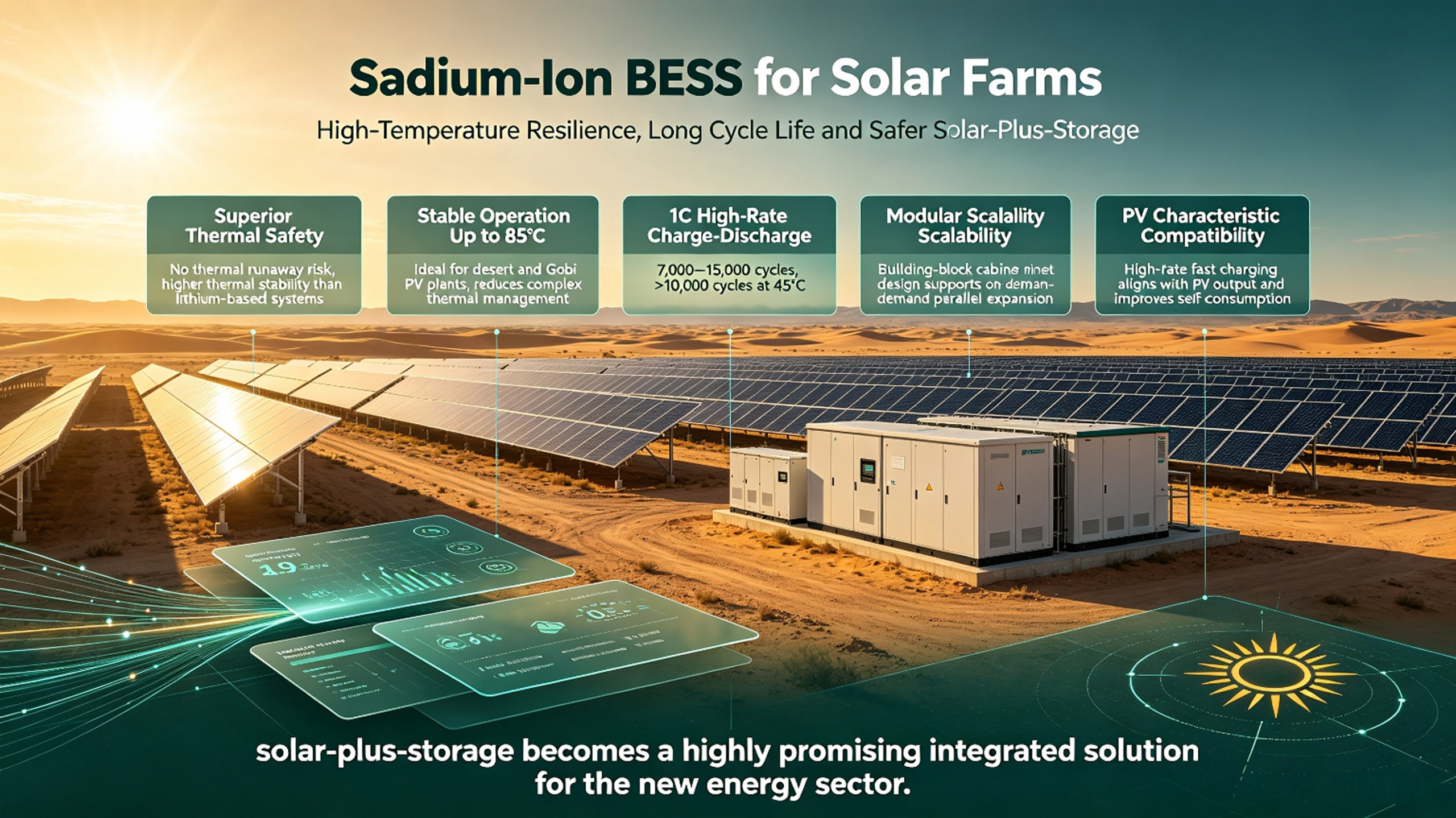
Thanks to core advantages such as high-temperature resilience, high safety and long cycle life, sodium-ion batteries along with their outdoor cabinet BESS are ideally suited to the complex outdoor operating conditions of distributed solar power and solar farms, which are rapidly transitioning from demonstration projects to large-scale commercial deployment.
The combination of solar and sodium-ion batteries represents a highly promising integrated solar-plus-storage solution in the new energy sector. It effectively addresses the challenges of intermittency and volatility associated with solar power generation, while significantly enhancing the stability and economic viability of new energy systems.
Key takeaways: sodium-ion BESS for solar farms
- Safety: sodium-ion cells and cabinet BESS pose no risk of thermal runaway, with higher thermal stability than lithium-based batteries
- Temperature: operating range extends up to 85°C, removing the need for energy-intensive thermal management — suited to desert and Gobi PV plants
- Cycle life: cabinet sodium-ion BESS delivers 7,000–15,000 cycles, exceeding 10,000 cycles at 45°C
- Rate capability: 1C charging and 1C discharging, absorbing midday PV peaks and reducing curtailment
- Scalability: modular building-block design, parallel expansion on demand
- Sizing: from 5kW–20kW residential PV to 300kW–500kW commercial and industrial PV
Core Technical Benefits of Sodium-Ion BESS for Solar Farms
The core parameters of sodium-ion batteries, along with cabinet sodium-ion BESS, align perfectly with the requirements of distributed solar power applications.
Superior Safety: No Thermal Runaway Risk
Sodium-ion battery cells, along with cabinet sodium-ion BESS, pose no risk of thermal runaway and offer significantly higher thermal stability than lithium-based batteries — fundamentally mitigating the safety hazards associated with outdoor distributed solar power deployments.
Stable Operation Under High-Temperature Conditions (up to 85°C)
Thanks to sodium-ion electrolyte technology, the operating temperature range extends up to 85°C, eliminating the need for energy-intensive, complex thermal management systems. This makes the technology suitable for high-temperature photovoltaic plant environments such as deserts and Gobi regions.
Long Cycle Life: 7,000–15,000 Cycles
Cabinet sodium-ion BESS offers a cycle life of 7,000–15,000 cycles, exceeding 10,000 cycles at high temperatures (45°C), with full-life cycle performance far surpassing that of traditional lead-acid batteries and LFP batteries.
High-Rate Charging and Discharging Performance (1C)
Outdoor cabinet sodium-ion BESS supports 1C charging and 1C discharging. Capable of high-current, rapid charge and discharge, the system efficiently absorbs peak photovoltaic generation during midday surges, reduces curtailment, and enhances the power plant’s overall returns.
Flexible, Modular Scalability
Cabinet sodium-ion BESS is a modular design; the capacity of each unit is 200kW/200kWh. Based on a building-block architecture, it supports parallel expansion on demand, eliminating the need for major overhauls of the overall control system and meeting the requirements of phased distributed PV development.
Compatibility with PV Characteristics and the 25-Year PV Design Life
High-rate fast-charging capabilities allow for the efficient absorption of peak midday solar generation, significantly reducing curtailment rates. With a verified cycle life exceeding 15,000 cycles — translating to over 25 years of stable operation based on a daily charge-discharge cycle — the system aligns closely with the 25-year design life of solar PV.
How to Configure Sodium-Ion BESS for Different Solar Farms
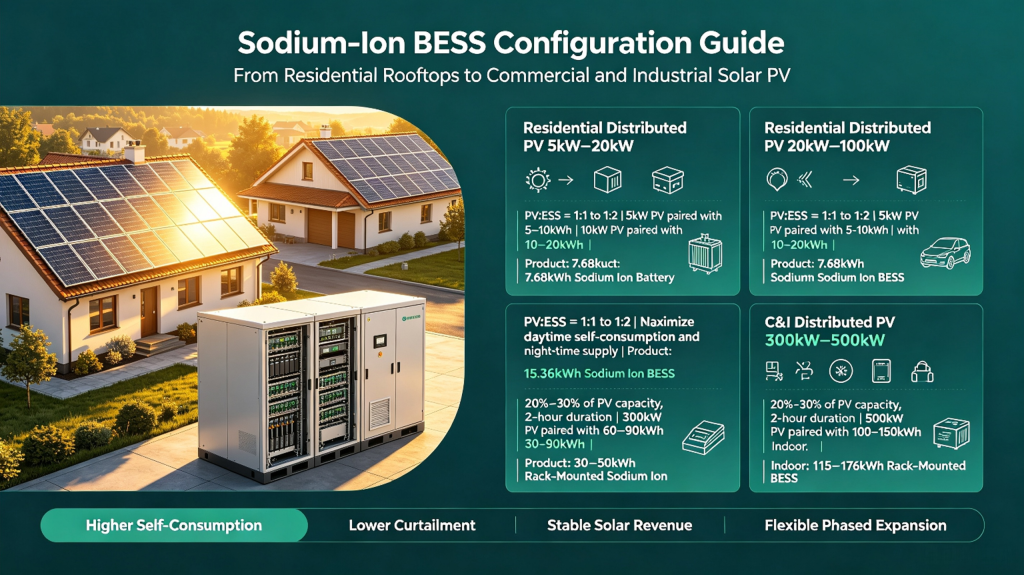
When configuring sodium-ion batteries for photovoltaic (PV) projects of varying capacities, the core logic involves matching PV output profiles, meeting specific application-scenario electricity demands, and managing investment payback periods. Mature, differentiated configuration solutions have already been established, ranging from residential distributed systems to gigawatt-scale wind-solar mega-bases.
Residential Distributed PV (5kW–20kW): Solar Sodium-Ion Battery
Typical configuration
PV installed capacity is paired with sodium-ion energy storage capacity at a ratio of 1:1 to 1:2. For instance:
- a 5 kW PV system is paired with 5–10 kWh of sodium-ion battery energy storage
- a 10 kW PV system is paired with 10–20 kWh of sodium-ion battery energy storage
Operational logic
Fully consumes daytime PV generation from residential rooftops and discharges stored energy at night, enabling self-consumption without feeding excess power back to the grid, thereby significantly reducing household electricity costs.
Product selection: 7.68kWh sodium-ion battery
Larger Residential Distributed PV (20kW–100kW): Residential Sodium-Ion Battery
Typical configuration
PV installed capacity is paired with sodium-ion energy storage capacity at a ratio of 1:1 to 1:2.
Operational logic
Fully consumes daytime PV generation from residential rooftops and discharges stored energy at night, enabling self-consumption without feeding excess power back to the grid, thereby significantly reducing household electricity costs.
Product selection: 15.36KWH sodium-ion BESS
Commercial and Industrial Distributed PV (100kW–300kW): Sodium-Ion BESS
Recommended sodium-ion battery BESS configuration
20%–30% of the installed photovoltaic (PV) capacity, with a storage duration of 2 hours. For example, a 300 kW PV system would be paired with 60–90 kWh sodium-ion storage.
Suitable applications
Small processing plants, retail shops, office buildings, and similar sites characterized by moderate daytime electricity loads and limited need for peak-valley price arbitrage. The primary objective is to increase the self-consumption rate of generated solar power and minimize losses associated with feeding surplus electricity back into the grid.
Product selection: rack-mounted sodium-ion BESS
Commercial and Industrial Distributed PV (300kW–500kW): Sodium-Ion BESS
Recommended sodium-ion battery BESS configuration
20%–30% of the installed photovoltaic (PV) capacity, with a storage duration of 2 hours. For example, a 500 kW system would be paired with 100–150 kWh sodium-ion storage.
Suitable applications
Small processing plants, retail shops, office buildings, and similar sites characterized by moderate daytime electricity loads and limited need for peak-valley price arbitrage. The primary objective is to increase the self-consumption rate of generated solar power and minimize losses associated with feeding surplus electricity back into the grid.
Product selection: rack-mounted sodium-ion BESS (indoor)
Product selection: cabinet sodium-ion BESS (outdoor)
FAQ — Sodium-Ion Battery Energy Storage for Solar Farms
Q1. Why is sodium-ion BESS suitable for solar farms? Sodium-ion batteries and their outdoor cabinet BESS combine high-temperature resilience, high safety and long cycle life, which suit the complex outdoor operating conditions of distributed solar power and solar farms. They address the intermittency and volatility of solar generation while enhancing the stability and economic viability of the system.
Q2. Is a sodium-ion battery safe for outdoor solar installations? Sodium-ion battery cells and cabinet sodium-ion BESS pose no risk of thermal runaway and offer significantly higher thermal stability than lithium-based batteries, fundamentally mitigating the safety hazards of outdoor distributed solar deployments.
Q3. What is the maximum operating temperature of sodium-ion BESS? Thanks to sodium-ion electrolyte technology, the operating temperature range extends up to 85°C. This removes the need for energy-intensive, complex thermal management systems and suits high-temperature PV environments such as deserts and Gobi regions.
Q4. How long is the cycle life of cabinet sodium-ion BESS? Cabinet sodium-ion BESS offers 7,000–15,000 cycles, exceeding 10,000 cycles at high temperatures (45°C). A verified cycle life exceeding 15,000 cycles translates to over 25 years of stable operation on a daily charge-discharge cycle, matching the 25-year design life of solar PV.
Q5. Can sodium-ion BESS absorb midday solar peaks? Yes. Outdoor cabinet sodium-ion BESS supports 1C charging and 1C discharging. Its high-current, rapid charge and discharge capability efficiently absorbs peak photovoltaic generation during midday surges, reduces curtailment and improves the power plant’s overall returns.
Q6. How do I size sodium-ion storage for a residential PV system (5kW–20kW)? Pair PV installed capacity with sodium-ion storage at a ratio of 1:1 to 1:2 — a 5 kW PV system takes 5–10 kWh, and a 10 kW PV system takes 10–20 kWh. Suitable products include the 48V160AH wall-mounted and 48V160AH rack-mounted solar sodium-ion batteries.
Q7. How do I size sodium-ion BESS for commercial and industrial PV (100kW–500kW)? Configure 20%–30% of the installed PV capacity with a storage duration of 2 hours. For example, a 300 kW PV system is paired with 60–90 kWh sodium-ion storage, and a 500 kW system with 100–150 kWh. The goal is to raise the self-consumption rate and minimize losses from feeding surplus power back to the grid.
Q8. Can sodium-ion BESS be expanded as a solar farm grows in phases? Yes. Cabinet sodium-ion BESS uses a modular, building-block architecture and supports parallel expansion on demand, eliminating the need for major overhauls of the overall control system.
Q9. How does sodium-ion BESS compare with LFP and lead-acid for solar storage? On full-life cycle performance, cabinet sodium-ion BESS far surpasses traditional lead-acid batteries and LFP batteries, while also offering no thermal runaway risk and stable operation up to 85°C.
Conclusion — Solar Plus Sodium-Ion Storage for Distributed and Utility PV
From 5kW residential rooftops to 500kW commercial and industrial PV, sodium-ion BESS provides a differentiated configuration path built on no thermal runaway risk, operation up to 85°C, 7,000–15,000 cycles and 1C charge/discharge capability. With a verified cycle life exceeding 15,000 cycles — over 25 years of stable operation on a daily cycle — sodium-ion BESS aligns with the 25-year design life of solar PV and strengthens both the stability and the economic viability of solar-plus-storage systems.
Explore Highstar sodium-ion BESS products