How to Select a Prismatic Sodium-Ion Battery Cell in 2026: A Scenario-Based Selection Guide
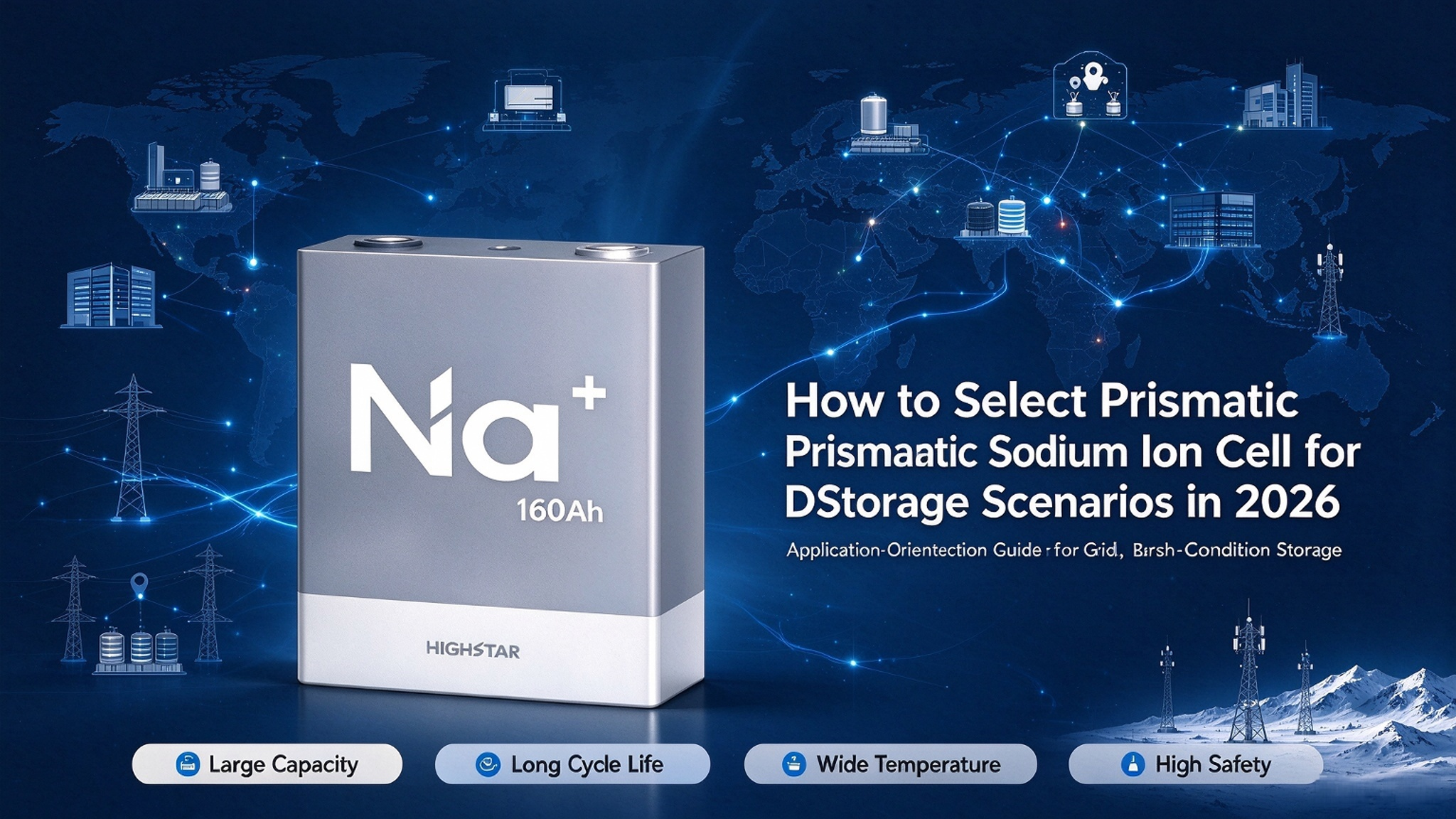
Updated for 2026.** As grid-scale battery energy storage systems (BESS), industrial & commercial (I&C) storage, and telecom backup rapidly adopt sodium-ion chemistry, choosing the right prismatic sodium-ion cell is no longer a one-size-fits-all decision. The optimal cell for a 4-hour grid battery is very different from the one you would put in a data-center UPS or a border-defense site at –40 °C.
This guide maps seven real-world energy storage scenarios to their selection logic, core performance indicators, and recommended prismatic sodium-ion models — so you can match cell chemistry and form factor to duty cycle, cost target, and safety standard in 2026.
Table of Contents
- Large-Scale Long-Duration Grid Energy Storage
- Short-Term Power Storage / Frequency Regulation
- Industrial & Commercial Energy Storage
- Data Center & Critical-Load Backup
- Cold / Harsh-Environment Energy Storage
- Special Industrial Energy Storage
- Communication Base-Station Standby Power
- Quick Comparison Table
- FAQ
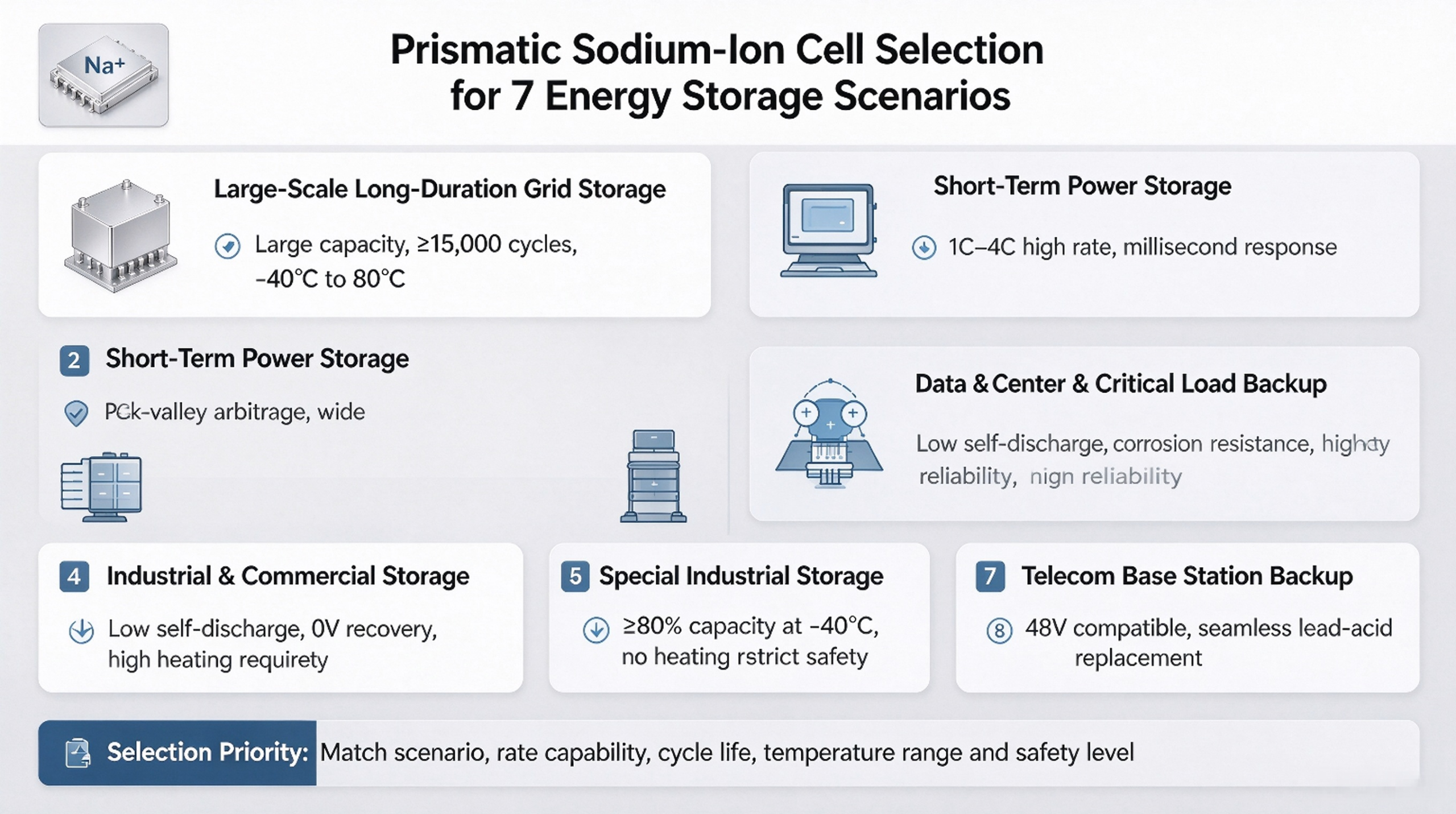
| # | Scenario | Target Duration / Rate | Min. Capacity | Cycle Life | Key Temperature / Safety Metric | Recommended Product |
|---|---|---|---|---|---|---|
| 1 | Long-duration grid BESS | 2–8+ h | ≥ 160 Ah | ≥ 15,000 (80% SOH) | –40 °C to 80 °C; GB/T 44265-2024 | NaCP71173208-160E3 · 2300 kWh container |
| 2 | Frequency regulation / power | 0.5–4 h, 1C–4C | 160 Ah class | ≥ 6,000 | Millisecond response; low high-frequency decay | 200 kWh cabinet BESS |
| 3 | Industrial & commercial | 1–2 cycles/day (peak-valley arbitrage) | — | ≥ 15,000 | ≥ 90% at –20 °C; puncture/overcharge non-flame; 30–50% cheaper than LFP | 115 kWh cabinet BESS |
| 4 | Data center / critical-load UPS | Long standby, instant full-power | 48 V 160 Ah class | — | Self-discharge ≤ 3.5%/month; 0 V recovery; GB/T 48072-2026 | 48 V 160 Ah telecom battery |
| 5 | Cold / harsh environment | Off-grid / remote | 48 V 320 Ah class | — | ≥ 80% at –40 °C; –40 °C to 70 °C; no heater needed | 48 V 320 Ah residential battery |
| 6 | Special industrial (refinery / chemical) | 0.5P industrial duty | ≥ 170 Ah | ≥ 8,000 @0.5P (≥ 80% retention) | No fire/explosion under abuse; GB/T 44265-2024 | 53/115/176 kWh BESS |
| 7 | Telecom base-station standby | 48 V float-charge standby | 100 Ah | ≥ 8,000 | ≥ 93% at –20 °C; ≥ 5-year maintenance-free | 48 V 100 Ah telecom battery |
1. Large-Scale Long-Duration Grid Energy Storage
Best for: 2–8+ hour BESS paired with wind & solar, utility-scale peak shaving, and renewable smoothing on the grid side.
Selection Logic
Prioritize ultra-large capacity and ultra-long cycle life, while maximizing the reduction of system group complexity and the per-kilowatt-hour cost. The cell must be suitable for long-duration charging and discharging cycles of 2–8 hours or more.
Core Indicators
- Cell capacity ≥ 160 Ah
- Cycle life ≥ 15,000 times (at 80% SOH)
- Operating temperature range: –40 °C to 80 °C
- Stable operation without complex temperature control
- Fully compliant with GB/T 44265-2024 Power Storage Sodium-Ion Battery Safety Specifications
Adaptation Benefits
The capacity of a single large-capacity prismatic sodium-ion cell can reach tens of times that of a conventional cylindrical sodium-ion cell, dramatically reducing PACK connection points and BMS sampling channels. This directly improves system reliability and makes the format ideal for large-scale deployment of long-duration energy storage power stations co-located with wind and solar generation.
Recommended Model
NaCP71173208-160E3 — a dedicated energy-storage prismatic sodium-ion battery cell already in mass production and roll-out, specially developed for long-duration energy storage scenarios on the grid side.
- Cell product page: 160 Ah NFPP sodium-ion prismatic cell (Highstar)
- System reference: 2300 kWh containerized sodium-ion BESS
2. Short-Term Power Storage / Frequency Regulation
Best for: 0.5–4 hour power support where response speed matters more than absolute capacity.
Selection Logic
Prioritize high-frequency bidirectional charge/discharge response and millisecond-level scheduling follow-up accuracy. This scenario adapts to 0.5-hour to 4-hour power support conditions — it is not about simply pursuing the largest possible cell capacity.
Core Indicators
- Continuous high-rate charging and discharging from 1C to 4C
- Attenuation under high-frequency cycling is far lower than conventional lithium batteries
- Instant response with no delay
- Cycle life ≥ 6,000 times
Application Scenarios
- Grid primary / secondary frequency regulation
- Smoothing the output of new-energy power stations
- Grid-side rapid peak shaving
The high-frequency charge/discharge attenuation advantage of sodium-ion cells is materially stronger than high-rate lithium iron phosphate (LFP), delivering more compelling economics over a long operating life.
Recommended Model
NaCP71173208-160E3 — the same dedicated energy-storage prismatic sodium-ion cell in mass production, also deployed in high-power cabinet solutions.
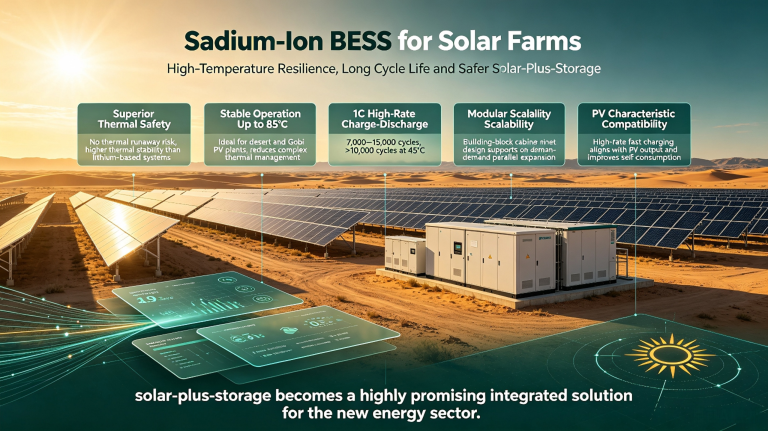
- System reference: 200 kWh cabinet sodium-ion BESS
3. Industrial & Commercial Energy Storage
Best for: Peak-valley arbitrage inside enclosed industrial and commercial buildings, southern heat and northern cold.
Selection Logic
Prioritize matching the daily 1–2 high-frequency charge/discharge cycles used for peak-valley arbitrage, while also weighing low-temperature adaptability and a high safety level — all meeting deployment requirements inside enclosed industrial and commercial buildings.
Core Indicators
- Cycle life ≥ 15,000 times
- Capacity retention ≥ 90% at –20 °C
- Passes puncture and overcharge non-flame safety tests
- Cell cost 30%–50% lower than LFP
Adaptation Advantages
Sodium-ion chemistry completely removes the cost risk introduced by lithium price fluctuations. It can operate stably in both southern high-temperature and northern low-temperature environments without complex temperature control, significantly lowering the O&M cost of industrial and commercial energy storage.
System Reference
4. Data Center & Critical-Load Backup
Best for: UPS replacement for data centers, hospitals, and substations where absolute reliability under standby is non-negotiable.
Selection Logic
Prioritize absolute reliability under extreme conditions: instant full-power output after long-term standby, plus compliance with strict uninterrupted-power-supply and black-start assistance requirements.
Core Indicators
- First-month self-discharge rate ≤ 3.5%
- Automatically activates after 0 V power loss
- No thermal-runaway risk across all temperature ranges
- Complies with the mandatory safety regulation GB/T 48072-2026 for sodium batteries
Adaptation Advantages
Sodium-ion packs replace traditional lead-acid UPS supplies, completely solving lead-acid pain points such as electrolyte leakage and winter failure to start after deep discharge. The full-service life is more than three times that of lead-acid, making the technology a strong fit for core-load backup in data centers, hospitals, and substations.
System Reference
5. Cold / Harsh-Environment Energy Storage
Best for: Remote northern households, high-altitude border-defense stations, and polar / icy-region outdoor systems.
Selection Logic
Prioritize stable operation in extremely cold, high-altitude, and unmanned environments — completely avoiding the inherent LFP defect of having its low-temperature capacity cut in half.
Core Indicators
- Capacity retention ≥ 80% at –40 °C
- Wide-temperature coverage of –40 °C to 70 °C
- No low-temperature lithium plating, no restricted charging or discharging
Application Scenarios
- Household energy storage in remote northern regions
- Energy storage power stations for border defense in high-altitude areas
- Outdoor energy storage systems in polar / icy regions
The low-temperature performance of sodium-ion cells exceeds that of LFP, and systems can operate normally without an additional heating system.
System Reference
6. Special Industrial Energy Storage
Best for: Refineries, chemical plants, and other high-risk industrial areas where fire and explosion risks must be eliminated.
Selection Logic
Prioritize meeting the special industrial conditions of high temperature, high corrosion, and high reliability. Comply with the mandatory safety standards for sodium batteries in power storage and eliminate fire and explosion risks.
Core Indicators
- Standard capacity ≥ 170 Ah
- After 8,000 cycles at 0.5P rate, capacity retention ≥ 80%
- No fire or explosion during overcharge, external short-circuit, and over-discharge tests
- Fully compliant with GB/T 44265-2024 technical specifications for power-storage sodium batteries
Application Scenarios
Energy storage for high-risk industrial areas such as refineries and chemical plants. The safety redundancy level is far higher than that of conventional lithium-ion energy storage.
System Reference
7. Communication Base-Station Standby Power
Best for: 48 V telecom standby, direct lead-acid replacement, and greenfield / retrofit base stations.
Selection Logic
Prioritize adapting to the standardized 48 V power-supply system of the telecom industry, directly reusing the installation space and operating system of existing lithium standby batteries, and achieving seamless lead-acid replacement.
Hard-Requirement Thresholds
- Cell capacity: 100 Ah
- Cycle life ≥ 8,000 times
- Capacity retention ≥ 93% at –20 °C
- Supports long-term floating-charge operation
- Maintenance-free period ≥ 5 years
Adaptation Advantages
The mainstream form of lithium batteries in telecom energy storage is the 48 V 100 Ah standardized product. A 48 V 160 Ah sodium-ion battery can directly adopt this size specification — no redesign of the cabinet or mounting brackets is needed. Retrofit and replacement cost is near zero, making it the optimal choice for communication base-station standby power.
System Reference
Quick Comparison Table
FAQ
What is a prismatic sodium-ion battery cell, and why choose it over cylindrical?
A prismatic sodium-ion cell is a rectangular, rigid-cased sodium-ion cell. In 2026, large prismatic cells (e.g., ≥ 160 Ah) can deliver tens of times the capacity of a conventional cylindrical sodium-ion cell. This cuts PACK connection points and BMS sampling channels, lowers system complexity, and improves reliability — the primary reason prismatic cells dominate grid-scale and industrial BESS designs.
Which prismatic sodium-ion cell is best for long-duration grid storage in 2026?
For 2–8+ hour grid storage paired with renewables, choose a cell with ≥ 160 Ah capacity, ≥ 15,000 cycles at 80% SOH, a –40 °C to 80 °C operating range, and compliance with GB/T 44265-2024. The NaCP71173208-160E3 is an example already in mass production for this duty.
Are sodium-ion cells suitable for frequency regulation?
Yes. They support continuous 1C–4C high-rate charging and discharging with millisecond-level response, and their high-frequency cycle attenuation is much lower than conventional lithium batteries. This makes them economically attractive for primary/secondary frequency regulation and renewable smoothing over long operating lives.
How safe are prismatic sodium-ion cells in industrial settings?
Compliant cells meet GB/T 44265-2024 and show no fire or explosion during overcharge, external short-circuit, and over-discharge tests — a safety redundancy level well above conventional lithium-ion storage. Data-center-grade products additionally comply with the mandatory GB/T 48072-2026 sodium-battery safety regulation.
Can sodium-ion batteries work at –40 °C?
Sodium-ion chemistry is inherently low-temperature friendly. Purpose-built cells retain ≥ 80% capacity at –40 °C across a –40 °C to 70 °C range, without the lithium plating or restricted charging that limits LFP. No additional heating system is required for many remote, high-altitude, or polar deployments.
How do sodium-ion cells compare to lead-acid for UPS and telecom standby?
Sodium-ion packs offer a service life more than three times that of lead-acid, a first-month self-discharge rate ≤ 3.5%, automatic recovery from 0 V power loss, and no leakage risk. In the standard 48 V telecom form factor (e.g., 48 V 100 Ah or 48 V 160 Ah), they drop directly into existing cabinets for near-zero retrofit cost.
What is the cost advantage of sodium-ion vs. LFP in 2026?
Industrial & commercial-grade sodium-ion cells are typically 30%–50% cheaper than lithium iron phosphate (LFP), and they decouple storage economics from lithium price volatility — a major long-term cost-planning benefit for peak-valley arbitrage projects.
Conclusion: Match the Cell to the Duty Cycle
There is no single “best” prismatic sodium-ion cell in 2026 — only the best fit for your duty cycle:
- Long-duration grid BESS → go large (≥ 160 Ah) and long-cycled (≥ 15,000).
- Frequency regulation / rapid peak shaving → prioritize 1C–4C rate and millisecond response.
- Industrial & commercial peak-valley arbitrage → balance 15,000-cycle life, –20 °C performance, and 30–50% lower cell cost.
- Data-center UPS → demand ≤ 3.5% monthly self-discharge, 0 V recovery, and GB/T 48072-2026 compliance.
- Cold / remote sites → require ≥ 80% retention at –40 °C and skip the heater.
- Refinery / chemical plants → insist on ≥ 170 Ah, 8,000 cycles at 0.5P, and abuse-test fire/explosion safety.
- Telecom 48 V standby → pick 100 Ah class, ≥ 8,000 cycles, ≥ 93% at –20 °C, and a ≥ 5-year maintenance-free float design.
Aligning the prismatic sodium-ion cell to the scenario — rather than forcing one chemistry into every use case — is the single biggest lever on both CAPEX and long-term O&M in 2026 energy storage deployments.
*For product specifications and system references, see the linked Highstar sodium-ion BESS and cell pages above.