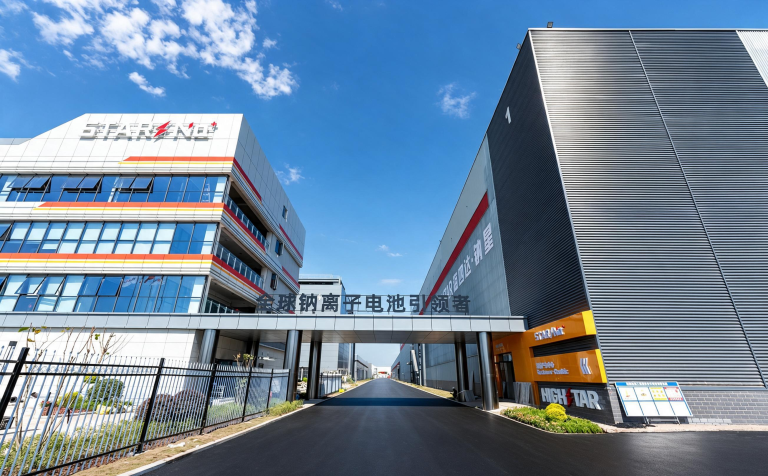
Liquid-Cooled Sodium-Ion Battery Cabinet: 100kW / 115kWh
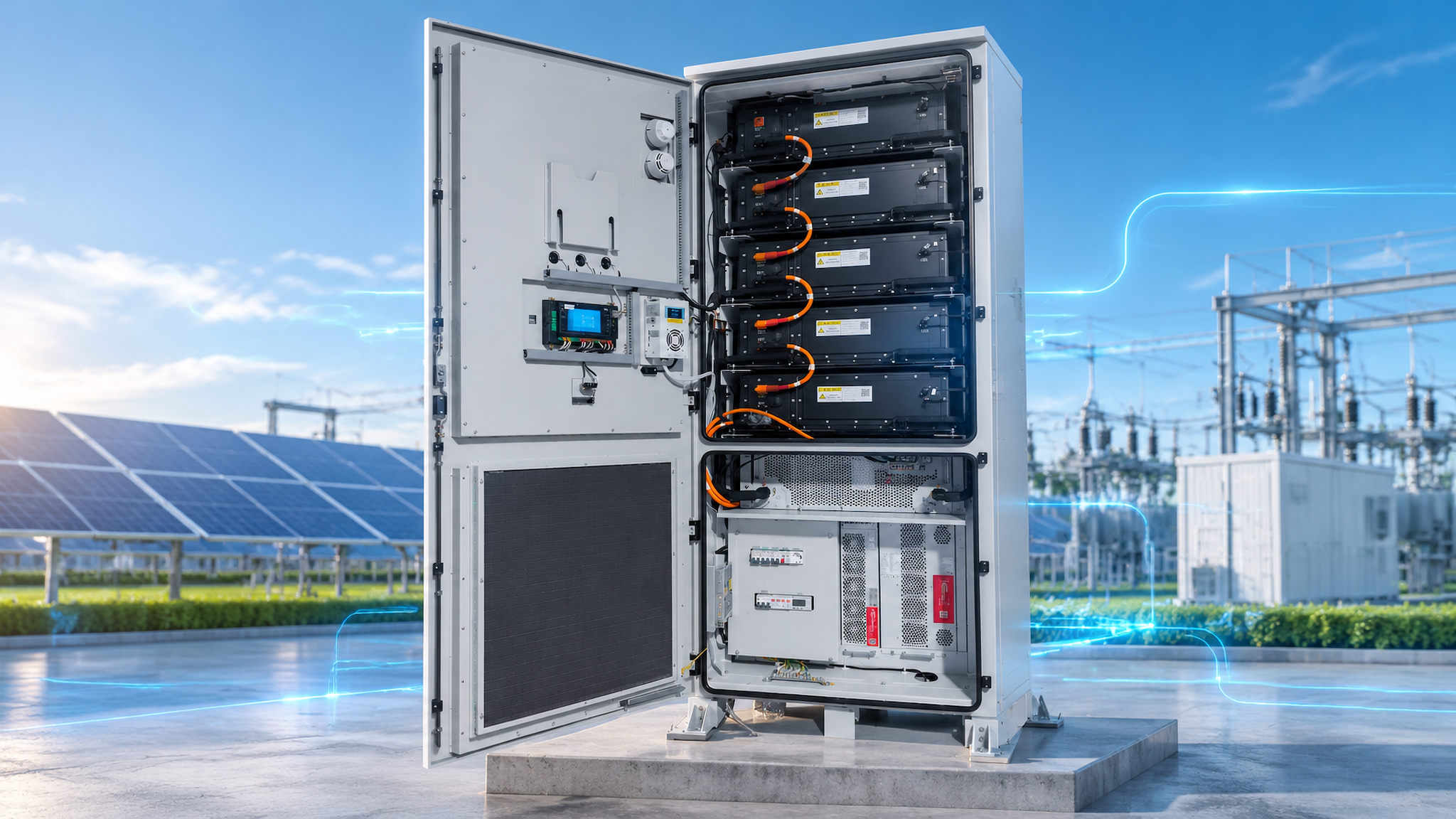
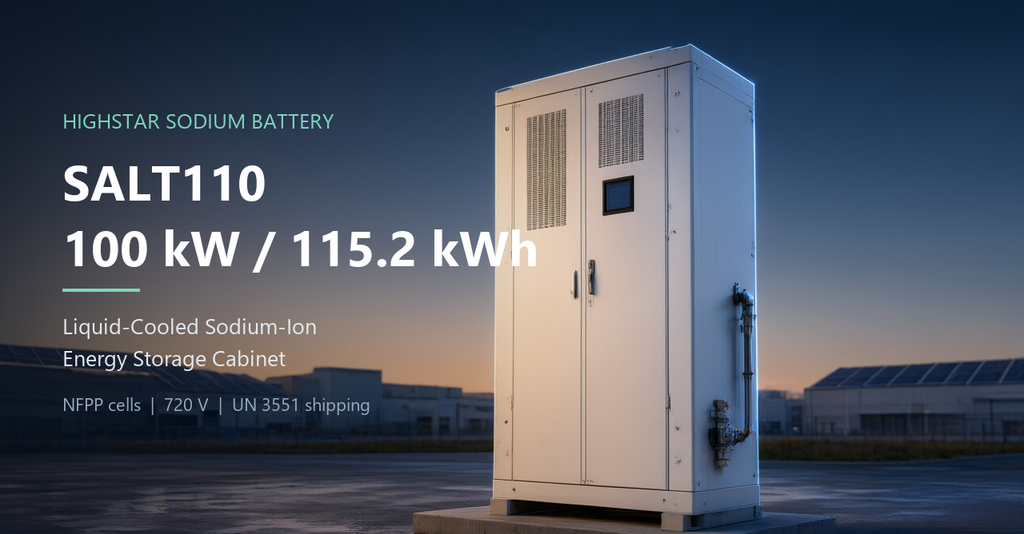
A liquid-cooled sodium-ion battery cabinet stores 115.2 kWh and delivers 100 kW from a single 1300 × 1000 × 2450 mm outdoor enclosure. HIGHSTAR’s SALT110 uses NFPP (sodium iron phosphate pyrophosphate) cells — no lithium, cobalt or nickel — with liquid cooling, two-layer aerosol fire suppression and a 100 kW PCS with PV input, in one unit that ships as UN 3551, Class 9.
This guide answers the questions buyers actually ask about a sodium-ion storage cabinet: what is inside it, how the cooling and safety systems work, what the cycle-life number really means, how it is documented for shipping, and where it fits. All parameters come from the SALT110 datasheet and its third-party test documents, not from a marketing deck.
SALT110 at a glance
- Energy / power: 115.2 kWh / 100 kW (0.87P continuous)
- Chemistry: NFPP prismatic cells, 160 Ah, 3.0 V — no lithium, cobalt or nickel
- Configuration: 1P240S, 720 V nominal, 432–828 V range
- Cooling: 6 kW liquid cooling, 50 L/min, -25 °C to +55 °C ambient
- Fire protection: pack-level + cluster-level aerosol, no external power needed at pack level
- Footprint: 1300 × 1000 × 2450 mm, ≈2,300 kg, IP54
- Shipping: UN 3551, Class 9, P903, UN38.3 + MSDS
- Cycle life (cabinet datasheet): ≥3,000 cycles — always ask for the test conditions
Why choose a liquid-cooled sodium-ion storage cabinet?
A 115 kWh cabinet standing behind a factory has a thermal problem a shipping container does not. Fans, filters and ducting have nowhere to go, and the cells deepest in the stack sit further from the airflow than the ones at the front. As ambient temperature climbs, the temperature spread widens and the derating curve starts eating into the usable power the site was sold on.
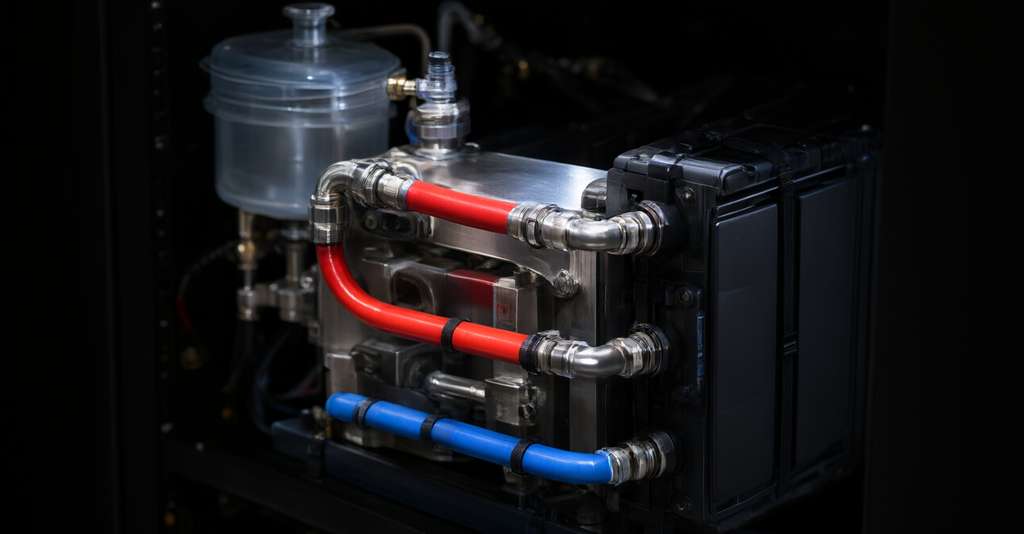
Liquid cooling removes heat at the pack instead of at the enclosure wall. The SALT110 circulates coolant at 50 L/min with 90 kPa supply pressure and delivers 6 kW of refrigeration at 18 °C supply when ambient is 45 °C at 50% RH. Because the loop is plumbed through each of the five packs, the temperature spread between cells stays narrow — and for calendar and cycle ageing, that spread matters more than the absolute temperature.
Sodium-ion NFPP then removes two structural dependencies at once. The cathode contains no lithium, cobalt or nickel, so the cell bill is decoupled from the lithium carbonate index that makes LFP project economics hard to underwrite. And the chemistry works across a wider envelope: the cabinet is specified for -25 °C to +55 °C ambient with derating above 45 °C. If you want the chemistry-level reasoning, our guide to choosing sodium-ion batteries in 2026 sets out where NFPP wins and where LFP still does.
What is inside the SALT110 cabinet?
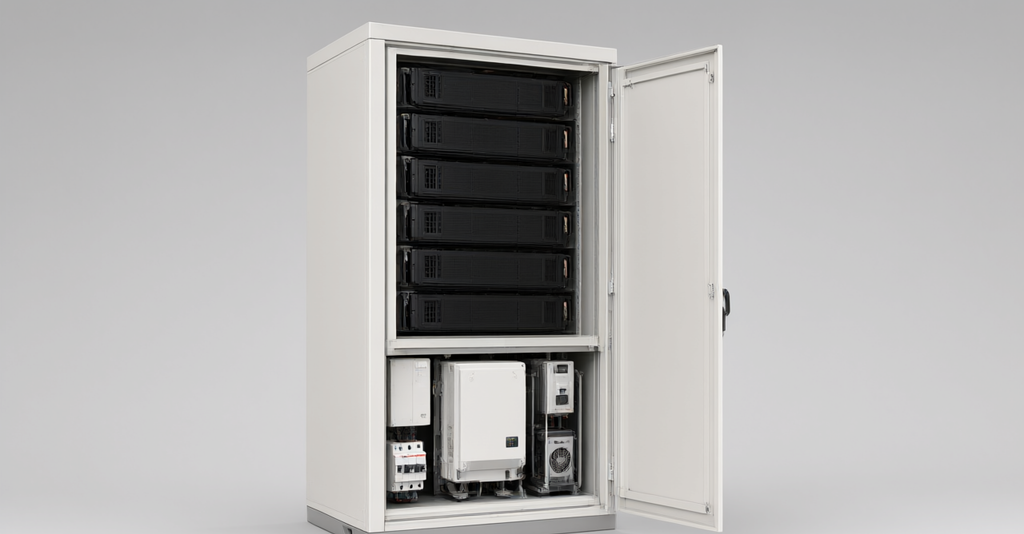
Six subsystems share one enclosure. Table 1 lists what each does and the specification that matters at commissioning.
| Subsystem | What it does | Key specification |
|---|---|---|
| Battery packs (×5) | Stores energy; 1P48S each, 160 Ah NFPP prismatic cells | 23.04 kWh per pack, 144 V nominal (48S × 3.0 V), 86.4–165.6 V range |
| High-voltage distribution unit (PDU) | Controls the cluster main circuit; houses the BCMU, breaker, fuse and contactors | 1500 V DC maximum |
| Liquid-cooling unit | Active thermal management for all five packs | 6 kW cooling, 2 kW heating, 50 L/min, R410A, IP54 (control box IP56) |
| DC/DC converter | Decouples the battery bus from the DC link; supports PV input | 100 kW rated, 300–900 V, ≥99% peak efficiency, 1× MPPT |
| PCS inverter | Bidirectional AC/DC conversion to the grid or load | 100 kW rated, AC 400 V 3P4W, ≥98% peak efficiency |
| EMS + fire protection | Site control, peak shaving, alarm handling; two-layer aerosol suppression | Modbus TCP/RTU, Ethernet/RS485; pack-level + cluster-level aerosol |
Two design choices show up in commissioning rather than in a brochure.
The battery and electrical compartments are physically separated. A technician can service the PDU, DC/DC or PCS without opening the live cell stack, and the heat load of the power electronics stays out of the cell volume.
Fire protection is layered, not a single bottle. Each pack carries its own aerosol generator with a thermistor detection wire — it detects, actuates and discharges with no external power supply, which matters when the fault is upstream in the auxiliary supply. The cluster level adds smoke and heat detection plus a second aerosol volume, and the EMS raises an indicator-light alarm. The pack-level arrangement is designed against the GB/T 42288 requirement referenced in the datasheet. For the underlying cell-safety testing, see our note on the 160Ah sodium-ion cell’s UL 9540A testing.
SALT110 specifications
DC and battery parameters
| Parameter | Value |
|---|---|
| Cell type | NFPP, 3.0 V / 160 Ah prismatic |
| System configuration | 1P240S (5 packs × 48 cells, 240 cells total) |
| Rated energy | 115.2 kWh |
| Nominal voltage | 720 V DC |
| Voltage range | 432–828 V DC |
| Charge / discharge rate | 0.87P, constant power |
| Conversion efficiency | ≥92% (excluding cabinet auxiliary consumption) |
| Cycle life (cabinet datasheet) | ≥3,000 cycles |
| Ingress protection | IP54 |
| Operating ambient | -25 °C to +55 °C (derating above 45 °C) |
| Relative humidity | 0–95% RH, non-condensing |
| Altitude | ≤2,000 m (derating above) |
| Dimensions (D × W × H) | 1300 × 1000 × 2450 mm |
| Weight | ≈2,300 kg |
| Communication | Ethernet / RS485; Modbus TCP / Modbus RTU |
Power conversion path
| Parameter | PCS | DC/DC |
|---|---|---|
| Rated power | 100 kW | 100 kW (110 kW peak) |
| DC voltage | 630–900 V (full load) | 300–900 V, full load 380–900 V (battery side) |
| AC interface | 400 V, three-phase four-wire, 50/60 Hz | — |
| Rated current | 145 A output, 190 A DC | 275 A low-voltage side, 200 A high-voltage side |
| Peak efficiency | ≥98% | ≥99% |
| Response | Charge↔discharge <100 ms | Charge↔discharge <20 ms |
| Power quality | THD ≤3% at full load; PF -0.99 to +0.99 | Current ripple ≤2%; 1% V/I measurement accuracy |
| Overload | 1.1× continuous, 1.2× for 1 min at ≤35 °C | — |
The 100 kW PCS and 100 kW DC/DC are matched: 115.2 kWh at 0.87P lands at roughly 100 kW, exactly the rating of both converters, so there is no undersized element between the cells and the 400 V bus. The DC/DC also opens a PV path — one MPPT channel with a 300–900 V window — so a rooftop array can feed the DC bus directly instead of going through a separate AC-coupled inverter.
Where does a 115 kWh sodium-ion cabinet fit?
- Factory and warehouse peak shaving. Charge in the valley tariff, discharge across the morning and afternoon peaks; 115.2 kWh absorbs a meaningful share of a 100 kW demand spike.
- PV self-consumption on an industrial roof. The DC/DC MPPT channel lets the array charge the battery on the DC side, avoiding a double conversion.
- Microgrids and weak-grid sites. Off-grid operation at 400 V (±3%), 100% unbalanced load capability, off-grid THDU ≤3% on linear loads, and 50/60 Hz selectable output.
- Backup for continuous processes. Transfer in under 100 ms on the PCS, with the EMS able to reserve a SOC floor for backup duty.
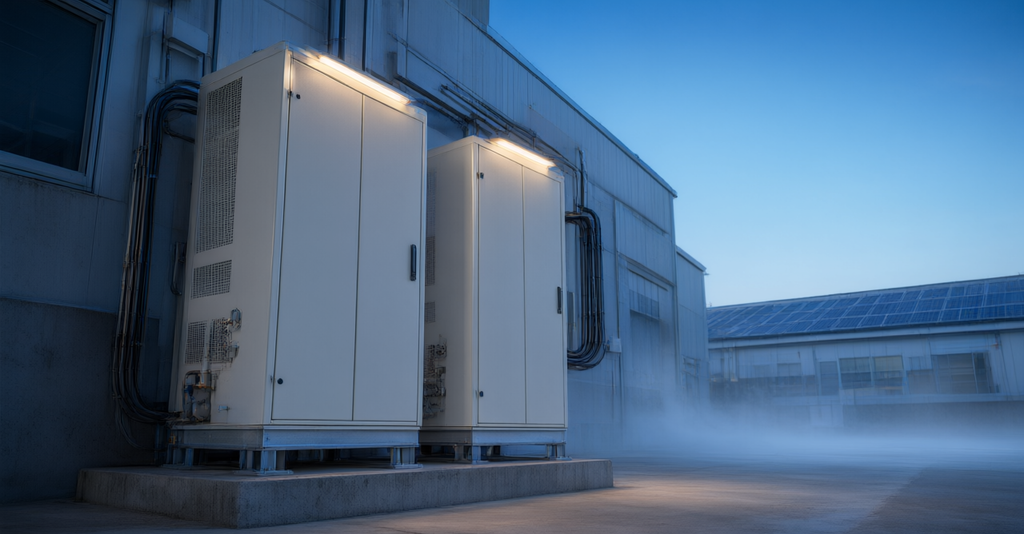
- Sites where a container will not fit. 1300 mm depth on a pad, with the same liquid-cooling architecture used in our larger systems.
The cabinet is not right for every site. A project needing four hours at 500 kW wants a containerised system, not five cabinets in parallel — see our 2300kWh container sodium-ion BESS for that scale. Above 2,000 m or routinely above 45 °C, derating curves must be applied honestly before power figures are promised.
How long does a sodium-ion cabinet last?
This is the section most sodium-ion marketing skips, so it is worth being explicit. The SALT110 datasheet states ≥3,000 cycles at cabinet level. Platform-level data for the same NFPP chemistry, tested at 25 °C and 70% depth of discharge, is materially higher — and figures in the tens of thousands circulate for cell-level tests at low C-rates. Those numbers are not interchangeable: C-rate, depth of discharge, ambient temperature and end-of-life criterion each move the answer by multiples, not percentages.
The practical rule: ask for a cycle-life figure with its test conditions attached — rate, DoD, temperature, EOL definition — then compare it to how the asset will actually run. A cabinet cycling at 0.87P twice a day is not living the same life as one cycling at 0.5P once a day. HIGHSTAR publishes measured cycle and round-trip-efficiency curves for its NFPP cells rather than a single headline number, and our engineers will quote the SALT110 figure that applies to your duty profile in writing. Put the warranted number in the contract, and treat any cycle-life claim without conditions as a question, not an answer.
How is a sodium-ion cabinet shipped and documented?
The SALT110 documentation set is issued by an accredited third-party laboratory and consists of four linked documents.
| Document | Reference | Scope |
|---|---|---|
| UN38.3 test summary | TSZ25MB052A01-02 (report TSZ25MB052A01-01, issued 2026-01-04) | Tests T.1–T.7 passed on the liquid-cooled pack; T.8 forced discharge not applicable |
| MSDS | TSZ25MB052A01-03 | 720 V / 160 Ah / 115 kWh, 2,300 kg |
| Sea-transport classification | TSZ25MB052A01-04 | IMDG Amendment 42-24; UN 3551, sodium ion batteries, Class 9, packing instruction P903 |
| Product datasheet | 100 kW / 115 kWh liquid-cooled cabinet | Electrical, thermal, mechanical and communication parameters |
UN 3551 is the classification that changes logistics. Units ship at 30% SOC with inter-pack copper bars removed, protected against short circuit and packed in a strong outer case, and can travel by road, rail or sea. The sea-transport identification report is valid to 31 December 2026 — confirm the current set is attached to your shipment before booking.
The datasheet also separates two things tenders often conflate. Its standards basis lists IEC 62619-2022, IEC 63056-2020, IEC 62477-1, GB/T 44265-2024, GB/T 34131-2023, GB/T 34120-2023, GB/T 36547-2018, GB 4208 and IEC 60068-2-6. Its separate compliance row lists GB/T 36276, GB/T 34120, GB/T 34131, UN38.3, IEC 62619, UL 1973, UL 9540 and CE-EMC. Ask for a specific certificate by name: UL 9540A, for example, is a test method that produces a report, not a certificate.
A few fields in our own documents are not yet aligned — cell capacity (160 Ah in the reports vs 163 Ah in one manual revision), pack nominal voltage (120 V printed vs 144 V derived from 48S × 3.0 V), voltage window, IP rating and cabinet depth. None is a performance dispute; they are documentation-version artefacts, and each has at some point delayed a FAT or a customs clearance. For a tender, ask HIGHSTAR for a single consolidated parameter sheet stamped for your project and hold the contract to that sheet rather than to a brochure.
What should I check before installing a sodium-ion cabinet?
- Foundation and access. Floor-mounted, 2,300 kg, 1300 mm deep. Allow clearance for door swing and for lifting the 6 kW cooling module out as a unit.
- Ambient. -25 °C to +55 °C with derating above 45 °C. Below 0 °C the cabinet discharges but does not charge; plan the SOC reserve for cold-morning starts.
- Altitude. Rated to 2,000 m, derating above.
- Storage and commissioning. Store at 30–50% SOC; if the unit sits longer than a month, cycle it back into that window. Shipping SOC is 30%.
- Communications. Ethernet or RS485 into the site network, Modbus TCP/RTU northbound. Remote dispatch needs a local telecom SIM fitted by the site — forgetting it is the most common commissioning delay we see.
- Parallel operation. Cabinets can be paralleled to build block size; confirm the count and EMS topology with our team for your project.
Frequently asked questions
What is the difference between 115 kWh rated energy and usable energy?
Rated energy is 115.2 kWh at the nominal 720 V, calculated from 240 cells × 3.0 V × 160 Ah. Usable energy is smaller and depends on the depth-of-discharge setting, the configured end-of-discharge voltage, the SOC floor reserved for backup, and round-trip losses. Size a business case on usable kWh at your intended DoD, not the nameplate figure.
Can a sodium-ion cabinet operate outdoors in winter?
Yes, with one qualification. Discharge is rated from -25 °C to 55 °C, so the site keeps its backup function in hard frost. Charging starts at 0 °C, and the cooling unit includes 2 kW of heating to bring the pack into its charging window. If your duty cycle requires charging below 0 °C, raise it at design stage — that is a project-level configuration, not a datasheet line item.
Is a sodium-ion cabinet cheaper than an LFP cabinet today?
Not automatically, and anyone quoting a single percentage should be asked for the assumptions. Sodium-ion cell pricing has converged with LFP and is trending down as capacity scales, but project economics depend on the duty cycle, the local tariff, the thermal system you avoid building, and the replacement schedule. We will model a specific site rather than publish a generic number.
What happens inside the cabinet during a thermal event?
The initiating pack is covered by its own aerosol generator, triggered by a thermistor detection wire and requiring no external power. The cluster level adds smoke and heat detection and a second aerosol volume to limit spread, while the EMS drives an alarm indicator. The intent is containment and rapid knockdown at the smallest possible volume, not reliance on one cabinet-wide bottle.
How is the cabinet shipped internationally?
As UN 3551, Class 9, under P903 of the IMDG Code (Amendment 42-24), supported by a UN38.3 test summary and an MSDS. Units leave the factory at 30% SOC with inter-pack copper bars removed, on a wooden pallet inside a wooden case, and can travel by truck, rail or sea. Because the classification report has a validity period, confirm the current document set before booking.
Can it integrate with an existing PV array or genset?
The DC/DC offers one MPPT channel across 300–900 V for DC-coupled PV, and the PCS runs grid-tied and off-grid at 400 V with 100% unbalanced load capability. Genset coupling, black-start sequencing and multi-cabinet EMS topology are engineering-scope items — bring the single-line diagram and we will confirm compatibility before the order.
Related HIGHSTAR resources
- 160Ah NFPP sodium-ion prismatic cell — the cell at the centre of the SALT110.
- All sodium-ion battery products — cells, modules, cabinets and containers.
- What is a container sodium-ion BESS? — basics of NFPP cells, liquid cooling and fire protection at container scale.
- Measured NFPP cycle-life data — raw curves at 25 °C, 45 °C and 60 °C.
- NFPP vs LFP: why choose sodium-ion in 2026 — the trade-offs behind the chemistry choice.
- SALT110 cabinet on the HIGHSTAR newsroom — the original product walkthrough.
- Contact HIGHSTAR SODIUM BATTERY — sizing studies, documentation packs and quotes.
For technical questions about sodium-ion batteries, contact info@highstar-sodium.com. For product information, solution inquiries or partnership opportunities, contact sales@highstar-sodium.com.
Author: HIGHSTAR SODIUM BATTERY technical content team | Published: 24 November 2026 | Sources: SALT110 product datasheet, English user manual, and UN38.3 / MSDS / sea-transport reports issued by Shenzhen Tiansu Calibration and Testing.
References
- HIGHSTAR SODIUM BATTERY — *100 kW / 115 kWh Liquid-Cooled Sodium-Ion Energy Storage Cabinet*, product datasheet.
- HIGHSTAR SODIUM BATTERY — *English User Manual, 115 kWh Model (SALT110)*.
- Shenzhen Tiansu Calibration and Testing — *UN38.3 Test Summary*, TSZ25MB052A01-02 / TSZ25MB052A01-01, issued 2026-01-04.
- Shenzhen Tiansu Calibration and Testing — *Material Safety Data Sheet*, TSZ25MB052A01-03, issued 2026-01-04.
- Shenzhen Tiansu Calibration and Testing — *Identification and Classification Report for Sea Transport of Goods*, TSZ25MB052A01-04, IMDG Amendment 42-24, valid to 2026-12-31.