Brief Introduction of Sodium Ion Battery

What is a Sodium-Ion Battery?
A sodium-ion battery is a rechargeable battery that uses sodium ions as the charge carrier. Like lithium-ion and lead-acid batteries, it belongs to the “rocking chair” battery system.
Its core working principle is: using an organic electrolyte as a carrier, sodium ions repeatedly insert and extract between the positive and negative electrodes to complete the charging and discharging process.
(1) Charging process: Sodium ions are extracted from the positive electrode material, pass through the electrolyte, and insert into the negative electrode material. Electrons simultaneously flow to the negative electrode through the external circuit, converting electrical energy into chemical energy for storage.
(2) Discharging process: Sodium ions are extracted from the negative electrode material, pass through the electrolyte, and insert into the positive electrode material. Electrons simultaneously flow to the positive electrode through the external current, converting chemical energy back into electrical energy to supply power.
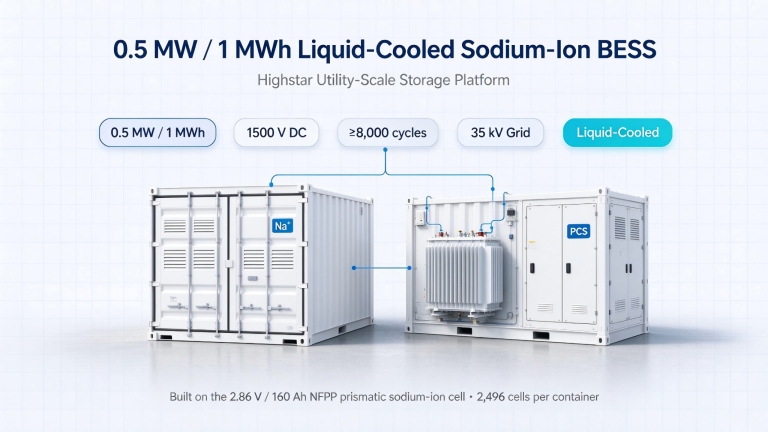
Starting in 2026, from the perspective of the development of China’s mainstream sodium-ion battery industry, NFPP sodium-ion batteries (NFPP Sodium Ion Battery) have become the mainstream sodium-ion battery technology, because of their advantages such as long cycle life, low material cost, and ability to pass the nail penetration test, and are widely used in energy storage scenarios.
The core materials of NFPP sodium-ion battery are: positive electrode materials (sodium iron phosphate and sodium iron sulfate), negative electrode materials (hard carbon), and electrolyte (sodium hexafluorophosphate).
(1) Positive electrode materials: Sodium-ion battery positive electrode materials are abundant and inexpensive. Although their energy density is relatively low, they have strong structural stability, good safety, and long cycle life.
(2) Negative electrode materials: Hard carbon, as a sodium-ion battery negative electrode material, has a larger structural porosity, making it suitable for sodium-ion battery insertion and extraction. It is derived from a wide range of biological materials, such as bamboo, reeds, coconut shells, and nut shells, making it sustainable.
(3) Electrolyte: Sodium hexafluorophosphate, as a sodium-ion battery electrolyte, shares production equipment and production lines with lithium-ion battery electrolytes (lithium hexafluorophosphate), making it easier to scale up production and lower in cost.